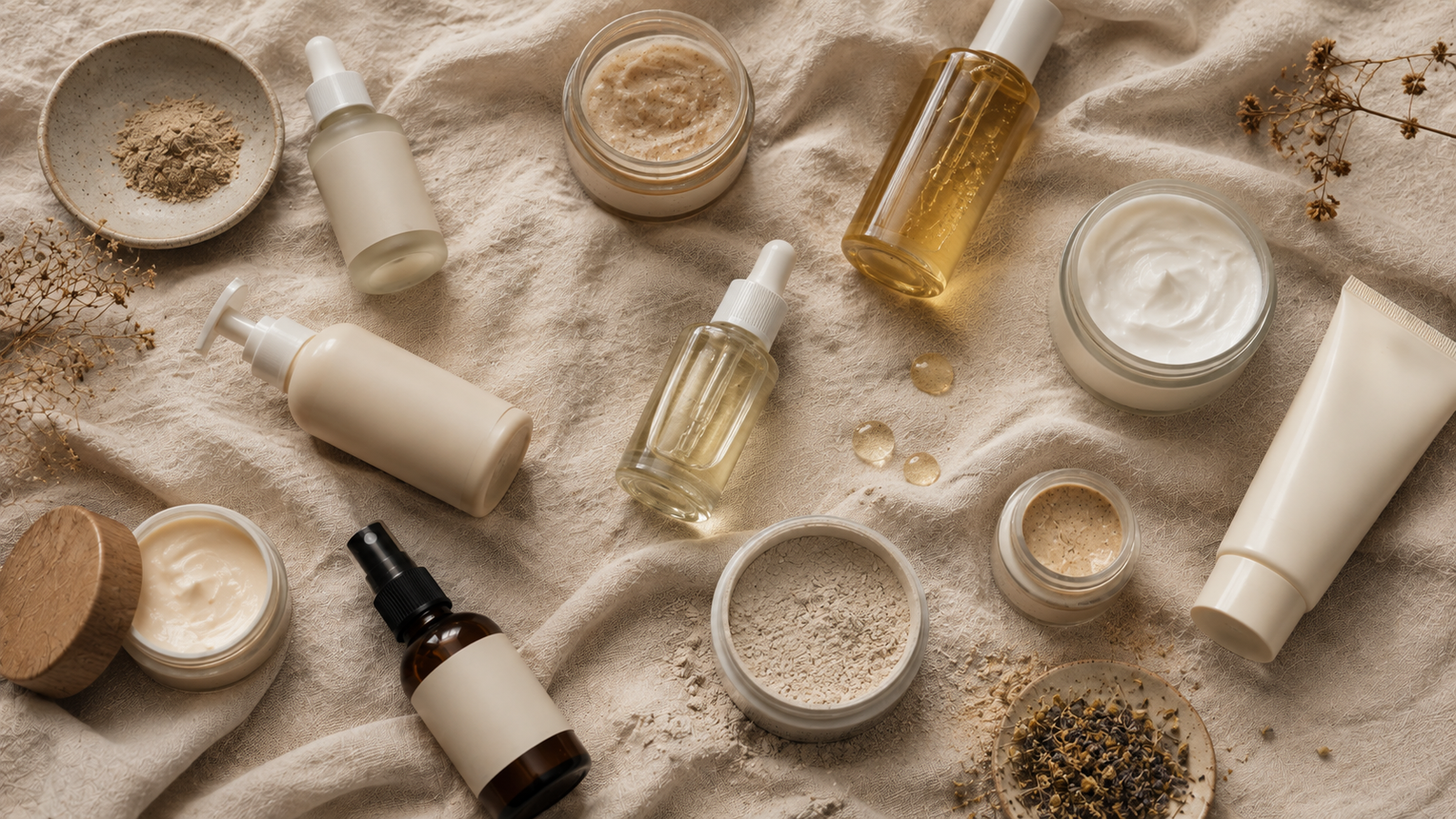
What we mean by "the beauty industry"
The "beauty industry" is a fuzzy term that different sources define differently. Understanding what's actually being counted matters when comparing statistics.
Core beauty categories
The categories almost always included:
- Skincare — Cleansers, moisturizers, serums, treatments, sunscreens
- Color cosmetics / makeup — Foundations, lipsticks, eye makeup, blush, mascara
- Hair care — Shampoos, conditioners, styling, coloring
- Fragrance — Perfumes, colognes, body sprays
- Body care — Body washes, lotions, exfoliants, hand and foot care
- Oral care — Some definitions include; others separate
Categories sometimes included
- Nail care — Polish, treatments, tools
- Men's grooming — Shave products, styling, skincare
- Personal care — Deodorants, feminine hygiene
- Beauty devices — LED masks, cleansing brushes, hair removal devices, tools
- Beauty services — Salons, spas, medical aesthetics
- Beauty supplements — Increasingly overlapping with wellness
Why definition matters
Depending on which categories are included, industry size ranges from about $400 billion (narrow definition, just cosmetics) to over $700 billion (broad definition including personal care, oral care, services). Most credible sources land around $580-680 billion for the beauty and personal care industry combined, growing at roughly 5-7% compound annual growth rate.
The narrower definition — "beauty industry" as color cosmetics, skincare, hair care, fragrance, and body care — sits closer to $400-500 billion. Adding personal care, services, and adjacent categories brings it higher.
The size and shape of the industry
Global market size
The global beauty and personal care industry generates approximately $580-680 billion annually depending on definition. Growth has been sustained through most economic conditions — beauty products are considered relatively recession-resistant, partly because of the "lipstick effect" (small luxuries purchased when larger luxuries feel out of reach).
Regional breakdown
Beauty spending is concentrated in specific regions:
- Asia-Pacific — Largest regional market, led by China, Japan, and South Korea. China alone represents one of the largest single-country beauty markets globally.
- North America — Second largest, dominated by the United States. Mature market with strong per-capita spending.
- Europe — Third largest overall, with France, Germany, UK, and Italy as leading markets. Home to major beauty conglomerates (L'Oréal, LVMH, Unilever, Beiersdorf).
- Latin America — Growing market with Brazil as the largest single country market
- Middle East and Africa — Rapidly growing markets with specific regional preferences
- India — Very rapidly growing market with distinctive characteristics (see our piece on Indian beauty standards)
Category breakdown
The relative sizes of beauty categories have shifted in recent years. Skincare overtook color cosmetics as the largest single category during the COVID-19 pandemic, when mask-wearing reduced makeup demand while home-based skincare routines expanded. Approximate current shares:
- Skincare — approximately 40% of total industry
- Hair care — approximately 20%
- Color cosmetics — approximately 15-18%
- Fragrance — approximately 10-12%
- Personal care and other — remainder
Growth patterns
The industry has multiple growth engines:
- Continued expansion in emerging markets (India, Southeast Asia, Latin America, Africa)
- Premium and luxury segment growth exceeding mass segment in mature markets
- Men's grooming expansion (previously smaller category, now among fastest-growing)
- Skincare "skinification" spreading to hair, body, and adjacent categories
- Wellness and beauty convergence (supplements, functional beauty products)
- Cross-border e-commerce enabling niche brands to reach global markets
Who owns the industry
The beauty industry is remarkably concentrated in ownership terms. Our detailed piece on how to evaluate beauty brands covers ownership in depth; the summary here:
The dominant conglomerates
- L'Oréal (France) — Approximately $40+ billion in annual revenue. World's largest cosmetics company. Owns 35+ brands across price tiers: Lancôme, YSL Beauty, Armani Beauty, Kiehl's, Urban Decay, IT Cosmetics, L'Oréal Paris, Maybelline, Garnier, CeraVe, La Roche-Posay, Vichy, Redken, Kérastase, and many others.
- Estée Lauder Companies (US) — Approximately $16+ billion annually. Owns 25+ brands: Estée Lauder, MAC, Bobbi Brown, La Mer, Aveda, Origins, Clinique, Tom Ford Beauty, Jo Malone London, Le Labo, Too Faced, GLAMGLOW.
- LVMH (France) — Luxury conglomerate with substantial beauty division: Christian Dior Beauty, Guerlain, Givenchy Beauty, Fresh, Benefit Cosmetics, Sephora (retail), majority stake in Fenty Beauty.
- Unilever (Netherlands/UK) — Major personal care division: Dove, Vaseline, TRESemmé, Suave, Simple, Nexxus, Sunsilk, Ren Clean Skincare, Living Proof, Kate Somerville, Dermalogica, Murad, Tatcha, Hindustan Unilever's Glow & Lovely.
- Procter & Gamble (US) — Olay, SK-II, Pantene, Head & Shoulders, Herbal Essences, Aussie, Old Spice, Gillette, Native, First Aid Beauty, Ouai.
- Shiseido (Japan) — Largest Asian beauty conglomerate: Shiseido, Clé de Peau Beauté, NARS, Laura Mercier, Bare Minerals, Drunk Elephant, Tory Burch Beauty.
- Coty Inc. (US) — CoverGirl, Rimmel, Max Factor, Sally Hansen, Kylie Cosmetics (51% stake acquired 2020), plus fragrance licenses.
- Amorepacific (South Korea) — Largest Korean beauty conglomerate: Sulwhasoo, Innisfree, Laneige, Etude House, Iope, Hera. Central to global K-beauty spread.
- Other significant conglomerates — Beiersdorf (Nivea, Eucerin, La Prairie), Kao Corporation (Bioré, John Frieda, Molton Brown), Johnson & Johnson (Neutrogena, Aveeno), Puig (Charlotte Tilbury, Byredo, Jean Paul Gaultier), e.l.f. Beauty (e.l.f., Naturium, Rhode).
The independent segment
Truly independent beauty brands represent a small but visible portion of industry revenue. Most "indie" brands are venture-backed with acquisition trajectories, or become corporate-owned upon reaching meaningful scale. Examples of substantial acquisitions in recent years:
- Drunk Elephant → Shiseido (2019)
- Tatcha → Unilever (2019)
- Charlotte Tilbury → Puig (2020)
- First Aid Beauty → P&G (2018)
- Ouai → P&G (2021)
- Byredo → Puig (2022)
- Naturium → e.l.f. Beauty (2023)
- Rhode → e.l.f. Beauty (2024, approximately $1 billion)
The direct-to-consumer wave
The 2010s and early 2020s saw substantial venture-backed DTC beauty brand growth — Glossier, Kylie Cosmetics, Fenty Beauty, Rare Beauty, various others. This model has faced challenges as customer acquisition costs rose and social media platforms became less effective for organic growth. Many DTC brands now sell primarily through Sephora, Ulta, and Amazon rather than exclusively direct.
How the industry actually works
Beauty product creation involves several distinct layers most consumers never see.
Ingredient suppliers
Before brands or products exist, someone must produce the actual raw materials. Major cosmetic ingredient suppliers include:
- BASF (Germany) — Global chemical giant with substantial cosmetic ingredients division
- Croda (UK) — Specialty chemicals with major beauty applications
- Symrise (Germany) — Fragrance and cosmetic ingredients
- Givaudan (Switzerland) — World's largest fragrance and flavor company
- IFF (International Flavors & Fragrances, US) — Major fragrance house
- Ashland (US) — Specialty chemicals for beauty and personal care
- Evonik (Germany) — Specialty chemicals
- DSM-Firmenich (Netherlands/Switzerland) — Merged 2023, combines nutrition and beauty ingredients
These companies produce the actives, base ingredients, emulsifiers, preservatives, fragrances, and colors that brands then formulate into finished products. When you see "hyaluronic acid" or "niacinamide" as an active in your serum, one of a handful of suppliers likely produced it.
Contract manufacturers
Many brands don't manufacture their own products. Instead, they design and market products made by contract manufacturers:
- Cosmax (South Korea) — Massive Korean contract manufacturer supplying brands globally
- Kolmar Korea — Major Korean contract manufacturer
- Intercos (Italy) — Global contract manufacturer specializing in color cosmetics
- Chromavis (Italy) — Italian contract manufacturer
- Various US and Chinese operations
The implications for consumers: many brands sharing the same contract manufacturer sometimes produce products with underlying formulation similarities. This is one reason a $200 luxury product and a $30 mass product from different brands can have surprisingly comparable formulations — they may have originated at the same manufacturing facility with similar underlying recipes.
Larger conglomerates operate own R&D and manufacturing
The major conglomerates (L'Oréal, Estée Lauder, Unilever, P&G, Shiseido) typically operate their own research facilities and manufacturing operations. This gives them formulation control that smaller brands using contract manufacturers don't have. Some of the more innovative recent formulations (advanced retinoid delivery systems, stable vitamin C, specific peptide developments) come from these R&D operations.
Retail layer
Products reach consumers through several retail channels:
- Sephora (LVMH) — Global specialty retailer with substantial market power over which brands succeed
- Ulta Beauty (US) — Major US specialty beauty retailer
- Amazon — Increasingly dominant particularly in mass segment
- Traditional department stores — Declining but still significant for prestige
- Drugstore chains — CVS, Walgreens, Boots, Watsons
- Direct-to-consumer — Brand websites
- Marketplaces and beauty platforms — Various emerging channels
- Wholesale to salons and professional
Retailer power matters substantially. A brand's placement at Sephora or Ulta can determine its trajectory; being dropped can end a brand. This concentration of retail power shapes what gets developed and how it gets marketed.
The regulatory environment
Beauty product regulation varies dramatically by jurisdiction, creating a global patchwork.
United States regulatory framework
US cosmetic regulation has historically been among the lightest of major markets. The Federal Food, Drug, and Cosmetic Act of 1938 provides FDA authority over cosmetics but with limited pre-market approval requirements. Key features:
- Cosmetics don't require FDA pre-market approval (unlike drugs)
- Manufacturers are responsible for product safety
- The FDA can take action against unsafe products but generally acts reactively
- Only about 11 ingredients are specifically banned in cosmetics (compared to ~1,300 in EU)
The MoCRA update (2022)
The Modernization of Cosmetics Regulation Act (MoCRA), signed into law in December 2022 as part of an omnibus spending bill, represents the first major update to US cosmetic regulation in over 80 years. Key provisions phasing in through 2024-2025:
- Mandatory facility registration and product listing with FDA
- Mandatory adverse event reporting
- Good Manufacturing Practices requirements
- Recordkeeping requirements
- Safety substantiation requirements
- Fragrance allergen labeling
- Expanded FDA authority to require mandatory recalls
MoCRA represents a substantial modernization but still doesn't reach EU-level restrictions on specific ingredients.
European Union regulatory framework
The EU Cosmetics Regulation (Regulation 1223/2009) is substantially stricter than US regulation:
- Every cosmetic product requires a designated "Responsible Person" in the EU
- Every product requires a Cosmetic Product Safety Report before market entry
- Approximately 1,300+ ingredients are prohibited
- Additional ingredients are restricted in specific applications or concentrations
- Animal testing for cosmetic purposes has been banned since 2013
- Extensive labeling and claims requirements
Other major markets
- Japan — Regulated by the Pharmaceuticals and Medical Devices Agency; medium-strict framework with specific claim requirements
- South Korea — Regulated by Ministry of Food and Drug Safety; has specific "functional cosmetics" category with pre-market requirements
- China — Historically required animal testing for imported cosmetics; regulations have shifted since 2021 with some exemptions, though the specifics matter substantially for brand cruelty-free claims
- India — Bureau of Indian Standards (BIS) regulations with some product-specific requirements
- Australia/New Zealand — Relatively light-touch cosmetic regulation
- Canada — Health Canada regulation with hotlist of prohibited/restricted ingredients
Consequences of the patchwork
The same product may be legal in the US and prohibited in the EU. Brands must reformulate for different markets, or exit markets where they can't comply. Ingredients banned in EU sometimes remain in US products because US regulation hasn't caught up. This creates confusing consumer situations where the "same" product from the "same" brand may have different formulations depending on where it's sold.
Labor and supply chain realities
The beauty industry has substantial supply chain issues that consumer-facing marketing rarely addresses.
Mica sourcing
Mica — the mineral responsible for shimmer effects in cosmetics — has documented supply chain problems. Much of the world's sheet mica comes from India's Jharkhand and Bihar states, where child labor has been widely documented in illegal mining operations. Investigations by news organizations and NGOs have repeatedly found children working in mica mines under dangerous conditions.
Industry responses include:
- The Responsible Mica Initiative — cross-industry coalition working on supply chain transparency
- Synthetic mica (fluorphlogopite) development — chemically similar but lab-produced without mining concerns
- Various brand-level commitments to responsibly sourced mica
Progress has been substantial but uneven. Consumers checking for responsible mica should look for brand-specific commitments and third-party verification rather than trusting general claims.
Palm oil derivatives
Palm oil and palm oil derivatives appear in beauty products under many names — cetyl alcohol, cetearyl alcohol, sodium lauryl sulfate, glyceryl stearate, and many others often derive from palm. Palm oil production has driven substantial deforestation in Indonesia and Malaysia, with associated biodiversity loss and greenhouse gas emissions.
Industry responses include:
- RSPO (Roundtable on Sustainable Palm Oil) certification — implementation varies
- Palm oil-free formulations — increasingly available
- Alternative sourcing (coconut, sunflower-based alternatives)
Talc concerns
Talc has faced substantial litigation regarding possible asbestos contamination — asbestos and talc sometimes occur in geological proximity, creating contamination risks. Johnson & Johnson faced extensive class action litigation over talc-based baby powder and eventually discontinued the North American product in 2020. Various other brands have moved away from talc in favor of alternatives (cornstarch, mica alternatives). The safety debate continues; some scientific consensus exists that pharmaceutical-grade talc without asbestos is generally considered safe, though testing standards vary.
Manufacturing labor
Beauty manufacturing occurs globally, with substantial production in China, South Korea, Italy, and other locations. Labor conditions vary widely. Documented issues have appeared periodically at specific facilities. Brand transparency about manufacturing conditions is inconsistent.
Packaging waste
The beauty industry generates substantial packaging waste — most cosmetic packaging is not easily recyclable due to material combinations (plastic, glass, metal, mirrors) that separate poorly. Refillable packaging, mono-material packaging, and take-back programs are emerging responses. Regulatory pressure (particularly in EU) is driving change.
Current trends reshaping the industry
AI and personalization
Artificial intelligence has moved from novelty to substantial factor in beauty:
- Custom formulation services (Curology, various DTC brands)
- Skin analysis apps and services
- Augmented reality try-on (Perfect Corp, YouCam, various brand implementations)
- Personalization algorithms driving product recommendations
- Content generation (with substantial concerns — see our piece on following beauty industry news)
Biotech and lab-grown ingredients
Biotechnology is producing new ingredient sources:
- Lab-grown squalane (originally from shark liver oil, then olives, now sometimes fermentation-produced)
- Fermentation-derived actives (various specific peptides, vitamin C, hyaluronic acid)
- Precision fermentation for specific molecules
- Cell-culture derived compounds
Some of these developments genuinely reduce environmental impact and improve consistency; some are marketing repositioning of existing ingredients.
The GLP-1 impact
The widespread adoption of GLP-1 weight loss drugs (Ozempic, Wegovy, Zepbound, Mounjaro) has affected the beauty industry in several ways:
- Rapid weight loss has caused "Ozempic face" — hollowed appearance from reduced facial fat
- Increased demand for filler injections and volume-restoring treatments
- Skincare products marketed for skin changes associated with rapid weight loss
- Body treatments for loose skin
- Broader impact on which body shapes are represented in beauty marketing
Sustainability pressure
Regulatory and consumer pressure on sustainability is increasing:
- EU sustainability regulations affecting beauty industry practices
- Extended producer responsibility (EPR) laws requiring brands to fund packaging waste management
- Consumer demand for refillable packaging
- Waterless formulations reducing shipping weight and preservative needs
- Third-party sustainability certifications gaining prominence
Wellness convergence
Beauty and wellness continue to converge:
- Beauty supplements (collagen, biotin, various "beauty from within" products)
- Sleep and stress positioned as beauty concerns
- Gut-skin axis marketing
- Adaptogenic ingredients in skincare
- Longevity marketing extending into beauty
The men's grooming expansion
Men's grooming has moved beyond traditional shave and haircare into serious skincare adoption:
- Male skincare category growth substantially exceeding overall beauty growth
- Gender-neutral products expanding market
- Male makeup adoption in specific demographics
- Continued expansion into fragrance and body care
Regional influence patterns
K-beauty influence has largely been absorbed into global beauty as trends rather than remaining a distinct category. J-beauty, C-beauty (Chinese beauty), Ayurvedic beauty, and various African beauty traditions increasingly influence global product development. See our pieces on Korean, Japanese, Chinese, Indian, and African beauty standards for regional context.
The industry's cultural role and critiques
The role of beauty standards
The beauty industry doesn't just respond to beauty standards — it actively shapes them. Advertising, product development, and marketing decisions collectively determine what "beautiful" looks like in mass culture. The industry has substantial power over cultural beauty definitions and has historically wielded it in exclusionary ways (see our pieces on Old Hollywood beauty and beauty standards across cultures).
The insecurity critique
A long-standing critique holds that the beauty industry creates and monetizes insecurity — inventing "problems" (pore contour, neck aging, hand rejuvenation) to sell "solutions." Our piece on the beauty industry marketing playbook covers this in depth.
The empowerment defense
Defenders argue beauty can be genuinely empowering — self-expression, pleasure, community, care. Beauty rituals have anthropological and psychological significance beyond commercial framing. Many beauty industry workers (formulators, artists, entrepreneurs) find meaningful careers in the industry.
The employment scale
The beauty industry employs millions of people globally in manufacturing, retail, services (hairstyling, makeup artistry, esthetics, nail care), formulation, marketing, and support roles. In many communities, beauty services represent significant local economic activity and social spaces.
The changing conversation
The industry conversation has shifted substantially in recent years — inclusion advocacy has pressured shade range expansion, body positivity has challenged specific beauty ideals, transparency movements have pressured formulation disclosure. Progress has been uneven and contested but real.
Where the industry is going
Several forces are likely to shape the next decade of beauty industry evolution.
Regulatory tightening
US regulation is likely to continue moving toward EU-style standards over coming years, though slowly. MoCRA implementation will substantially change US market operations. New categories (like sunscreen filter innovation, which the US lags behind on) may see specific regulatory changes.
AI-driven personalization at scale
Custom formulation, AI-driven skin analysis, and personalized product recommendations are likely to move from novelty to standard offering. This may reshape the mass-market vs. luxury-market divide.
Biotech ingredient revolution
Fermentation-derived, cell-cultured, and lab-synthesized ingredients are likely to expand substantially. This may reduce environmental impact for some traditionally problematic ingredients while raising new questions about "natural" definitions.
Male market expansion
Men's grooming market growth is likely to continue substantially outpacing overall beauty growth as generational attitudes shift and gender-neutral products expand.
Regional influence rebalancing
Chinese, Indian, African, and Latin American beauty markets and traditions are likely to increase their influence on global beauty as they grow larger and more culturally confident about exporting their traditions rather than just importing Western ones.
Wellness convergence deepening
The beauty-wellness boundary is likely to continue blurring, with implications for how products are formulated, marketed, and regulated. Longevity marketing may particularly reshape beauty category boundaries.
The transparency challenge
Consumer demand for transparency about ingredients, supply chains, labor practices, and manufacturing is likely to continue increasing. Brands that provide genuine transparency will differentiate; those that don't will face increasing skepticism.
The AI content challenge
AI-generated content presents both opportunities (personalization, education) and challenges (misinformation, manipulation) that will shape how consumers relate to beauty information over coming years.
The bottom line: The global beauty industry generates approximately $580-680 billion annually and grows at roughly 5-7% per year. It's dominated by a small number of conglomerates — L'Oréal ($40+ billion, 35+ brands), Estée Lauder Companies ($16+ billion, 25+ brands), LVMH (Dior Beauty, Guerlain, Fenty Beauty), Unilever, Procter & Gamble, Shiseido, Coty, Beiersdorf, Amorepacific, e.l.f. Beauty, and a handful of others. Behind the brand names, the industry operates on ingredient suppliers (BASF, Croda, Symrise, Givaudan, IFF, Ashland, DSM-Firmenich), contract manufacturers (Cosmax, Kolmar Korea, Intercos), and retail giants (Sephora, Ulta, Amazon). Regulation ranges from relatively light (US, with the 2022 MoCRA update phasing in through 2024-2025) to substantially stricter (EU Regulation 1223/2009 bans ~1,300+ ingredients versus ~11 in US). Supply chain concerns include documented child labor in mica mining (particularly Jharkhand and Bihar in India), palm oil-driven deforestation, and occasional talc contamination issues. Current trends include AI personalization, biotech ingredients (lab-grown squalane, fermentation-derived actives), sustainability pressure, GLP-1 drug impacts on the body and skin market, and continued wellness convergence. The industry both responds to and shapes beauty standards — a cultural role deserving critical engagement rather than passive acceptance. Understanding what the industry actually is enables more informed consumer choices about what to support and how to evaluate what it produces.