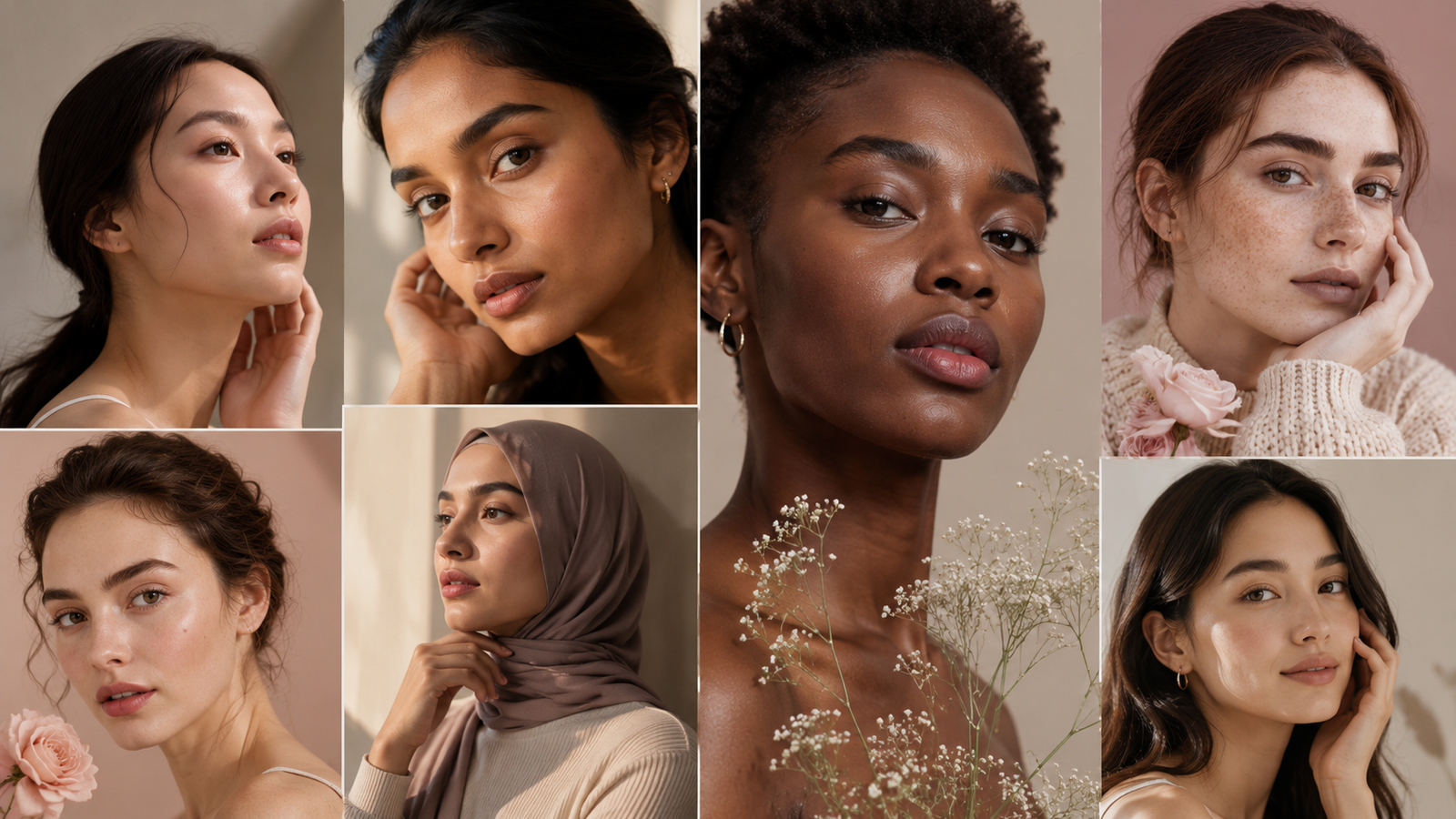
The "universal beauty" myth
One of the most persistent ideas in beauty media is that some standards are universal — that "everyone agrees" symmetrical faces, smooth skin, or certain body proportions are beautiful. Some of this is partly true. Cross-cultural research does find that facial symmetry, clear skin, and signs of health are broadly preferred across most studied cultures. These preferences are often interpreted as evolved cues for partner health.
But beyond a thin layer of broad health-signaling features, beauty standards diverge sharply. The specific definitions of what counts as beautiful — which skin tone, which body shape, which eye shape, which lip size, which hair texture — vary enormously between cultures and shift dramatically across history within the same culture.
The myth of universal beauty often serves to make one specific cultural standard (frequently the dominant media culture's) seem natural and inevitable. It isn't. What's "natural" is variation.
How beauty standards actually form
Beauty standards don't appear from nowhere. They're built from five overlapping forces:
Class and labor history
Many beauty standards encode who in a society did or didn't have to work outside. Pale skin signaled wealth in agricultural societies where laborers worked sun-exposed jobs. Soft hands signaled the same. When industrialization moved work indoors, the meaning of skin tone flipped in some Western contexts — now tanned skin signaled the leisure to be outside, while pale skin marked indoor factory work.
Climate and biology
Standards often emphasize whatever's rare in the local population. In regions where most people have dark hair, blonde hair becomes a beauty marker. In regions where most people have light eyes, dark eyes become more prized. Whatever stands out gets coded as beautiful.
Religion and morality
Many cultures have religious or moral frameworks that shape what beauty looks like — emphasis on modesty, restrictions on certain ornamentation, or symbolic features tied to spiritual meaning.
Media and political power
Whoever controls mass media shapes what gets defined as desirable. Hollywood's global reach for most of the 20th century made specific Western features into a global default. K-pop's reach in the 2010s and 2020s has done similar work for certain East Asian features. Instagram and TikTok algorithms in the 2020s amplified a specific subset of features (high cheekbones, full lips, slim-thick bodies) into a recognizable global look.
Colonial history
European colonialism exported European beauty standards globally, including the elevation of lighter skin and European facial features. The effects are still measurable centuries later — fair-skin preferences in many post-colonial societies, the global skin-lightening industry, and the continued dominance of European features in international media all trace partly to this history.
Beauty standards are not preferences that float in the air. They're encoded with information about class, race, religion, and power. When you recognize a standard as the result of these forces rather than as an objective rating of attractiveness, it becomes easier to question whether it deserves your attention.
Skin color: from pale-as-status to tan-as-status
Skin color is the clearest example of how beauty standards reflect class rather than nature.
In pre-industrial societies where most people worked outdoors, pale skin signaled wealth. You could afford to stay inside. You didn't labor in fields. You had servants who did the sun-exposed work. Across very different cultures — pre-Industrial Europe, Tang Dynasty China, Mughal India, pre-modern Japan — pale skin meant status.
Then Western industrialization moved labor indoors. By the 1920s, tanned skin in Western culture started signaling the opposite of what it had meant before: leisure, travel, sports, beach houses. Coco Chanel famously popularized the deliberate tan in 1923. Within a generation, pale skin had transitioned in Western culture from a status marker to something often described as "sickly looking" or "needs sun."
Crucially, this Western flip did not happen everywhere. In much of East Asia, South Asia, and parts of Africa and the Middle East, pale skin continues to signal status — partly because labor patterns differ, partly because of colonial legacies, partly because anti-tanning practices remained socially encoded. The global skin-lightening industry is worth tens of billions of dollars annually, concentrated in markets where pale skin remains the dominant standard.
Same biology. Opposite meanings. Both presented as "natural beauty" within their respective contexts. Neither is.
Body shape: contradictions across regions
Body ideals contradict each other so sharply across cultures that any claim to a "universal" body standard collapses on inspection.
| Region/Culture | Historically and currently valued body ideal |
|---|---|
| Western media (1980s–2000s) | Very slim, tall, long-limbed |
| Western media (2010s–2020s) | "Slim-thick" — small waist, full hips, defined glutes |
| Much of West Africa (traditional) | Fullness signals health, prosperity, and beauty |
| Much of East Africa (traditional) | Tall and slim often valued in many ethnic groups |
| East Asia (contemporary mainstream) | Slim, petite, often "S-line" with specific proportions |
| South Asia (varies by region) | Often curvier figures considered ideal in classical and current contexts |
| Latin America (varies) | Curves often celebrated; specific ideals vary by country |
| Middle East (varies) | Fuller figures often historically prized; contemporary urban media often closer to Western standards |
The same body that fits one cultural ideal completely fails another. Bodies that are celebrated in one place are pathologized in another. None of this is biological inevitability — all of it is constructed meaning.
What makes this especially clear: ideals shift within the same culture over decades. Western body ideals went from the curvier 1950s pinup to the very slim 1990s "heroin chic" to the current slim-thick standard within a single human lifetime. Nothing about the biology of attractiveness changed. The cultural ideal did.
Facial features: what's valued where
Facial feature ideals show similar variation. Brief, generalizing snapshots (with the important caveat that within any region there's enormous individual and sub-cultural variation):
East Asia (Korea, Japan, China)
Contemporary mainstream standards often emphasize pale skin, smooth "glass-like" complexion, V-line jaw, oval face shape, and double eyelids. The double-eyelid standard is contentious — many East Asians naturally have monolids, and the elevation of double eyelids as an ideal has driven a substantial cosmetic surgery industry.
South Asia
Standards have historically emphasized fair skin (a colorism deeply tied to caste and colonial history), almond eyes, defined eyebrows, and long thick hair. Regional variation is substantial — what's emphasized in Punjabi traditions differs from Tamil or Bengali traditions. Anti-colorism movements have made fair-skin marketing increasingly contested.
Sub-Saharan Africa
The 54-country continent has too much diversity for any single description. Specific ethnic groups have specific traditional beauty markers — particular scarification patterns, beadwork, hairstyles, body modifications. In many West African traditions, fullness and roundness of features have been valued. In many East African traditions, height and slimness. Generalizing "African beauty standards" as one thing is itself a colonial-era simplification.
Middle East and North Africa
Standards often emphasize strong defined eyebrows, expressive eyes (especially valued when emphasized with kohl traditions), full lips, and thick hair. Modesty norms in some sub-regions shape what's emphasized publicly versus privately. Substantial variation between, say, Egyptian, Lebanese, Iranian, and Moroccan traditions.
Europe and European-derived cultures
Contemporary ideals often include high cheekbones, defined jawlines, full lips, large eyes, and small noses. Historical European standards have changed dramatically — Renaissance ideals featured high foreheads (sometimes plucked), fuller bodies, and pale skin; Victorian ideals shifted toward smaller features and corseted waists; mid-20th century shifted again.
Latin America
Substantial variation between countries. Often emphasizes expressive features, defined cheekbones, full lips, and (in many regions) hourglass body proportions. Brazilian beauty standards differ from Mexican, which differ from Argentine. Indigenous influences vary by country.
These descriptions are generalizations of dominant mainstream media standards — they don't describe how people in any of these regions actually look, nor what individuals in those cultures personally find attractive. Real human beauty in every region is far more varied than mainstream beauty marketing portrays. Don't read regional summaries as descriptions of people; read them as descriptions of advertising.
Hair: tradition, identity, and beauty
Hair is one of the most culturally loaded beauty features. Texture, length, color, and styling all carry meaning beyond aesthetics.
Across many cultures, long hair has signaled health, fertility, and femininity. In specific religious or spiritual traditions, hair carries sacred meaning — Sikh practice of uncut hair, Rastafarian dreadlocks, the symbolism of hair in many Indigenous traditions worldwide.
Hair texture has been politicized in particular ways. The systemic Western (and globalized) preference for straight hair over coiled or kinky hair has caused real harm — chemical relaxers, hair discrimination in workplaces and schools, internalized aesthetics that pathologize natural Black hair textures. The growing natural hair movement in Black communities globally is partly a recovery of textures that mainstream beauty marketing had marginalized for generations.
In East Asia, long straight glossy hair has been an enduring ideal across centuries. In many South Asian traditions, long thick dark hair is similarly valued. In contemporary Western media, hair has more aesthetic flexibility — but specific textures and presentations still get coded with class and race information.
What this means in practice: the texture of hair you were born with carries different cultural meaning depending on where and when you live. None of those meanings are facts about your hair. They're meanings projected onto it.
How globalization is reshaping standards
Two opposing forces are reshaping global beauty standards simultaneously.
Homogenization through media
Instagram, TikTok, and similar platforms have spread a recognizable global beauty ideal — sometimes called "Instagram face." Its features: high cheekbones, snatched waist, full lips, defined brows, smooth contoured skin, fox-eye shape, slim-thick body. This look draws from multiple cultural sources but reads as ethnically ambiguous and is amplified by filters, photo editing, and the cosmetic procedure industry. It's now arguably more influential globally than any traditional regional standard.
K-pop and K-beauty influence
The global success of Korean pop culture has spread certain East Asian beauty ideals — pale glass-like skin, smooth complexions, minimal makeup looks, V-line jaws — beyond their original geographic context. Younger consumers in many regions now reference K-beauty ideals alongside or instead of Western ones.
Counter-movements toward localism
At the same time, anti-homogenization movements have grown. Body positivity, skin positivity, natural hair movements, and various #IAmEnough campaigns push back against narrow standards. Some makeup brands actively celebrate regional features rather than homogenizing them. Whether these counter-movements will durably shift mainstream standards or remain niche is still being decided.
The cosmetic procedure industry
Globally accessible cosmetic surgery and injectables have made it more feasible than ever to physically alter features toward whatever ideal is currently trending. This has accelerated the dominance of specific looks (the "Instagram face" effect) and created a feedback loop: filters set the ideal, procedures match it, photos of procedure results amplify it further.
The cost of beauty standards (everywhere)
Beauty standards harm people in every culture they exist in. This isn't unique to any one region.
- Body image issues and eating disorders appear globally wherever thin-body standards dominate.
- Skin-lightening cream use remains widespread in regions where pale skin remains the standard, despite documented health risks from mercury and hydroquinone in some formulations.
- Cosmetic surgery rates are climbing globally, often along very specific ethnic-feature lines — eyelid surgery in East Asia, rhinoplasty across many regions, jaw reshaping for specific face-shape ideals.
- Mental health consequences of feeling permanently inadequate against ideals you can't meet appear across every culture studied. This is not a Western-only phenomenon — it's a beauty-standards phenomenon.
- Economic costs of beauty-standard compliance fall disproportionately on women globally, though men are increasingly affected too.
Acknowledging that standards harm people doesn't require pretending standards don't exist or pretending they don't influence you. It requires recognizing them clearly enough to make conscious decisions about how much weight you give them.
What changes when you see standards as constructs
Recognizing beauty standards as cultural constructs doesn't make them disappear. They still exist. They still shape what gets celebrated in media, what gets photographed at events, what gets praised on Instagram. You still encounter them daily.
What changes is the relationship to them. Three specific shifts:
The standard becomes external, not internal
When you recognize a standard as a specific cultural construction rather than a natural fact about attractiveness, it stops feeling like a personal verdict on you. It's a description of what one culture in one time period has elevated — not a measurement of your worth.
Your features stop being defects against a fixed scale
The features you have are not deviations from any universal ideal because there is no universal ideal. They are features. They have different cultural meanings in different places. None of those meanings is a fact about whether you're beautiful.
You become free to choose which standards to engage with
Some people enjoy participating in beauty culture, experimenting with looks, expressing themselves through makeup, hair, fashion, and style. Recognizing standards as constructs doesn't ruin that. It just makes the engagement a choice rather than a tax. You can use makeup for fun and self-expression without believing the underlying claim that you needed it to be acceptable.
The bottom line: Beauty standards are not natural facts. They are cultural constructs shaped by class history, climate, religion, media, and colonial influence. They vary dramatically across cultures and shift within cultures over time. There is no single universal beauty standard — only specific historical ones that get presented as universal. The features you have are not defects against any fixed scale. There is no fixed scale. What you do with that knowledge is up to you — but the knowledge itself is the starting point.