What Chinese beauty standards emphasize today
The mainstream contemporary Chinese beauty ideal can be summarized in a specific list of features:
- Skin: Very pale, smooth, with a "white as snow" (肤白如雪) clarity
- Face shape: Oval, often described as "goose egg face" (鹅蛋脸) or sometimes "melon seed face" (瓜子脸) — narrower with a slightly pointed chin
- Eyes: Large, with double eyelids, "almond-shaped"
- Nose: Small, straight, with a refined bridge
- Lips: Small, full but contained — the classic "cherry mouth" (樱桃小嘴)
- Eyebrows: Long, gracefully curved — historically called "willow leaf eyebrows" (柳叶眉)
- Body: Very slim, with a "willow waist" (杨柳腰) — long-standing ideal of a narrow waist and graceful proportions
- Hair: Long, straight, dark, glossy
Many of these features have names rooted in classical Chinese aesthetics that have existed for centuries — "goose egg face," "willow leaf eyebrows," "cherry mouth," "willow waist." These aren't recent inventions; they're vocabulary inherited from classical poetry and painting. What's new is how they've been intensified, narrowed, and homogenized by modern media and the cosmetic industry.
Like any beauty standard, this describes mainstream advertising and entertainment ideals — not how real Chinese people actually look. China has 56 recognized ethnic groups across 1.4 billion people in a country roughly the size of the United States. The diversity of actual Chinese appearance vastly exceeds any single beauty standard.
A 3,000-year context — Chinese beauty isn't one thing
Chinese beauty standards are unusual in how well-documented they are across history. Classical poetry, dynastic paintings, court records, and aesthetic treatises stretch back over 3,000 years, giving us a clearer picture of how these ideals shifted than is available for many other cultures.
The most important thing to know upfront: the standards changed dramatically. The fuller figure celebrated in Tang Dynasty paintings would have been considered unsuitably "heavy" by Song Dynasty standards just two centuries later. The same dynasty often had different ideals for women of different classes. And the influence of regional, ethnic, and political shifts on beauty ideals is well-documented across the historical record.
This long history matters because contemporary marketing sometimes presents current Chinese standards as "ancient" or "traditional." Many of them aren't. The current ideal is often a modern construction that selectively references historical aesthetics rather than continuing them.
Dynasty by dynasty: what was beautiful when
A simplified survey across major dynasties shows how dramatically standards shifted:
Tang Dynasty (618–907) — fuller is beautiful
The Tang Dynasty is famous for celebrating fuller figures and rounder faces. Paintings and sculptures from the era depict women with full cheeks, round bodies, and an overall robust appearance. This was tied to prosperity and health signaling — only well-fed, comfortable women would have this body type. Yang Guifei, the legendary Tang Dynasty beauty, is often described as plump by modern standards. Drawn eyebrows in various exaggerated shapes were also fashionable.
Song Dynasty (960–1279) — refined and restrained
The Song Dynasty marked a sharp shift toward slim, delicate, refined beauty. Pale skin became more prized. Body ideals slimmed dramatically. Makeup became more restrained. The aesthetic shift mirrored broader cultural changes — Neo-Confucianism's emphasis on restraint and order influenced what was considered beautiful as well as how women were expected to behave.
Ming Dynasty (1368–1644) — modest beauty
Beauty ideals during the Ming emphasized modesty, restraint, and inner virtue alongside outer appearance. Slim, pale, with delicate features. Long flowing hair and traditional Han clothing styles dominated the aesthetic.
Qing Dynasty (1644–1911) — Manchu-Han duality
The Qing Dynasty saw a complicated period where Manchu rulers and Han Chinese populations had partly distinct beauty cultures. Manchu women wore different hairstyles and clothing than Han women. Foot binding remained widespread among Han Chinese (Manchu women generally didn't bind feet). The pale-skin ideal continued, intensified for noble women.
Republic era (1912–1949) — Western influence enters
After the fall of the Qing Dynasty, Chinese fashion and beauty rapidly incorporated Western influences. The qipao (cheongsam) became the iconic dress style — a hybrid garment combining Manchu and Western tailoring. Hair styles began to shorten. Makeup adopted European elements. Movie stars of the Shanghai film industry of the 1920s and 30s set new beauty standards.
The dramatic shifts across dynasties are some of the clearest evidence that beauty standards are cultural constructions, not natural facts. The same culture, on the same land, with substantially the same gene pool, considered completely different bodies and faces ideal across different centuries. What changed was the cultural context, not biology.
Foot binding: the historical practice and its end
Foot binding is the most consequential and painful chapter in Chinese beauty history, and it deserves honest attention.
The practice emerged in the 10th century and became widespread among Han Chinese families across class lines (Manchu, Mongolian, and many ethnic minority families generally did not practice it). Small bound feet — called lián zú (莲足, "lotus feet") — were considered the highest mark of feminine beauty.
The reasoning behind the practice combined several factors:
- Small bound feet signaled marriage suitability across most Han Chinese class levels
- Limited mobility signaled that the woman didn't need to do physical labor
- The painful, time-intensive process of binding signaled the family's investment in the daughter's marriage prospects
- Cultural aesthetics tied small feet to delicacy, modesty, and feminine virtue
The cost was enormous. Foot binding caused lifelong disability, severe pain, frequent infections, sometimes gangrene and death. Bound feet limited mobility for life and required ongoing care.
The end of the practice came through sustained campaigning by Chinese reformers and feminists in the late 19th and early 20th centuries. The Hundred Days' Reform (1898) included anti-foot-binding advocacy. The practice was officially banned in 1912 after the founding of the Republic of China. Enforcement was uneven, and the practice continued in remote areas through mid-20th century. The last women with bound feet are now in their 90s and older.
Foot binding is now universally condemned within China and globally. It remains one of the most stark historical examples of how beauty standards can cause serious lasting harm — not just psychological pressure but physical disability — and how cultural practices once considered beautiful can be revealed, in retrospect, as deeply harmful. It's an honest part of Chinese beauty history, and modern Chinese culture treats it as the cautionary lesson it is.
The 20th century: revolution and reopening
The 20th century reshaped Chinese beauty culture more than perhaps any prior century.
Republic era and Shanghai cinema (1912–1949)
Western influence entered Chinese beauty rapidly. Shanghai became a hybrid East-West cultural center. Film stars wore qipao, set hair, and incorporated Western makeup. This era produced the iconic "Shanghai calendar girl" aesthetic — pale-skinned, slim, delicate, with traditional Chinese aesthetics in modernized form.
Cultural Revolution era (1966–1976)
Under Maoist Cultural Revolution policy, beauty culture was largely suppressed. Makeup, fashion, and ornament were considered "bourgeois" and politically suspect. The standard look was unisex: short hair, the "Mao suit," no makeup, no jewelry. This represented a deliberate state-level effort to eliminate beauty standards as a system of social control — though it imposed a different uniform standard in their place.
Reform and Opening (1978 onward)
After Deng Xiaoping's reforms began in 1978, the beauty industry returned rapidly. The 1980s saw Western fashion magazines re-enter China, the 1990s saw the rise of domestic media and entertainment, and the 2000s saw explosive growth in the cosmetic industry. Hong Kong and Taiwanese pop culture heavily influenced mainland Chinese beauty ideals through this period before mainland Chinese media became dominant.
Social media era (2010s onward)
The rise of Weibo, WeChat, Xiaohongshu (Little Red Book / RED), and especially Douyin (Chinese TikTok) created an unprecedented amplification of beauty standards. Influencers became major cultural arbiters of taste. The "Wang Hong face" (网红脸, internet celebrity face) — a recognizable, often surgically-influenced homogenized look — became a phenomenon.
The specific modern features
Each element of the contemporary Chinese beauty standard has its own context:
Pale skin (白)
The strongest and oldest standard. Pale skin has been valued across Chinese society for millennia, originally as class signaling (those who didn't work outside stayed paler), and the preference has only intensified in modern times. The skin-lightening industry is massive in China, encompassing serums, capsules, treatments, and increasingly invasive procedures. The English-language phrase "one whiteness covers three uglinesses" (一白遮三丑) captures how strongly this single feature is weighted.
Goose egg face / melon seed face (鹅蛋脸 / 瓜子脸)
The ideal Chinese face shape is oval, narrowing slightly toward a defined but not sharp chin. "Goose egg face" describes a softer oval; "melon seed face" describes a slightly more angular version with a more defined point. Both contrast with the very sharp V-line preferred in Korean standards.
Double eyelids and large eyes
Similar to Korean preferences, but Chinese standards are typically less surgically dependent and more often achieved through makeup techniques. Double eyelid surgery is common but not as universal as in Korea.
Cherry small mouth (樱桃小嘴)
Small, defined, slightly pursed lips. The aesthetic predates modern times — classical Chinese poetry describes the ideal mouth as a small cherry. Modern Chinese lip styling often emphasizes this with focused color on the center of the lip rather than full coverage.
Willow leaf eyebrows (柳叶眉)
Long, gracefully curved eyebrows resembling the leaf of a willow tree. A classical aesthetic that remains influential. Contemporary styles can be more squared, but the willow leaf reference still appears in beauty media regularly.
Slim body
The body ideal is extreme thinness, often beyond what's healthy. Several internet trends in the 2010s and 2020s have measured the "thinness" of bodies against specific objects — the "A4 waist" challenge, the iPhone-knee challenge, the collarbone challenge.
"A4 waist" and the social media body challenges
One of the more documented and criticized phenomena in modern Chinese beauty culture is the proliferation of social media body challenges that measure thinness against arbitrary objects:
- A4 waist challenge (A4腰): a waist narrow enough to be entirely hidden behind a vertical A4 sheet of paper (about 21 cm / 8.3 inches wide)
- iPhone knee challenge: knees no wider than an iPhone
- Collarbone coin challenge: collarbones prominent enough to hold a stack of coins
- Belly button reach-around: arms thin and long enough to reach around the back to touch the navel
- Earphone string challenge: waist narrow enough to fit within the length of typical earphone cables
These challenges spread primarily on Chinese social media platforms in the mid-2010s and have been widely criticized by Chinese health authorities, women's rights groups, and mental health advocates as promoting unhealthy body image and disordered eating. Some platforms have moderated this content. The cultural pressure they reflect, however, remains substantial.
The body challenges described above are documented cultural phenomena worth understanding, not goals worth pursuing. They reflect a particular intersection of social media virality and unhealthy beauty pressure that has been linked to documented increases in disordered eating in Chinese populations, especially among teenagers and young women. Anyone struggling with body image should know that no measurement against an arbitrary object — paper, phone, coins — has anything to do with health, beauty, or worth.
C-beauty and the heritage aesthetic revival
The Chinese beauty industry — "C-beauty" — is younger globally than K-beauty but growing rapidly. Several distinctive features set it apart:
Heritage and traditional motifs
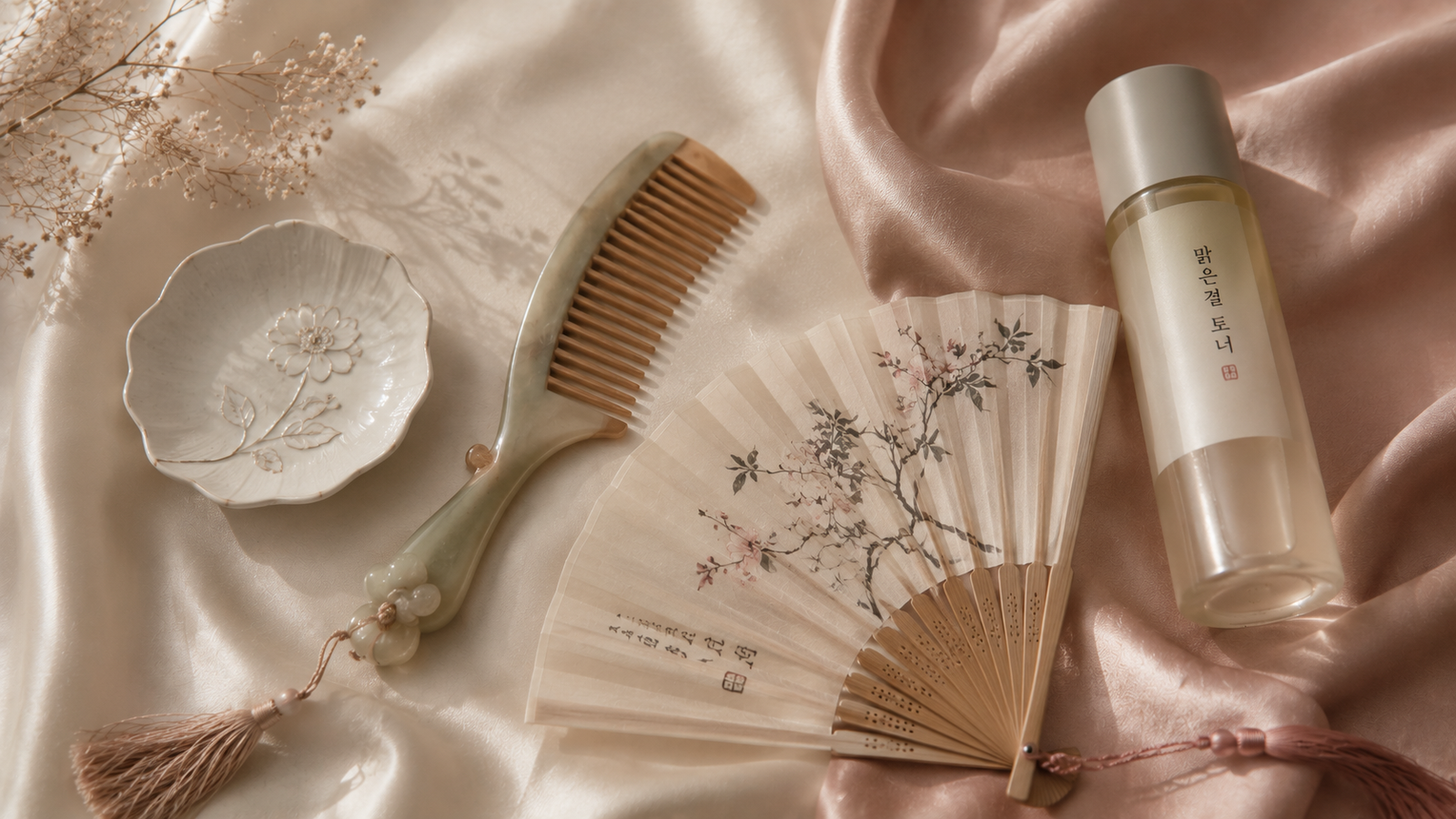
Many leading Chinese cosmetic brands lean heavily on traditional Chinese aesthetics — classical painting motifs, dynastic-era imagery, qipao patterns, calligraphy. Brands like Florasis (花西子) build entire product lines around Chinese cultural references, with packaging that resembles classical lacquerware and product names drawn from poetry.
Major C-beauty brands
- Florasis (花西子) — heritage-inspired, calligraphy and classical motifs, expanded internationally in 2021
- Perfect Diary (完美日记) — affordable mass market, modern packaging
- Pechoin (百雀羚) — heritage skincare brand dating to 1931, strong domestic loyalty
- Maogeping (毛戈平) — premium makeup line by famous makeup artist Mao Geping
- Herborist (佰草集) — Traditional Chinese Medicine-inspired skincare
- Winona (薇诺娜) — focused on sensitive skin, scientific positioning
The hanfu revival
Alongside the cosmetic industry, the hanfu (汉服) movement — the revival of traditional Han Chinese clothing — has reintroduced classical beauty aesthetics to younger generations. Hanfu enthusiasts study and recreate dynastic-era styling, makeup, and hair, often as conscious alternatives to homogenized social media beauty standards. The movement has grown significantly since the 2010s.
The hanfu revival represents one of the most interesting counter-currents to modern beauty homogenization in Chinese culture. Participants often celebrate features and styles deliberately distinct from "Wang Hong face" — embracing classical ideals that don't require surgery, heavy filtering, or homogenized makeup looks. It's a useful reminder that beauty culture in China contains far more diversity than international media coverage usually shows.
Where Chinese beauty standards are heading
Several forces are reshaping Chinese beauty standards into the 2030s:
Government regulation
The Chinese government has taken active steps against what it considers excessive beauty culture, including restrictions on certain cosmetic surgery advertising (especially for minors), bans on extreme beauty challenges on social media platforms, and rules limiting depictions of "sissy men" (referring to certain male beauty trends). The state's role in shaping beauty culture is more direct in China than in most other countries.
Pushback against Wang Hong face
The homogenized internet-celebrity look has substantial critics within Chinese culture. Some platforms have reduced filter capabilities. Some celebrities have publicly rejected the look. The criticism is becoming mainstream.
The heritage revival
Beyond hanfu, broader interest in traditional Chinese aesthetics — Tang Dynasty fuller figures, classical proportions, regional ethnic minority beauty traditions — is offering alternatives to the narrow mainstream standard.
Cultural nationalism in beauty
C-beauty brands explicitly position themselves as Chinese alternatives to Western and Korean beauty influences. This nationalism in beauty has economic and cultural dimensions that are reshaping consumer preferences.
Mental health awareness
Chinese society is gradually opening up about mental health, including body image issues and the costs of beauty conformity. This conversation, while still nascent, is creating space for more diverse standards.
The bottom line: Chinese beauty standards have shifted dramatically across 3,000 years and continue to shift today. The current mainstream ideal emphasizes pale skin, an oval face, large eyes, small lips, and an extremely slim body — but this is not "traditional Chinese beauty." It's a modern construction that selectively references some classical features while ignoring others. The historical record shows fuller bodies, varied face shapes, and dramatic regional differences were all considered beautiful at different times. The hanfu revival, the criticism of "Wang Hong face," and the heritage C-beauty industry all represent ongoing internal Chinese conversations about which standards deserve continued influence. If you're interested in Chinese beauty culture, the most accurate version isn't the homogenized social media look — it's the 3,000-year tradition that has been consistently more diverse than any single moment in it suggests.