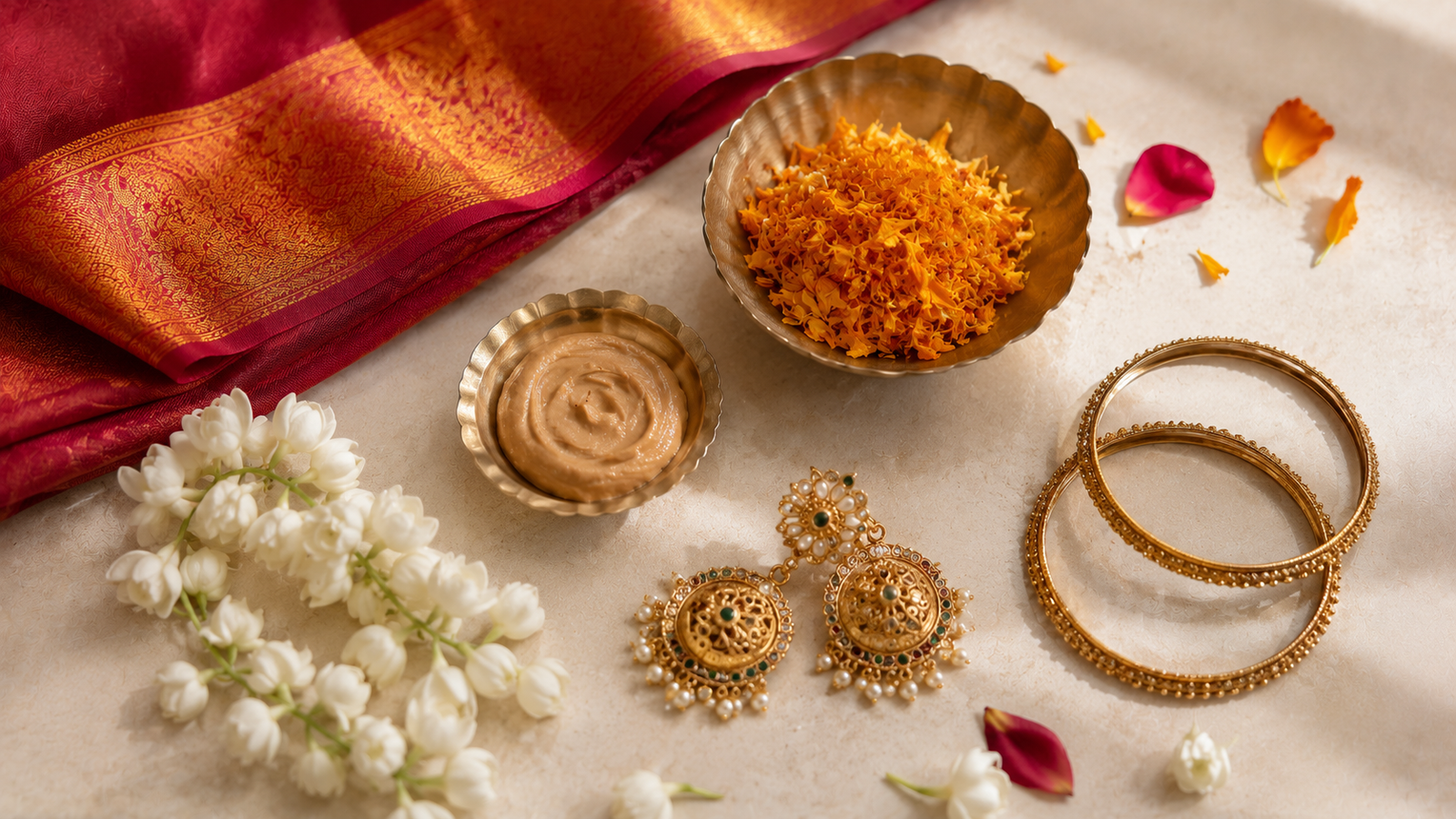
Why Indian beauty needs its own treatment
India presents one of the world's most complex beauty traditions — three and a half millennia of recorded aesthetic philosophy, vast regional diversity, multiple major religious traditions, profound colonial disruption, and one of the world's most influential entertainment industries shaping contemporary standards.
The phrase "Indian beauty" obscures more than it reveals. India contains regions with beauty traditions as different from each other as European and East Asian traditions are. Bengali beauty culture, Tamil beauty culture, Kashmiri beauty culture, Marathi beauty culture, Punjabi beauty culture, Assamese beauty culture, Malayali beauty culture, and many others each have distinct histories that get flattened by the singular label.
This piece takes Indian beauty seriously across its actual historical depth and regional variation. It also addresses honestly the central feature contemporary Indian beauty discourse must engage with: persistent colorism, the preference for lighter skin that has structured Indian beauty culture for centuries and continues to do so despite reform movements.
Working alongside our pieces on Korean, Chinese, and Japanese beauty standards, this completes a major regional coverage in the cultural commentary cluster.
The classical foundations: Vedic, Sanskrit, Gupta (1500 BCE - 500 CE)
The earliest sustained reflections on beauty in Indian tradition appear in Vedic literature (composed roughly 1500-500 BCE) and the classical Sanskrit literature that followed (peaking during the Gupta period, 320-550 CE).
Vedic beauty references
The Vedas — particularly the Rigveda — contain numerous references to beauty in describing deities, ritual objects, and natural phenomena. Female deities like Ushas (goddess of dawn) are described in extensive detail, with imagery emphasizing radiance, golden coloring, beautiful adornment, and graceful movement.
Vedic beauty was deeply tied to ritual context. Beauty in objects, in deities, and in humans signaled cosmic order (rita) and proper relationship to divine principles. The aesthetic dimension wasn't separate from religious significance — beauty was a quality of properly ordered things.
Sanskrit literature and the Padmini classification
By the classical period, Sanskrit literature had developed elaborate aesthetic theory. The Natyashastra (the foundational treatise on Indian performing arts, attributed to Bharata Muni, composed between 200 BCE and 200 CE) developed extensive aesthetic theory including the concept of rasa — emotional essence or response that art aims to evoke.
The classical period also produced the famous classification of four feminine types found in the Kama Sutra (attributed to Vatsyayana, composed roughly 200-400 CE) and related texts:
- Padmini (lotus woman) — the highest type, characterized as having soft skin like a lotus, fragrant breath, graceful movements, delicate temperament. Associated with refinement and spiritual sensitivity.
- Chitrini (artistic woman) — characterized as creative, devoted to arts and music, with specific physical and temperamental features.
- Shankhini (conch woman) — characterized as quick-tempered, strongly physical, with distinctive features.
- Hastini (elephant woman) — characterized as physically larger, sensual, earth-bound.
The classification system is now mostly of historical interest but reveals something important: ancient Indian aesthetic thought formally categorized beauty rather than treating it as a single ideal. Different types were considered beautiful in different ways. The pluralism is striking.
Visual evidence: Ajanta and Sanchi
The cave paintings at Ajanta (1st century BCE - 5th century CE) and the sculptures at Sanchi and Bharhut show classical Indian beauty ideals in visual form. The figures display certain consistent features:
- Full figures with rounded forms
- Narrow waists with full hips and breasts
- Long dark hair, often elaborately styled
- Elongated eyes (often described as "deer eyes")
- Abundant jewelry — necklaces, earrings, bangles, anklets, waist chains
- Graceful curved postures (the tribhanga, three-bend pose)
- Skin tones varying from pale gold to deeper bronze
The classical Indian aesthetic celebrated abundance — abundant ornament, abundant form, abundant graceful motion. Beauty was richness, not restraint.
The poetic tradition
Sanskrit poetry, particularly Kalidasa's works (4th-5th century CE), developed elaborate vocabularies for describing beauty. The Meghaduta (Cloud Messenger) and other works of Kalidasa contain some of the most refined descriptions of feminine beauty in any tradition. The imagery — comparing eyes to lotus petals, gait to that of a swan, lips to bimba fruit — established conventions that would influence Indian literature for over a thousand years.
Medieval India and regional traditions (500-1500 CE)
The medieval period saw the development of distinct regional traditions across the Indian subcontinent. The Gupta era's relatively unified classical aesthetic gave way to more localized variations as different regions developed under different ruling powers.
South Indian temple aesthetics
The temples built across South India between roughly 600 and 1500 CE — particularly during the Chola, Pallava, and Pandya dynasties — contain extensive sculpture depicting ideal feminine beauty. The Chola bronze sculptures (10th-13th centuries CE) are among the most refined depictions of feminine beauty in world art.
The South Indian classical ideal included:
- Full figures with rounded forms (continuing the classical tradition)
- Specific facial proportions described in shilpa shastra (architectural and sculptural treatises)
- Elaborate jewelry and adornment
- Graceful dance postures (Bharatanatyam developed during this period)
- Floral garlands as both adornment and offering
Bhakti devotional traditions
The Bhakti movement (roughly 6th-17th centuries CE), particularly in South India initially and later spreading north, developed devotional literature that often celebrated divine beauty. Tamil Alvar poets (8th-10th centuries) wrote extensively about the beauty of Vishnu and his consorts. Kannada Vachana poets (12th century) similarly wrote about Shiva. Hindi devotional poets like Mirabai (16th century) wrote about Krishna.
The devotional tradition mattered for beauty culture because it celebrated divine forms as supreme beauty, providing models for human aesthetic aspiration that were religious rather than purely secular.
Tribal and folk traditions
India's tribal communities — Santhals, Gonds, Bhils, Nagas, and many others — maintained beauty traditions distinct from the dominant Hindu and Muslim cultures. Body modification practices including extensive tattoos (particularly in Northeast India), elaborate jewelry traditions, distinctive textile and decoration practices all formed parallel beauty cultures that have often been marginalized in dominant Indian beauty narratives.
Bengali medieval aesthetics
Medieval Bengal developed its own beauty traditions tied to Vaishnav devotional culture, particularly the worship of Radha and Krishna. The Bengali aesthetic of "roop" (form/beauty) — emphasizing soft features, expressive eyes, graceful movement, and elaborate hair adornment — was elaborated in devotional literature and continued shaping Bengali beauty culture into the modern period.
The Mughal era: Persian influence and cosmetic culture (1526-1857)
The Mughal Empire established Persian-influenced cultural traditions across much of North India and influenced beauty culture throughout the subcontinent.
Mughal court aesthetics
The Mughal court, particularly during its peak under Akbar (1556-1605), Jahangir (1605-1627), and Shah Jahan (1628-1658), developed elaborate beauty culture combining Indian and Persian traditions.
Mughal beauty ideals included:
- Fair skin — preference for lighter skin reflected Persian aesthetic preferences (Persian-influenced beauty literature emphasized "moon-like" pale skin)
- Almond eyes — lined with kajal (kohl) for emphasis
- Henna decoration — elaborate mehndi patterns on hands and feet, particularly for weddings and festivals
- Elaborate jewelry — gold and gemstones in elaborate designs
- Luxurious clothing — fine silks, embroidered fabrics, jewel-encrusted garments
- Perfumed presence — extensive use of attar (Indian perfumes), rose water, sandalwood
- Long dark hair — oiled with coconut, almond, or jasmine-infused oils
Mumtaz Mahal and royal beauty
Mumtaz Mahal (1593-1631), Shah Jahan's beloved wife for whom the Taj Mahal was built, became something of a beauty icon in Mughal cultural memory. Court chroniclers described her with elaborate aesthetic vocabulary that drew on Persian poetic conventions. Her status as supreme beloved made her beauty culturally significant beyond purely individual terms.
Mughal miniature paintings
The miniature painting tradition that flourished under Mughal patronage and continued in Rajput courts after Mughal decline produced extensive visual record of beauty ideals. The conventions — almond eyes, slender figures, elaborate dress, courtly settings — became defining for North Indian beauty culture for centuries.
Sufi influences
Sufi spiritual traditions, particularly strong in the Mughal era, developed extensive beauty-related vocabulary connecting earthly beauty to divine love. The Sufi poetic tradition (Rumi, Hafiz in the Persian context; Amir Khusrau, Bulleh Shah in the Indian context) shaped how beauty was understood as having spiritual dimension. This influenced subsequent beauty discourse including how Bollywood would later draw on Sufi imagery.
The colonial period: when British standards reshaped Indian beauty (1757-1947)
British colonial rule fundamentally restructured Indian beauty culture in ways that continue to shape contemporary standards.
The intensification of fair-skin preference
Fair-skin preference existed in India before British colonialism — Sanskrit literature contains references to "moon-like" pale skin, Mughal court culture valued lightness, and some caste-based associations between skin tone and status predated colonial rule. However, British colonialism dramatically intensified the preference by:
- Directly associating lighter skin with social mobility under British rule
- Creating educational and professional advantages tied to physical proximity to European appearance
- Importing European beauty products that explicitly marketed skin-lightening effects
- Establishing entertainment, advertising, and media patterns that featured lighter-skinned representations
- Reinforcing caste hierarchies that already had partial colorism elements
The colonial period transformed what had been one element among many beauty preferences into a dominant structural feature of Indian beauty culture.
The decline of traditional aesthetics
The colonial period also marginalized many traditional Indian aesthetic forms. Court cultures that had sponsored elaborate beauty traditions lost economic and political support. Folk and tribal traditions were further peripheralized by colonial administrators who saw them as primitive. The classical Indian aesthetic of abundance, ornament, and graceful curve was repositioned as "ornate" or "excessive" against European preferences for restraint.
The hybridization period
By the late colonial period (1850s-1947), Indian beauty culture in urban centers had developed hybrid forms — traditional elements (saris, jewelry, henna, kajal) combined with European elements (Western-style cosmetics, hairstyles, increasing focus on skin lightness). The hybrid culture became the basis for what would emerge as "modern Indian beauty" after independence.
Indian nationalism and beauty
The Indian independence movement included some explicit aesthetic dimensions. Khadi (homespun cloth), traditional dress, and Indian aesthetic forms were promoted as alternatives to British-influenced consumption. Tagore in Bengal championed Indian aesthetic forms (including in fashion, music, and visual arts) as expressions of national pride. These movements established a parallel aesthetic tradition that continues today, though it has rarely been dominant against Bollywood and global beauty industry influence.
Bollywood beauty: from independence to global icons (1947-2010)
From independence onward, no cultural force has shaped Indian beauty standards more than Bollywood.
The golden age (1950s-1970s)
Early Bollywood beauty was defined by actresses including Madhubala (1933-1969), Meena Kumari (1933-1972), Nutan (1936-1991), Sharmila Tagore (born 1944), Hema Malini (born 1948), Rekha (born 1954), and others. The defining features:
- Light to fair skin (with rare exceptions like Smita Patil and Shabana Azmi in parallel cinema)
- Large expressive eyes emphasized with heavy kajal
- Long dark hair
- Full feminine figures (not the extreme thinness of later eras)
- Traditional Indian dress (saris, salwar kameez) with selective Western additions
- Elaborate jewelry, particularly for ceremonial scenes
The early Bollywood aesthetic combined traditional Indian beauty elements with the visual conventions of cinema, creating a distinctive style that defined Indian feminine beauty across the subcontinent.
The 1980s-1990s shift
Bollywood beauty in the 1980s and 1990s saw shifts toward thinner figures (influenced by global trends), more elaborate Western-style makeup, and the international glamour that came with India's economic opening. Actresses like Sridevi (1963-2018), Madhuri Dixit (born 1967), and Karisma Kapoor (born 1974) defined this transitional era.
The 1994 transformation
The year 1994 was a watershed for Indian beauty culture globally. Aishwarya Rai won Miss World in November; Sushmita Sen won Miss Universe in May. Two Indian women won the two most prestigious international pageants within six months. (See our piece on beauty pageants for the full pageant context.)
Both women immediately became Bollywood stars. Aishwarya Rai went on to become one of the most internationally recognized Indian actresses of all time. Sushmita Sen had a major Bollywood career. The pageant-to-Bollywood pipeline became established as a defining feature of Indian beauty culture.
The 2000s globalization
Through the 2000s, Bollywood became increasingly global. Aishwarya Rai appeared at Cannes, in international films, on global magazine covers. Priyanka Chopra won Miss World in 2000 and went on to global film and TV success. Deepika Padukone (born 1986) emerged as the next generation's defining beauty icon.
Indian beauty culture also became more visible globally during this period. Bollywood styling, Indian designers (Sabyasachi, Manish Malhotra, others), and Indian beauty practices gained international audiences. Indian-American identities became more visible in Western media.
Contemporary Indian beauty (2010-2026)
Social media transformation
The 2010s saw social media transform Indian beauty culture as dramatically as it did elsewhere. Instagram, YouTube, and later TikTok (banned in India in 2020) created entirely new beauty influencer ecosystems. Indian beauty influencers — Komal Pandey, Diipa Khosla, Komal Basith, Malvika Sitlani, and many others — built substantial followings.
The new generation of icons
Current Indian beauty icons span Bollywood, modeling, and influencer worlds. Deepika Padukone, Alia Bhatt, Anushka Sharma, Kareena Kapoor, Katrina Kaif, Priyanka Chopra remain culturally central. Newer figures including Sara Ali Khan, Janhvi Kapoor, Ananya Panday represent newer cohorts. The Miss Universe and Miss World successes have continued — Manushi Chhillar (Miss World 2017), Harnaaz Sandhu (Miss Universe 2021).
Indian beauty brand growth
Indian beauty brands have grown substantially. Lakmé (originally launched in 1952, now owned by Hindustan Unilever) remains a dominant force. Newer brands including Forest Essentials (founded 2000, luxury Ayurvedic), Kama Ayurveda (founded 2002), Sugar Cosmetics (founded 2015), Plum Goodness (founded 2014), MyGlamm, and many others have built substantial businesses celebrating Indian aesthetic traditions or modern Indian identity.
The diversity moment
Recent years have seen growing celebration of dusky, dark-skinned, and regionally diverse Indian beauty in advertising, casting, and broader media. This represents real if incomplete progress against historical colorism. Indian brands increasingly feature diverse models. Bollywood casting has slowly diversified. Social media has given voice to creators challenging traditional beauty conventions.
Persistent skin lightening
Despite reform progress, the skin-lightening industry remains massive in India. The 2020 rebranding of Hindustan Unilever's "Fair & Lovely" to "Glow & Lovely" was a significant moment — the brand had been India's largest skin-lightening product for decades — but the underlying product and marketing approach didn't fundamentally change. Other skin-lightening products from multinationals (Olay, Pond's) and Indian brands remain widely sold. The industry continues to generate billions of dollars annually.
Regional diversity: there is no single Indian beauty
Within India, beauty traditions vary substantially by region. The treatment above has often unavoidably emphasized dominant North Indian traditions; this section restores some balance.
Bengali beauty traditions
Bengali culture has developed distinctive beauty traditions, particularly around weddings and festivals. The Bengali bridal aesthetic includes:
- Distinctive sari draping (the Bengali style with pleats over the shoulder)
- Red and white color emphasis in bridal traditions
- Specific bridal makeup including red bindi shapes
- Chandan (sandalwood paste) designs on face
- Elaborate gold jewelry (Bengali designs)
- The Tagore-era cultural aesthetics that influenced Bengali fashion and grooming
The Bengali bhadralok cultural tradition (the educated middle class that emerged in 19th-century Bengal) developed its own aesthetic conventions that continue to influence Bengali beauty culture.
South Indian beauty traditions
South India encompasses Tamil Nadu, Kerala, Karnataka, Andhra Pradesh, and Telangana — each with distinct cultures. Common features include:
- Elaborate gold jewelry traditions (particularly Tamil and Kerala styles)
- Distinctive flower garland (gajra) hair adornment
- Specific bridal saris (Kanchipuram, Mysore silk)
- The continuing influence of classical dance traditions on aesthetic ideals
- Coconut and other South Indian hair oil traditions
- Kerala's Ayurvedic beauty tradition
Northeast Indian beauty traditions
The eight states of Northeast India (Arunachal Pradesh, Assam, Manipur, Meghalaya, Mizoram, Nagaland, Tripura, Sikkim) have beauty cultures often very different from mainstream Indian standards. Distinctive features include:
- Various indigenous tattoo traditions (now mostly preserved by older generations)
- Distinctive textile traditions (Assamese silk, Naga weaves, Mizo textiles)
- Elaborate bead jewelry traditions
- Different facial feature distributions and standards
Northeast Indian beauty has been historically marginalized in dominant Indian beauty narratives, with Northeast Indians sometimes mistaken for East Asian rather than recognized as Indian. This marginalization is itself a feature of Indian beauty culture that deserves honest acknowledgment.
Punjabi beauty traditions
Punjabi culture, particularly visible in North Indian wedding aesthetics:
- Vibrant color palettes
- Specific traditional dress (salwar kameez, lehenga choli for weddings)
- Distinctive gold jewelry traditions
- The cultural prestige of "Punjabi beauty" as a recognized type
Many other traditions
Marathi, Gujarati, Rajasthani, Kashmiri, Tamil, Telugu, Kannada, Malayali, Oriya, and many other regional traditions each have distinct beauty cultures. The Marwari bridal aesthetic differs from the Rajasthani. The Kashmiri beauty tradition (with its distinctive bridal headdress) differs from the Punjabi. Each deserves its own treatment that exceeds the scope of any single article.
One of the harms of homogenized "Indian beauty" discourse is the erasure of these regional differences. When Bollywood (concentrated in Mumbai, drawing heavily on North Indian traditions) represents "Indian" beauty globally, the result has been substantial erasure of South Indian, Northeast Indian, and other regional aesthetic traditions even within India itself.
The honest tensions and the reform movements
The central tension: persistent colorism
Despite reform movements and progress, fair-skin preference remains the central feature of contemporary Indian beauty culture. The reasons are layered:
- Pre-colonial preferences existed in some traditions (though varied regionally)
- British colonialism intensified the preference structurally
- Post-independence Bollywood reinforced it through casting and visual conventions
- Multinational beauty companies developed and aggressively marketed skin-lightening products
- Skin-lightening industry generates billions of dollars annually, creating ongoing economic incentive
- Marriage market preferences continue to favor lighter skin in many communities
Honest treatment requires acknowledging that colorism in Indian beauty culture is structural, not merely individual prejudice. Reform requires changing structures, not just attitudes.
The Bollywood casting question
Bollywood casting has been credibly criticized for systematically favoring lighter-skinned actresses, often using cosmetics, lighting, and post-production to lighten the appearance of cast members who don't already match the preferred standard. The pattern reinforces colorism in both representation and aspiration. Some progress has been made in recent years; substantial structural patterns remain.
The 2020 Fair & Lovely rebrand
In June 2020, in the context of global Black Lives Matter conversations and growing Indian critique, Hindustan Unilever (Indian subsidiary of Unilever) renamed its dominant skin-lightening brand from "Fair & Lovely" to "Glow & Lovely." The name change was widely covered. The product, packaging design, and core marketing approach changed less dramatically. Critics argued the rebrand was insufficient — the product still functions as a skin-lightener, the underlying values it appeals to weren't addressed. The episode crystallized both how far reform had come (the brand renaming was unimaginable a decade earlier) and how far it has to go.
The #DarkIsBeautiful movement
The #DarkIsBeautiful campaign was founded by Indian actress Nandita Das in 2009. The campaign has involved advertising, social media activism, and engagement with the entertainment industry to push back against colorism in casting, advertising, and broader beauty culture. The movement has been one of several reform efforts that contributed to gradual changes.
The growth of inclusive Indian brands
Newer Indian beauty brands have explicitly positioned themselves as inclusive — featuring diverse models, offering broader foundation shade ranges, marketing without colorist appeals. Sugar Cosmetics, Plum Goodness, MyGlamm, and others have positioned around modern Indian identity that doesn't require lightness. The market response has been mixed — substantial growth for these brands, but the colorist mainstream remains larger.
The diaspora dimension
Indian diaspora communities in the UK, US, Canada, and elsewhere have developed parallel beauty cultures that both engage with Indian traditions and shape them. Indian-American beauty influencers, designers, and brands have introduced Indian beauty practices to global audiences. They've also sometimes carried colorist preferences into diaspora contexts, where they intersect with the racial dynamics of the host countries in complex ways.
The honest position
Indian beauty culture in 2026 is in genuine transition. Real progress against colorism exists alongside persistent structural colorism. New beauty brands celebrating diversity exist alongside continuing massive skin-lightening industry. Regional traditions get more attention than they did, but dominant narratives still flatten them. Bollywood casting has slowly diversified, but the slow speed makes the persistence of the pattern visible.
The honest treatment doesn't celebrate Indian beauty culture uncritically (the colorism is real) and doesn't dismiss it (the traditions are deep, varied, and meaningful). It tries to hold both: the richness of three and a half millennia of beauty tradition, and the specific contemporary work of honest reform.
The bottom line: Indian beauty has evolved through Vedic-era ideals, classical Sanskrit aesthetics (including the four feminine types classification), medieval regional traditions, Mughal Persian-influenced courtly culture, British colonial intensification of colorism, and Bollywood-era dominance. Contemporary Indian beauty culture combines extraordinary regional diversity (Bengali, South Indian, Punjabi, Northeast Indian, and many other traditions) with persistent colorism, dramatic Bollywood influence, and growing reform movements. Aishwarya Rai's 1994 Miss World and Sushmita Sen's same-year Miss Universe wins, Priyanka Chopra's Miss World 2000, Manushi Chhillar 2017, and Harnaaz Sandhu's Miss Universe 2021 mark India's continuing global pageant presence. The 2020 Fair & Lovely rebranding to Glow & Lovely, Nandita Das's #DarkIsBeautiful campaign, and the growth of inclusive Indian beauty brands represent real but incomplete progress against colorism. The honest position holds both: India's beauty traditions are remarkable in depth and variety, and contemporary Indian beauty culture is in genuine reform transition that's still very much in progress. There is no single Indian beauty — there are many Indian beauties, each deserving recognition.