What a beauty mark actually is (and why the label matters)
A beauty mark is a small dark spot on the face — typically a mole, freckle, or other pigmented mark — that has been culturally designated as aesthetically enhancing rather than a flaw. The important thing to notice: the term reflects cultural evaluation, not medical distinction. "Beauty mark" and "mole" can describe exactly the same physical feature. What changes is whether it's considered beautiful.
This distinction from the medical category matters. Our companion piece on beauty mark vs. mole covers the medical distinction — when a mark warrants dermatological attention, when it doesn't. This piece is different. It's about the cultural history of what people have decided to call certain marks beautiful, why, when, and with what consequences.
The cultural history is more interesting than most beauty coverage suggests. Beauty marks have been fashion, statement, coded language, personal identity, and cultural marker across multiple centuries and contexts. The current TikTok drawn-on beauty mark trend isn't an invention — it's revival of a practice that goes back at least 400 years in Western culture and much further in others.
Ancient and early modern origins
Roman and Egyptian antecedents
Ancient Egyptians used cosmetics elaborately, including facial decoration that could be considered antecedent to later beauty marks. Egyptian eye makeup was extensive, but records of specific "beauty mark" style small applied marks are less clear.
Roman literature contains references to women applying small patches to the face to conceal blemishes or emphasize features. Ovid's writings on cosmetics reference various techniques, though the specific practice of the coded position-based patch culture that would characterize French mouches was still centuries away.
Medieval Europe
Medieval European beauty culture generally didn't favor facial marks. Religious associations linked visible skin marks to disease (leprosy, plague scars) or moral judgment (witch's marks in some traditions). The medieval preference was for unblemished, pale skin — features that would signal both health and distance from outdoor labor.
The Renaissance beginning
By the 16th century, aesthetic preferences began shifting. Renaissance portraits sometimes showed subjects with visible facial marks, and small facial patches — sometimes applied for practical reasons like covering scars from smallpox or other pox diseases — began to acquire aesthetic value alongside their practical function.
The mouches era: 17th and 18th-century French court culture
The elaborate beauty mark culture that would define much of European fashion for two centuries reached its peak in the French court of Louis XIV and continued through the 18th century.
What mouches were
A "mouche" (literally "fly" in French, referring to the small dark shape) was a patch of silk, velvet, or taffeta applied to the face as a beauty ornament. Mouches came in various shapes:
- Simple dots and small circles
- Stars
- Crescents (moon shapes)
- Hearts
- Diamonds
- More elaborate cut shapes for special occasions
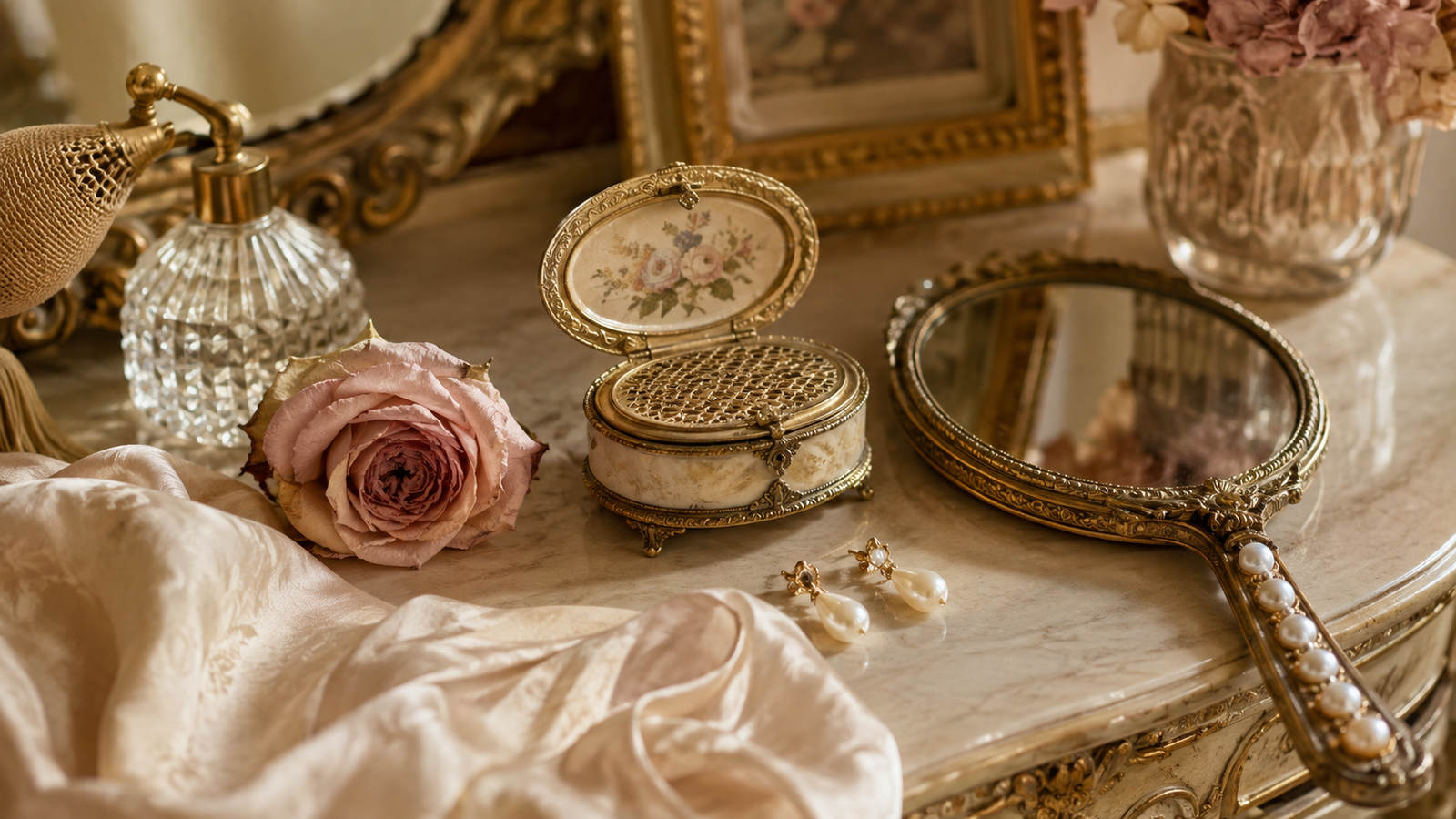
The patches were kept in small ornamental boxes (boîtes à mouches) and applied fresh for each social occasion. Ladies of means carried these boxes with them, allowing for repositioning and replacement throughout the day.
The named positions
The most fascinating aspect of the mouches culture was that specific positions on the face had specific names carrying specific meanings — a coded language of ornamentation:
- La passionnée — at the corner of the eye, signaling passion
- La coquette — near the mouth or on the lip, signaling flirtation
- La majestueuse — on the forehead, signaling dignity or majesty
- La galante — on the middle of the cheek, signaling elegance
- La baiseuse — at the corner of the mouth, signaling amorous intent
- La discrète — on the lower lip, signaling discretion
- L'assassine — near the eye, signaling deadly attractiveness
- L'enjouée — on the laugh line, signaling playfulness
- La voleuse — on a pimple, humorously "stealing" attention from the blemish
The system allowed women to communicate personality traits, moods, and social positioning through their choice of mouche placement — a coded aesthetic language embedded in daily fashion.
Political dimensions
The mouches culture even acquired political dimensions. In certain periods, women signaled political allegiances through which side of the face they wore their mouche on — right-side wearers versus left-side wearers were said to represent different court factions. Whether this was systematically observed or partly a later romanticization is debated, but the association shows how elaborated the practice became.
Cross-class adoption
The practice began at the highest levels of French court society but gradually spread across European aristocracy and eventually to broader middle-class women. By the mid-18th century, mouches were fashionable throughout much of Europe. Similar practices developed independently in various contexts, but the French version became the dominant international model.
The decline
The French Revolution (1789) began a rapid decline of mouches culture. The elaborate cosmetic practices of the aristocracy became politically suspect. Post-Revolutionary and Napoleonic-era beauty preferences shifted toward more restrained natural looks. By the early 19th century, mouches had largely disappeared as everyday fashion, though they persisted in certain formal contexts and in theatrical costume.
The 19th century: from applied patches to natural marks
The 19th century represented a transition period in beauty mark culture.
Victorian moral aesthetics
The Victorian era (roughly 1837-1901) generally favored natural, modest, unadorned feminine appearances at least in theory. Elaborate applied cosmetics were considered morally suspect, associated with actresses (considered dubious professionals in Victorian judgment), prostitutes, or the fallen aristocracy of the pre-Revolutionary era.
This didn't mean cosmetics disappeared — they became covert, marketed as "beautifiers" rather than "makeup," often labeled as medicinal treatments. Small subtle enhancements were still practiced. The overt patch culture of the previous century was decidedly out of fashion.
The natural mole gains new value
As applied patches lost favor, natural facial moles began to acquire specifically aesthetic value in a way they hadn't before. Portraits and photographs of celebrated 19th-century beauties often featured visible moles that were understood as enhancing distinctive features rather than concealing.
This shift was culturally significant. What had been achieved through applied ornament in the previous era was now achieved through celebration of natural features that resembled the position and prominence of former mouches. The aesthetic goal was the same; the means had shifted from artifice to natural feature emphasis.
The early photography effect
The rise of photography from the mid-19th century created new visibility for individual facial features including moles. Where painted portraits had allowed selective emphasis and idealization, photographs recorded features more literally. Public figures whose photographs circulated widely became identified with their specific features, including their moles, in ways painted portraits had partially obscured.
The Hollywood era: Elizabeth Taylor to Marilyn Monroe
The 20th century saw beauty mark culture centered increasingly on Hollywood celebrity culture.
Early Hollywood beauty marks
Silent film stars including Clara Bow and Louise Brooks helped establish specific individual features — including sometimes moles — as part of their recognizable images. The close-up cinematography of early film gave individual facial features more visual prominence than earlier media.
Elizabeth Taylor
Elizabeth Taylor (1932-2011) had a small mole on her right cheek that became part of her recognizable image throughout her career. Combined with her famously violet eyes and dark eyebrows, the mark contributed to her distinctive appearance across decades of films.
Marilyn Monroe
Marilyn Monroe (1926-1962) is arguably the most iconic beauty-mark-associated celebrity in history. Her mole, typically visible on her left cheek near her mouth, was a natural feature that she consistently darkened and emphasized as part of her signature look.
Monroe reportedly had multiple moles on her face and body but chose to highlight this specific one. Studio makeup artists sometimes emphasized it further. It became so identified with her image that many contemporary drawings, images, and impersonations of Monroe emphasize the mark prominently.
Monroe's beauty mark had wider cultural consequences: it demonstrated that a specifically positioned facial mole could be part of an idealized beauty image rather than a flaw. Her enormous cultural influence in the 1950s and beyond helped rehabilitate facial marks aesthetically in ways that would continue affecting beauty culture decades after her death.
The mid-20th century broader normalization
Through the 1950s and 1960s, multiple stars including Sophia Loren, Anna Karina, and others featured visible facial moles as part of their images. Fashion magazines gradually began including models with visible marks. The category of "beauty mark" as celebrated feature became more culturally established than it had been in any period since the mouches era.
Cindy Crawford and the fashion rehabilitation
The 1990s brought a distinct moment in beauty mark history: the emergence of Cindy Crawford (born 1966) as one of the most successful models of her era, with a distinctly visible mole above her upper lip as one of her most recognizable features.
The early-career pressure
Crawford has discussed in interviews how early in her modeling career, some professionals recommended she have the mole removed because it was seen as a potential barrier to booking work. She declined. The mark became one of her most distinctive features.
The fashion industry impact
Crawford's massive success — she became one of the highest-paid supermodels of the 1990s — had substantial impact on fashion industry attitudes toward facial marks. If the model on multiple Vogue covers had a prominent mole, the argument that models should have unblemished features became substantially weakened.
The broader cultural rehabilitation
Following Crawford's era, subsequent models and celebrities with visible facial marks faced less pressure to remove or conceal them. Enrique Iglesias's mole (later removed after concerns about melanoma), Eva Mendes's small facial mark, Blake Lively's mole above her lip, and many others became simply features rather than problems.
The cultural rehabilitation wasn't universal — the beauty industry continued (and continues) selling mole-removal services, and social pressure varies by region and community. But the celebrity-driven normalization was real and observable.
The TikTok revival: drawn-on beauty marks return
Beginning around 2019-2020 and accelerating through subsequent years, drawn-on beauty marks emerged as a substantial social media beauty trend, particularly on TikTok.
The trend patterns
The revival has included:
- Individual creators drawing on beauty marks as part of daily makeup
- Tutorials on placement, size, and product choice for drawn marks
- Fashion connections — vintage or "old money" aesthetic styles often featuring drawn beauty marks
- Some semi-permanent versions using microblading or similar techniques
- Discussion of the cultural history (though often less than history-informed reporting would provide)
The techniques
Contemporary drawn-on beauty marks typically use:
- Fine-tipped eyeliner or eyebrow pencils
- Dedicated "beauty mark" products from some brands
- Colors selected to match subtle natural pigmentation (deep brown for most skin tones, adjustments for specific tones)
- Small size (2-5mm, matching natural mole size)
- Positions matching traditional "beauty mark" locations (near mouth, on cheekbone, above upper lip)
The pattern in historical perspective
Placed in historical context, the TikTok drawn beauty mark revival is a return to the applied ornamentation of the mouches era after two centuries when natural marks had displaced applied ones. The cyclical pattern is worth noting:
- Pre-1600s: Facial marks generally considered flaws
- 1600s-1700s: Elaborate applied patches (mouches)
- 1800s: Applied patches out of fashion; natural marks celebrated
- 1900s: Individual celebrity natural marks iconic (Marilyn, Cindy)
- 2020s: Applied/drawn marks return as social media aesthetic
The categories of "applied ornament" and "natural feature" have alternated in cultural prominence across centuries, with each era finding some version of facial marks aesthetically valuable.
Beauty marks across cultures
Beauty mark culture isn't universal — different cultures have treated facial marks differently across history.
South Asian traditions
In many South Asian cultures, small facial marks have often been considered auspicious. The tila (small applied dot) traditions in India — decorative, sometimes religious — represent a distinct tradition of intentional facial marks that operates differently from Western beauty marks. The bindi is the most familiar version internationally, but there are many others. Our piece on Indian beauty standards covers these traditions more fully.
East Asian traditions
Traditional East Asian beauty ideals often emphasized unblemished skin more strictly than Western traditions. Facial marks were sometimes read through physiognomy (face-reading) traditions that assigned specific meanings to marks in specific positions — but these were often interpretive rather than aesthetic frameworks. Contemporary East Asian beauty culture has become more diverse in attitudes toward facial marks, with celebrity examples both featuring and concealing them.
African and diaspora traditions
Various African traditions have included intentional facial marking practices (some tribal traditions), body painting practices, and diverse attitudes toward natural marks. The specific "beauty mark" concept as understood in Western tradition doesn't map cleanly onto African beauty cultures, which have their own frameworks for evaluating facial features and adornment. Our piece on African beauty standards covers the diversity of these traditions.
Middle Eastern and North African traditions
Berber and other traditions historically included intentional facial tattoos with specific tribal and family meanings — a different tradition from Western beauty marks but relating to the broader category of intentional facial marking. Contemporary Middle Eastern beauty culture has various attitudes toward facial marks, often influenced by both traditional and global beauty industry standards.
Latin American traditions
Various Latin American celebrities including Salma Hayek and others have featured visible facial marks prominently. Latin American beauty culture generally treats moles in ways similar to broader Western traditions, with celebrity examples helping normalize them.
The honest assessment
Beauty marks illustrate several patterns worth naming clearly.
Cultural evaluation isn't fixed
What counts as a beauty mark rather than a flaw depends on cultural moment. The same physical feature can be an asset in one era and a defect in another. This should make people skeptical of any beauty industry claim that specific features are objectively flaws — most such claims are historically contingent, not stable evaluations.
Celebrity influence is enormous
Marilyn Monroe made a mole on the left cheek near the mouth a specifically valuable facial feature. Cindy Crawford made a mole above the upper lip specifically valuable. These aren't the only positions that could have been elevated — they became prominent because specific celebrities with those features became prominent. Beauty ideal formation is often less principled than it appears.
The applied-versus-natural cycle
The historical alternation between applied ornamentation (mouches, contemporary drawn marks) and natural feature celebration (19th and 20th century natural moles) shows a recurring cultural rhythm. Each mode has periods of dominance. Neither is more authentic than the other — they're two versions of the same underlying interest in facial marks as aesthetic features.
The medical dimension matters
While this piece focuses on cultural history, the medical dimension of facial marks (moles, freckles, pigmented spots) shouldn't be forgotten. Some marks require dermatological attention. Our beauty mark vs. mole piece covers when a mark warrants medical evaluation. Cultural celebration of certain marks doesn't override the importance of skin health monitoring.
What this reveals
Beauty marks are ultimately a small case study in how beauty culture works generally: specific features get culturally elevated for reasons partly aesthetic, partly historical, partly celebrity-driven, and partly random. What one era considers a defining beautiful feature, another era might consider a flaw. The cycling itself is one of the most consistent features of beauty history.
The bottom line: Beauty marks have a documented cultural history spanning centuries. In 17th-18th century France, elaborate silk patches called mouches were applied in specific positions with named meanings — la passionnée at the eye corner, la coquette near the mouth, la majestueuse on the forehead. The French Revolution ended the elaborate patch culture. The 19th century transitioned from applied patches to celebration of natural facial moles. Hollywood-era stars — especially Marilyn Monroe (left cheek near mouth) and Elizabeth Taylor (right cheek) — established specific positions as iconic beauty mark locations. Cindy Crawford's mole above her upper lip in the 1990s substantially rehabilitated facial marks in fashion after early-career pressure to remove it. Contemporary TikTok revival of drawn-on beauty marks continues a tradition dating back to the mouches era. Cross-cultural beauty mark traditions vary substantially, with South Asian, East Asian, African, and Middle Eastern cultures each having distinct frameworks. The larger pattern: what counts as a beauty mark rather than a flaw depends on cultural moment — the same physical feature can be an asset in one era and a defect in another.