This is not medical advice. Skin growths can occasionally be serious. Nothing in this article replaces an in-person dermatologist examination. If you have any concern about a mole, see a board-certified dermatologist — most will examine a single concerning spot in a short, often inexpensive visit.
Are beauty marks and moles different things?
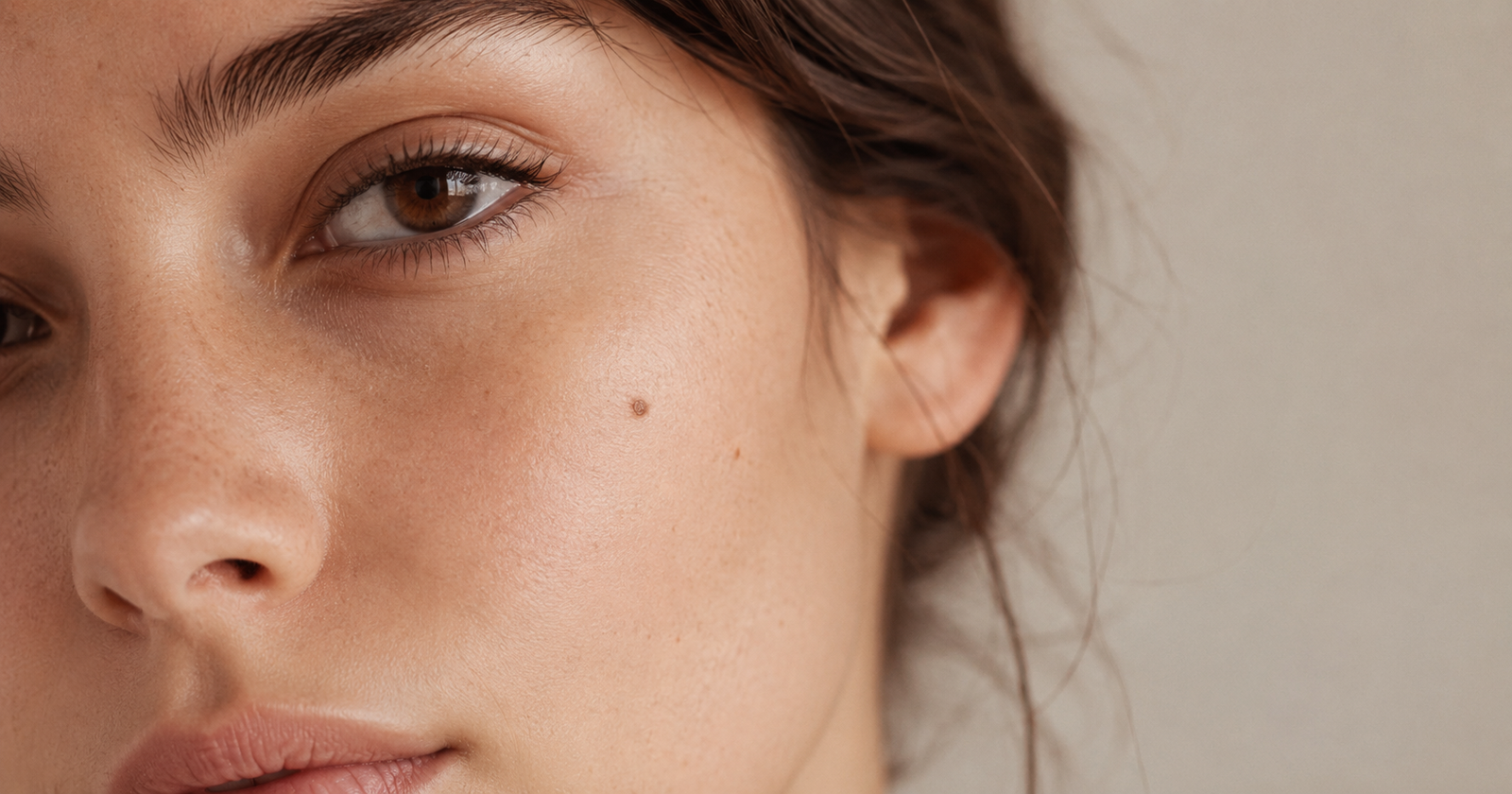
No. Biologically, they are the same growth — what dermatologists call a melanocytic nevus (plural: nevi). A nevus is a cluster of melanocytes, the pigment-producing cells in your skin. When these cells grow in a defined cluster instead of spreading evenly, they create a darker, often slightly raised spot.
Whether that spot gets called a "beauty mark" or a "mole" comes down to four cultural factors:
- Size — Small (under 5 mm) leans "beauty mark." Larger leans "mole."
- Color uniformity — A single solid brown or near-black color leans "beauty mark." Mixed or fading colors lean "mole."
- Location — Upper cheek, above the lip, near the eye, chin — these positions have historically been considered flattering. The same spot on the back or arm rarely gets the romantic label.
- Definition — Crisp edges and round shape lean "beauty mark." Irregular borders lean "mole."
Marilyn Monroe, Cindy Crawford, Madonna, Eva Mendes, and Enrique Iglesias all became famous for the same thing: a small, defined, well-placed mole that fits the cultural template of a "beauty mark." Crawford's, on the upper left lip area, is the textbook example.
Where beauty marks usually appear
Beauty marks can technically appear anywhere on the body, but the spots culturally celebrated as "beauty marks" cluster in predictable face locations:
| Location | Why it became associated with beauty |
|---|---|
| Upper lip area | Most iconic in modern beauty history (Monroe, Crawford). Draws the eye to the mouth. |
| Upper cheekbone | Considered to flatter the cheekbone structure. Common in European court portraits from the 1600s–1700s. |
| Below the eye | Sometimes called a "tear-drop" mark. Considered alluring in many cultures. |
| Chin | Draws attention to the lower face. Less common in modern beauty ideals but historically significant. |
| Forehead (between brows) | Associated with marks worn or drawn on the forehead in South Asian and Eastern European traditions. Usually intentional, not natural. |
A mole in any of these locations is more likely to be called a "beauty mark." The same mole on the neck, ear, scalp, back, or limb usually doesn't get the romantic label, even though biologically it's identical.
A brief history of the beauty mark
The cultural fixation isn't new. In 17th and 18th century European courts, a fashion called mouches (French for "flies") had aristocrats applying tiny black silk patches to their faces — sometimes shaped like stars, hearts, or crescents. The placement carried coded meaning. A patch near the lip was flirtatious. Near the eye was passionate. Each position had a name.
These artificial beauty marks signaled status (you had time to fuss over your face) and serviced a practical purpose: they covered smallpox scars during outbreaks.
In mid-20th century Hollywood, the natural beauty mark became iconic again. Marilyn Monroe didn't have a mark on her upper lip in every photograph — some sources note she enhanced or moved it depending on the shoot. Cindy Crawford was famously advised early in her career to remove hers; she refused, and it became her signature.
None of this changes the biology. Cultural beauty marks are moles that won the location lottery.
Beauty marks vs freckles vs age spots
Three things commonly get confused with beauty marks. They are not the same.
Freckles
- What they are: Flat clusters of melanin produced in response to UV exposure.
- How they behave: Appear and darken in summer, often fade in winter. Cluster in groups (cheeks, nose, shoulders).
- How to tell them apart: Freckles are flat, light brown to tan, irregular in border, and appear in groups.
Age spots (solar lentigines)
- What they are: Flat patches of pigmentation caused by long-term sun exposure, typically appearing after age 40.
- How they behave: Stay flat, gradually darken with continued sun exposure, appear on sun-exposed areas.
- How to tell them apart: Larger and more diffuse than beauty marks, often irregularly shaped, light brown to tan, never raised.
Moles (nevi)
- What they are: Same as beauty marks. Defined clusters of melanocytes.
- How they behave: Stable for years to decades. Can be flat or slightly raised.
- How to tell them apart from freckles: Single defined spot, year-round, often slightly raised or thicker.
You can have all three on the same face — a few freckles across the nose, a beauty mark on the cheek, an age spot near the temple. They coexist comfortably.
When a mole becomes a medical concern: the ABCDE signs
This is the part that genuinely matters. Most moles stay benign for life. But melanoma — a serious skin cancer — often appears either as a new dark spot or as a change in an existing mole. Dermatologists teach a five-letter shorthand for what to look for.
The ABCDE rule: if any of these apply to a mole, see a dermatologist. Not next month — within a few weeks.
A — Asymmetry
Mentally divide the mole in half. The two halves should look like mirror images. If one half is noticeably different in shape from the other, that's a warning sign. Benign moles are usually symmetric.
B — Border irregularity
Healthy moles have smooth, defined borders. Worrying moles have edges that look jagged, blurred, notched, or scalloped. If you can't trace a clean outline around the mole, that's the warning.
C — Color variation
A normal mole is one fairly even color throughout — brown, black, or tan. Concerning moles show multiple shades within a single growth: tan plus dark brown plus black, or a pink/red component, or pale areas. Color variation is one of the strongest melanoma signals.
D — Diameter
Moles larger than 6 millimeters in diameter (about the size of a pencil eraser) deserve closer attention. This isn't an absolute rule — small melanomas exist — but combined with other ABCDE signs, larger size raises concern.
E — Evolution
The most important sign. Any mole that is changing — growing larger, changing color, becoming raised when it was flat, itching, bleeding, scabbing without healing, or feeling different — needs evaluation. Stable moles are reassuring. Changing moles are not.
Take a phone photo of any mole you're watching, with a coin or ruler beside it for scale. Re-photograph every 2–3 months from the same angle and lighting. Side-by-side comparison catches slow changes your eyes miss.
The "ugly duckling" test
This is a useful concept dermatologists rely on. Look at all your moles together. Most adults have somewhere between 10 and 40 moles, and on any given person, they tend to look similar to each other — similar size, similar color, similar shape. They are siblings.
The "ugly duckling" is the one that doesn't fit the pattern. If 30 of your moles are small, round, and medium brown, and one is larger, oddly shaped, and a different color, that one deserves attention even if it doesn't perfectly match the ABCDE rule.
This is part of why annual skin checks are useful: a professional can compare your moles to each other and catch the one that looks different.
When you should NOT worry
To balance the above — most moles are completely fine and stay fine. The reassuring signs:
- The mole has looked the same for years. Stable is good.
- It's symmetric, evenly colored, and has smooth borders. No ABCDE flags.
- It matches your other moles in size and appearance. Not an ugly duckling.
- It doesn't itch, bleed, or change. Quiet is good.
- You've had it since childhood. Most childhood moles never become problematic.
A small, defined, even-colored mole on your upper cheek that has been there as long as you can remember and hasn't changed is overwhelmingly likely to be exactly what it appears to be — a beauty mark, in the cultural sense, and a benign nevus, in the medical sense.
Should you remove a beauty mark?
Three reasons people consider mole removal:
1. Medical concern
If a dermatologist has flagged a mole as suspicious or wants a biopsy, removal is medical, not cosmetic, and follows a specific protocol (excisional or shave biopsy depending on the mole).
2. Functional discomfort
A raised mole in a location where it catches on clothing, gets nicked while shaving, or rubs uncomfortably can be removed for practical reasons. This is also medical — most insurance covers it when the mole causes documented irritation.
3. Cosmetic preference
Some people don't like the appearance of a particular mole and choose elective removal. This is a personal call, and a dermatologist can do it safely.
Never use DIY mole removal products. Creams, "natural" removal kits, and at-home freezing methods are dangerous for two reasons: they can cause severe scarring and infection, and they destroy the mole tissue without allowing it to be examined. If that mole was an early-stage melanoma, you've eliminated the only evidence while potentially leaving cancer cells deeper in the skin. Mole removal is a 15-minute in-office procedure with a dermatologist. It's not worth the risk to do it at home.
When to book the dermatologist visit
Three rules of thumb:
- Any single mole with an ABCDE warning sign. Within a few weeks, not "eventually."
- A baseline skin check at least once. If you've never had a full-body skin check, schedule one. They take about 15 minutes. The dermatologist maps your moles and notes any that look unusual. Future visits compare against this baseline.
- Annual checks if you're high-risk. Higher risk includes: many moles (50+), fair skin, history of bad sunburns (especially in childhood), family history of melanoma, immunosuppression, or any past skin cancer.
Most adults benefit from annual checks regardless of risk level. The exam is painless, fast, and the most reliable early detection method for skin cancer.
The bottom line: A "beauty mark" is a culturally flattering mole. The biology is identical. What separates a charming beauty mark from a medical concern isn't the location or the romantic name — it's whether the mole shows any ABCDE warning sign, looks different from your other moles, or has changed in any way you can document. If it has, see a dermatologist. If it hasn't, enjoy your beauty mark and keep an eye on it during the once-a-year skin check that every adult should be doing anyway.