Understanding the scope: MENA is not one culture
The "Middle East" or "MENA" (Middle East and North Africa) region typically encompasses:
- The Levant — Lebanon, Syria, Jordan, Palestine, Israel
- The Gulf — Saudi Arabia, United Arab Emirates, Qatar, Kuwait, Bahrain, Oman, Yemen
- Egypt — Sometimes grouped with Levant, sometimes with North Africa
- Iraq — Sometimes grouped with Levant, sometimes separately
- North Africa — Morocco, Algeria, Tunisia, Libya (the Maghreb)
- Iran — Persian rather than Arab, distinct civilization
- Turkey — Turkic rather than Arab, secular republic historically
- Sometimes included: Afghanistan, various Central Asian countries
The diversity that matters
The region contains fundamental distinctions that beauty industry marketing often obscures:
- Ethnic diversity — Arabs, Persians (Iranians), Turks, Kurds, Berbers/Amazigh, Assyrians, Armenians, and many other groups
- Linguistic diversity — Arabic (with distinct regional dialects), Persian (Farsi), Turkish, Kurdish, Berber languages, Hebrew, and others
- Religious diversity — Majority Muslim across most countries (Sunni and Shia varying by country), with substantial Christian populations (especially Lebanon, Egypt, Syria), Jewish (majority in Israel), Druze, Yazidi, Baha'i, Zoroastrian, and other minority traditions
- National distinctions — Different colonial histories, different political systems, different degrees of economic development
The Arab-Persian-Turkish distinction
The three largest cultural spheres in the region deserve specific distinction:
- Arab cultures — Share Arabic language and substantial cultural overlap across the Levant, Gulf, Egypt, and North Africa (though North Africa also has substantial Berber influence). Beauty traditions with strong regional variations but common threads.
- Persian culture (Iran) — Persian language (Farsi), distinct civilization dating to ancient Persia, distinct beauty tradition. Historically Zoroastrian, now majority Shia Muslim. Not Arab.
- Turkish culture — Turkic language family, Ottoman Empire heritage, secular republic since 1923. Distinct from Arab tradition. Includes substantial Kurdish and other minority populations.
Grouping these as "Middle Eastern" flattens substantial differences. Contemporary beauty industry has been slowly learning to distinguish rather than group.
Ancient roots: Egyptian, Persian, and Mesopotamian traditions
The region hosts some of the oldest continuous beauty traditions documented anywhere on earth.
Ancient Egyptian beauty
Ancient Egyptian beauty practices are perhaps the most influential and best-documented ancient tradition globally. Archaeological evidence documents extensive practice starting at least 4,000 years ago:
- Kohl eyeliner — Ground galena (lead-based mineral) applied to define the eyes. Both practical (thought to protect against sun glare and infection) and aesthetic. Perhaps the oldest continuous eye cosmetic tradition documented.
- Green eye pigment — Malachite-based green pigment used on upper eyelids, particularly in earlier periods.
- Wigs and hair adornment — Elaborate wig culture across social classes. Heads often shaved and wigs worn.
- Perfumes and oils — Extensive fragrance industry using local and imported materials. Cones of perfumed fat worn on wigs to release fragrance as they melted.
- Nail treatments — Henna staining and other nail decoration.
- Skin oils — Extensive use of oils for skin care in the desert climate.
- Body hair removal — Documented practice using sugar-and-lemon paste (still used today as "sugaring").
- Bathing culture — Ritual and social bathing practices.
Cleopatra VII (69-30 BCE) has become the archetypal figure representing Egyptian beauty, though her actual image is heavily reconstructed through Roman and Greek accounts. The Cleopatra of popular imagination reflects Roman rather than ancient Egyptian beauty ideals in many respects.
Persian beauty heritage
Persian civilization developed distinct beauty traditions:
- Elaborate hair traditions — Long, styled hair as central beauty feature
- Beard traditions — Male beauty emphasizing well-groomed beards
- Rosewater tradition — Persian innovation in rosewater production and use, still central to regional beauty
- Persian miniature painting — Visual documentation of Persian beauty ideals: arched brows meeting at the center (unibrow historically valued), almond eyes, small mouths, oval faces
- Perfume culture — Persian traditions of perfumery, including work with attar (concentrated oils)
- Kajal/surma — Persian version of kohl eye makeup
- Persian garden aesthetics — The chahar bagh (four-part garden) tradition shaped Persian aesthetic sensibility broadly
Mesopotamian traditions
The civilizations of ancient Mesopotamia (what's now Iraq, parts of Syria, Iran) contributed:
- Early cosmetic and perfume industry
- Elaborate jewelry traditions (Ur, Assyrian, Babylonian)
- Hair styling and beard grooming (particularly Assyrian elaborate beards)
- The oldest known perfume-making documentation, credited to Tapputi (Babylonian, ~1200 BCE, often called the world's first documented chemist)
The Ottoman period
Ottoman Empire beauty culture (roughly 1299-1922) developed substantial traditions:
- Hammam (bath) culture — Elaborate public and private bath traditions with beauty rituals
- Elaborate hair and jewelry — Ottoman miniature painting documents beauty ideals
- Substantial cosmetic industry — Court beauty preparation and consumer market
- Coffee's introduction to beauty — Ottoman coffee culture had beauty dimensions (coffee grounds as scrub tradition)
The Islamic beauty framework
Islamic religious tradition provides frameworks for beauty and adornment that shape practice across Muslim-majority countries in the region (which is most, though not all).
Zeenah: the concept of adornment
The Arabic word زينة (zeenah) refers to adornment and beautification. Islamic sources treat physical adornment positively within specific frameworks:
- Personal grooming and cleanliness are religiously encouraged
- Perfume use is sunnah (recommended prophetic practice)
- Attention to appearance in appropriate contexts is valued
- Adornment for spouse and appropriate audiences is encouraged
Modesty considerations
Islamic frameworks also emphasize modesty (haya, hijab as concept), with substantial interpretation variation:
- Some traditions emphasize adornment as private, for family and specific audiences
- Others integrate modesty with visible adornment (elaborate hijab styling, visible makeup for face)
- Practice varies enormously across schools of thought, cultural contexts, and individual interpretation
Prophetic tradition on grooming
Hadith (recorded prophetic tradition) includes substantial material on personal care:
- Regular use of miswak (natural toothbrush from Salvadora persica tree)
- Use of kohl/kuhl for eye care and beauty
- Beard grooming for men
- Hair care and coloring (henna specifically encouraged)
- Perfume use
- Fingernail trimming and grooming
- Bathing practices connected to prayer
Wudu and physical care
Ritual purification (wudu) before prayer includes washing face, hands, arms, and feet. This regular practice — performed multiple times daily by observant Muslims — has connections to skin care and hygiene culture across the region.
The framework's flexibility
Islamic beauty framework isn't monolithic. Contemporary Muslim women interpret and practice within it in enormously varied ways — from very traditional interpretations to progressive integrations with contemporary beauty and fashion. The "modest fashion" industry (see contemporary shifts section) represents one substantial contemporary interpretation.
Regional and country-by-country distinctives
Iran (Persian)
Iranian beauty culture blends Persian classical heritage with contemporary complexities:
- Persian classical beauty ideals emphasize refined features, arched brows, defined but understated makeup
- Contemporary Iran has the world's highest per capita rate of rhinoplasty
- Post-1979 revolution required hijab has complicated relationships with visible beauty
- Substantial makeup skill developed despite/because of restrictions on other visible expression
- Persian cinema historically strong in showcasing distinct Iranian beauty (Golshifteh Farahani, others)
- The Woman Life Freedom movement (following Mahsa Amini's death in September 2022) has created substantial cultural moment around beauty, hijab, and women's rights
Turkey
Turkish beauty culture blends Ottoman heritage with contemporary secular republic context:
- Global capital of hair transplantation (medical tourism industry substantial)
- Substantial cosmetic surgery destination
- Turkish soap operas ("dizi") export Turkish beauty ideals across the region and beyond
- Distinct Turkish beauty pageant history (Miss Turkey substantial)
- Contemporary Turkey blends European-influenced modernity with more traditional practices depending on class and region
- Hammam (Turkish bath) tradition remains substantial
Lebanon
Lebanese beauty culture has historically been influential across the Arab world:
- Beirut historically called the "Paris of the Middle East"
- Substantial cosmetic surgery culture
- Strong beauty industry despite country's political and economic challenges
- Christian, Muslim (Sunni and Shia), and Druze diversity produces distinct traditions
- Lebanese diaspora spreads beauty influence globally
- Lebanese singers (Nancy Ajram, Elissa, others) influential in setting regional beauty trends
- Substantial fashion and beauty entrepreneurship
Saudi Arabia
Saudi Arabian beauty culture operates within strict traditional Islamic frameworks that are undergoing substantial change:
- Traditional public modesty requirements affect visible beauty expression
- Elaborate private beauty tradition, particularly for family and wedding contexts
- Substantial cosmetic surgery culture despite conservative public frameworks
- Vision 2030 modernization program has substantially opened cultural landscape
- Growing beauty industry with international brand presence
- Distinct wedding beauty tradition with elaborate preparation
- Strong fragrance culture (oud particularly)
United Arab Emirates (Dubai particularly)
UAE has become a global beauty destination:
- Dubai as international luxury beauty market
- Multi-national population produces mixed traditions
- Substantial spa and wellness industry
- Cosmetic procedures normalized and widely available
- Home base for Huda Beauty and other regional beauty entrepreneurship
- Extensive luxury fragrance market
- Growing tech-integrated beauty (AI, personalization)
Egypt
Egyptian beauty culture connects ancient heritage with contemporary practice:
- Enormous ancient beauty heritage that influences contemporary culture
- Egyptian film industry ("Egyptian Hollywood") historically shaped regional beauty ideals
- Umm Kulthum (1898-1975) and other iconic figures shaped mid-20th century beauty
- Substantial contemporary beauty industry
- Distinct beauty traditions with regional variations (Cairo, Alexandria, Upper Egypt, Sinai)
- Coptic Christian traditions alongside Muslim majority
- Complex hijab practice varying across social groups
Morocco and the Maghreb
North African beauty traditions blend Arab and Berber (Amazigh) heritage:
- Argan oil tradition — the oil derived from argan trees native to Morocco has become globally recognized in beauty industry
- Berber/Amazigh distinct beauty traditions with substantial tattooing history (particularly facial tattoos, now largely discontinued)
- Distinctive hammam culture with rassoul clay tradition and black soap (savon noir)
- Henna traditions varying by region
- Rosewater tradition (particularly Rose Valley in Morocco)
- Amber, musk, and complex fragrance traditions
- Distinctive traditional dress and adornment
Israel
Israeli beauty culture is complex given the country's population diversity:
- Jewish population from enormously diverse origins (Ashkenazi European, Mizrahi Middle Eastern and North African, Sephardic Iberian, Ethiopian, and others)
- Arab-Israeli population maintaining distinct traditions
- Druze and Bedouin populations with distinct practices
- Substantial beauty industry
- Both Middle Eastern and Western influences prominent
- International models (Bar Refaeli, Gal Gadot, others)
Palestine
Palestinian beauty tradition maintains cultural identity under difficult political conditions:
- Traditional tatreez embroidery as cultural identity marker
- Beauty as cultural resistance
- Distinct wedding traditions
- Diaspora Palestinian communities maintaining traditions globally
- Gigi and Bella Hadid (Palestinian-Dutch-American) as internationally recognized figures
The fragrance tradition: oud, rose, and attars
Middle Eastern fragrance culture is among the most sophisticated and historically continuous in the world.
The importance of fragrance
Fragrance holds cultural significance across the region beyond aesthetic:
- Religious significance in Islamic tradition (sunnah practice)
- Hospitality — offering fragrance to guests is traditional
- Personal signature — many people identify with specific perfumes over years
- Layering culture — multiple fragrances used together
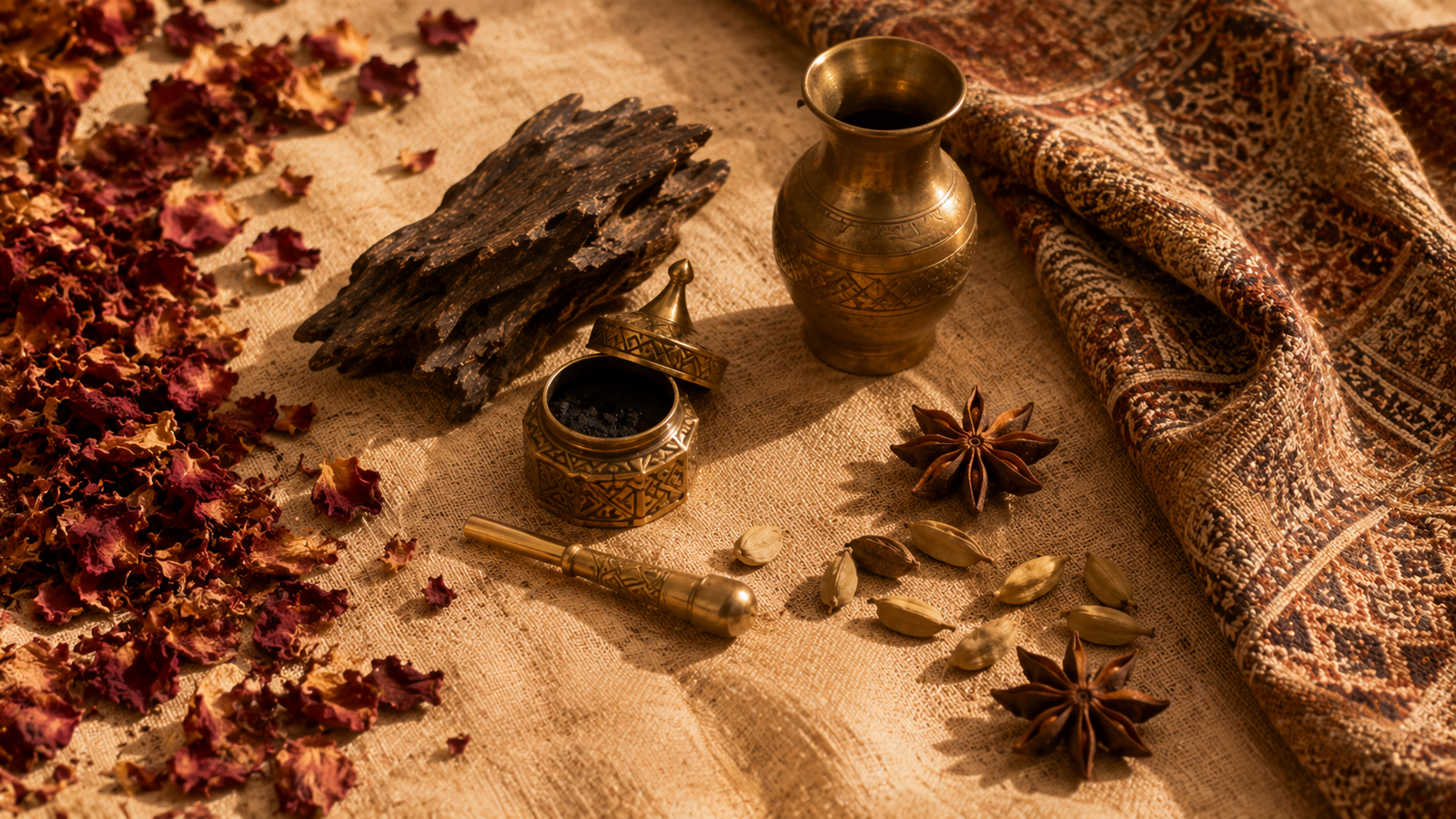
- Household perfuming — bakhoor (incense) scenting homes and clothes
Oud (agarwood)
Oud is central to Gulf state perfumery particularly:
- Origin — Fragrant resinous wood produced when Aquilaria trees become infected with a specific mold; the tree's response produces the aromatic resin
- Traditional uses — Burning oud chips as bakhoor (incense), oud oil as attar (concentrated perfume oil), oud as base note in perfume compositions
- Value — Among the most valuable natural fragrance ingredients globally, with premium oud oil reaching thousands of dollars per ounce
- Wild vs. cultivated — Wild oud is now rare due to overexploitation; substantial cultivation industry has developed
- Global influence — Oud has entered global luxury perfumery over the past two decades, with major Western brands (Tom Ford, Yves Saint Laurent, Creed, Maison Francis Kurkdjian, and many others) incorporating oud
Rose
Rose has extensive tradition across the region:
- Persian rose culture — Traditional rosewater production, particularly in the Kashan region of Iran
- Rose Valley (Morocco) — Kelâat M'Gouna rose festival annually celebrates rose harvest
- Damask rose — Rosa damascena central to Middle Eastern perfumery
- Uses — Rosewater for cooking, drinking, skincare; rose oil (attar) for perfumery; rose petals in food and beauty preparations
- Global influence — Middle Eastern rose extraction techniques influence global perfumery
Attar (Ittar)
Attar refers to natural concentrated perfume oils, traditionally produced through hydrodistillation:
- Concentrated form requires only small amounts applied to pulse points
- Rose attar, sandalwood attar, oud attar, jasmine attar, and many others
- Traditional attars are alcohol-free, making them permissible in Islamic contexts
- Some attars age like fine wines, becoming more valuable over time
Bakhoor
Bakhoor refers to scented wood chips burned to release fragrance:
- Traditional oud bakhoor most valued
- Complex blends of resins, oils, and aromatic materials
- Used to scent clothes, hair, and homes
- Central to hospitality tradition (guests scented at arrival or departure)
The layering tradition
Middle Eastern fragrance culture emphasizes layering — using multiple fragrances together rather than single-scent application. Body oil first, then attar, then perhaps sprayed perfume, plus bakhoor for hair and clothes. The composite creates complex, lasting scent presence.
Kohl and eye makeup heritage
Kohl (Arabic: كحل, also called kajal in Persian and South Asian traditions, surma in some contexts) is among the oldest continuous beauty practices in human history.
Ancient origins
Kohl use is documented archaeologically from at least 4,000 years ago in Egypt and shortly after in Mesopotamia. The practice may be older than documentation shows. Traditional formulations vary:
- Egyptian kohl often included galena (lead sulfide) ground to fine powder
- Some traditions used antimony sulfide (stibnite)
- Additives included various oils, ash, botanical materials
- Preparation was often ceremonial and specialized
Traditional purposes
Kohl served multiple functions historically:
- Aesthetic — Defining and darkening eyes
- Practical — Thought to protect against sun glare (function has been debated by modern science)
- Medical — Traditionally believed to protect against eye infections and improve eye health
- Spiritual — Protection from the evil eye (nazar/ayn)
- Religious — Islamic sunnah practice (particularly ithmid kohl)
Contemporary kohl
Contemporary kohl products vary widely:
- Traditional lead-based kohl — Still available in some markets but raises substantial safety concerns due to lead toxicity, particularly for children
- Modern cosmetic industry kohl — Uses safer synthetic pigments, often black carbon or iron oxides
- Ithmid kohl — Antimony-based traditional kohl considered by some Islamic sources as the specific type mentioned in prophetic tradition
- Herbal kohl — Various botanical-based formulations
Eye makeup style variations
Middle Eastern eye makeup emphasizes eyes as central beauty feature:
- Winged liner — Extended eye definition, varying from subtle to dramatic
- Waterline application — Kohl applied inside the lower lash line
- Smokey styles — Blended shadow around the eye
- Defined brows — Strong brow shaping and definition
- Full lashes — Emphasis on visible lashes, often with false lashes for occasions
Regional variations create distinct looks — Egyptian classical style differs from Gulf contemporary style differs from Iranian aesthetic differs from Turkish traditional.
Cosmetic surgery culture and hair transplant tourism
Several Middle Eastern countries have become substantial cosmetic surgery and medical tourism destinations.
Iran and rhinoplasty
Iran has the world's highest per capita rate of rhinoplasty (nose reshaping):
- Estimated rates several times higher than United States per capita
- The procedure normalized across gender lines (though higher in women)
- Cultural factors include: Persian classical preferences for refined features, contemporary appearance emphasis in society, well-developed medical infrastructure
- The visible bandaged nose during recovery becomes something of a status marker
- The phenomenon has been analyzed extensively in academic and journalistic contexts
- Debate exists about whether the trend reflects cultural preference or Western beauty standard adoption
Turkey and hair transplantation
Turkey has become the global capital of hair transplantation:
- Estimated ~1 million procedures annually
- Substantial medical tourism industry particularly serving male hair loss
- Istanbul, Ankara, and Izmir as main destinations
- Costs typically 60-80% less than equivalent procedures in Western Europe or United States
- Quality varies enormously — established clinics generally excellent, but budget operators have quality concerns
- The FUE (follicular unit extraction) technique widely practiced
Lebanon and cosmetic surgery
Lebanon has substantial cosmetic surgery culture:
- Beirut historically an aesthetic surgery destination
- Wide range of procedures normalized
- Political and economic difficulties have complicated the industry
- Substantial physician training tradition
UAE and medical tourism
UAE has developed substantial medical tourism:
- Dubai particularly as luxury medical destination
- International-standard facilities
- Cosmetic procedures normalized
- Serves regional and international clientele
The critique
Cosmetic surgery culture in the region faces multiple critiques:
- Pressures particularly on young women to undergo procedures
- Safety concerns with unregulated providers, particularly for medical tourism
- Cultural questions about whether procedures reflect authentic preference or Western beauty standard adoption
- Economic dimensions — procedures accessible primarily to those with substantial resources
- Feminist critique of appearance pressures
Contemporary shifts and the modern beauty industry
Middle Eastern beauty entrepreneurship
Middle Eastern beauty entrepreneurship has reached global scale in recent years:
- Huda Beauty — Founded by Iraqi-American Huda Kattan in 2013 from Dubai, has become one of the most commercially successful beauty brands founded by a Middle Eastern entrepreneur. Valued at over $1 billion. Distributed globally through Sephora and major retailers. Kattan sisters Alya and Mona Kattan (Kayali Fragrances) have built the business.
- Kayali — Mona Kattan's fragrance brand, honoring Middle Eastern fragrance traditions with contemporary luxury positioning
- Various regional brands — Ounass, Namshi, Shukr, and others building substantial businesses
The modest fashion industry
Modest fashion has emerged as major global industry:
- Estimated at approximately $300+ billion globally
- Includes hijab fashion, modest swimwear, elegant covered dressing
- Major fashion houses have entered the space
- Global influencers ("hijabistas") have built substantial platforms
- Combines religious/cultural observance with fashion expression
- Dolce & Gabbana, Uniqlo, Nike, and various luxury brands have offered modest fashion lines
Instagram and TikTok influence
Social media has enabled substantial Middle Eastern beauty influence globally:
- Regional influencers reaching global audiences
- Specific "Arab girl" aesthetic patterns entering global mainstream (contoured face, defined brows, dramatic eyes)
- Modest fashion content creators building substantial followings
- Regional beauty brands using social media for direct global distribution
Political and cultural shifts
The Woman, Life, Freedom movement (Iran) — Following Mahsa (Jina) Amini's death in September 2022 after being detained by morality police for allegedly improper hijab, substantial protests emerged across Iran and internationally. The movement has centered women's rights broadly and challenged mandatory hijab. Beauty, hair, and appearance have become sites of political expression — public appearance without hijab as protest. The movement has evolved through phases and faces continued government suppression while remaining culturally significant.
Saudi Vision 2030 — Saudi Arabia's modernization program has substantially opened cultural landscape, allowing entertainment, women driving, cinema, and expanded beauty industry. The changes have real limits (political criticism remains dangerous) but represent substantial cultural shift.
Diaspora and cultural exchange — Middle Eastern diaspora communities globally maintain and evolve traditions, influencing beauty in host countries while being influenced by them.
Contemporary regional beauty preferences
Some contemporary Middle Eastern beauty preferences documented in beauty industry research:
- Emphasis on radiant, glowing skin
- Substantial contour and highlight in makeup
- Defined brows
- Dramatic eyes with heavy lashes
- Full lips valued
- Bronzed rather than pale complexion often preferred (contrasting with East Asian mainstream preference for pale)
- Long, styled hair (whether visible or concealed under hijab)
- Substantial fragrance layering
The ongoing complexity
Contemporary Middle Eastern beauty exists at multiple intersections:
- Ancient traditions with contemporary practice
- Islamic frameworks with individual interpretation
- Regional identity with global integration
- Traditional preferences with beauty industry marketing
- Political constraints with creative expression
The region is neither the exotic "harem" imagination of Orientalist Western fantasy nor a monolithic religious constraint that Western media sometimes portrays. It's diverse, contested, evolving, and connected to global beauty culture while maintaining substantial distinctive traditions.
The bottom line: Middle Eastern beauty standards vary enormously across the region's Arab, Persian, Turkish, and Berber cultures, spanning from Morocco to Iran. Ancient roots include Egyptian beauty tradition (kohl eyeliner dating back 4,000+ years, henna body art, elaborate wig culture), Persian civilization's contribution (rosewater tradition, elaborate hair, refined features aesthetic), and Mesopotamian innovations (Tapputi, ~1200 BCE, credited as world's first documented chemist through perfumery). Islamic frameworks emphasize both adornment (zeenah) and modesty with varying interpretations. The region hosts extraordinary fragrance culture — oud (agarwood) central to Gulf perfumery, rose traditions across Persian and Moroccan cultures, attar (concentrated oils), bakhoor (incense), and layering traditions. Country distinctives include Iran's world-leading rhinoplasty rate, Turkey as hair transplant capital (~1 million procedures annually), Lebanon's substantial beauty industry, UAE as global beauty destination, Egypt's ancient heritage plus contemporary film industry influence, and Morocco's argan oil and hammam traditions. Middle Eastern beauty entrepreneurship reached global scale through Huda Kattan's Iraqi-American founded Huda Beauty (2013, from Dubai, $1 billion+ valuation) and Kayali fragrances. Contemporary shifts include the ~$300+ billion modest fashion industry, Iran's Woman Life Freedom movement (following Mahsa Amini's 2022 death), Saudi Vision 2030 opening, and growing regional beauty industry. Global beauty industry has slowly moved from flattening "Middle Eastern beauty" as one thing to recognizing the region's substantial diversity — though the flattening still persists in much mainstream coverage.