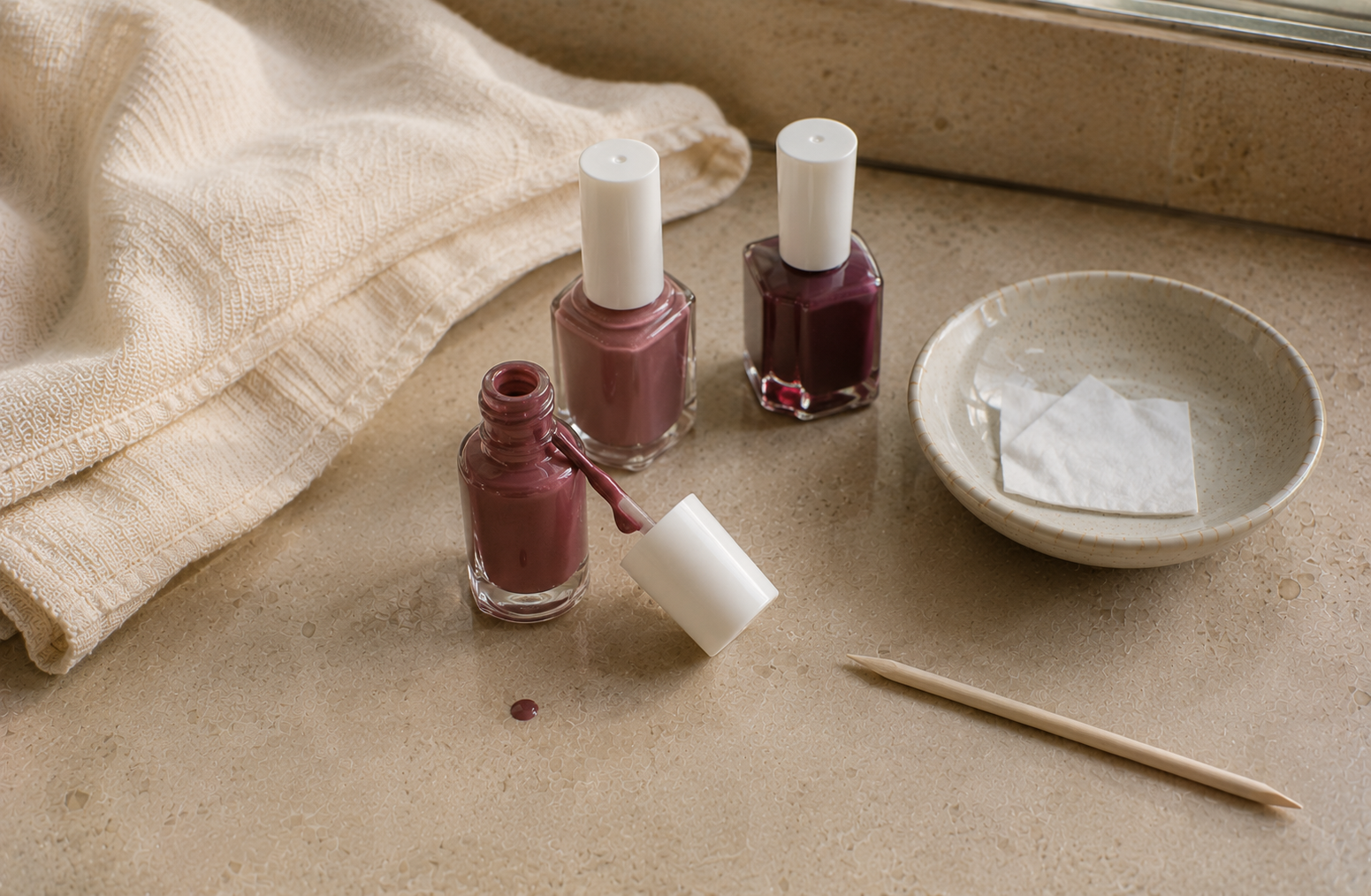
Why nail polish chips so quickly
Understanding why polish fails helps you choose products and techniques that prevent it. Regular nail polish chips for specific reasons — most of them addressable.
The chemistry problem
Regular nail polish is essentially pigmented solvent that dries through evaporation. The film it leaves behind is flexible but not particularly hard — it has to flex with your nail as it bends throughout the day. Each time the nail flexes, microscopic cracks develop in the polish film. Over days, these cracks accumulate until visible chips appear.
Gel polish is different — it cures under UV/LED light into a hard cross-linked polymer. The chemistry creates a much stronger, more rigid film that resists chipping for 2–3 weeks. The trade-off is the need for UV exposure and acetone soak-off removal.
Where chips actually start
Chips almost always begin at one of three weak points:
- The free edge (tip) — the most common chip origin. The tip experiences the most mechanical stress and is often where polish is thinnest.
- The cuticle line — particularly if polish touched the cuticle during application; this creates a weak adhesion point
- The sidewalls — where the nail meets the skin fold on the sides
Once a chip starts at any of these points, the polish edge becomes exposed to daily friction and the chip enlarges quickly.
What accelerates chipping
- Polish applied too thick — thick layers don't dry uniformly and develop more internal stress
- Polish applied to skin or cuticle — fails to bond properly
- Applied to oily or moisturized nails — adhesion is poor
- Insufficient drying time between coats — layers don't bond properly
- Hot water exposure soon after application — softens polish before it's fully cured
- No top coat or low-quality top coat — leaves polish vulnerable
- Hand usage patterns — typing, manual work, frequent washing all stress polish
Most polish failures are technique problems, not product problems. The same $8 drugstore long-wear polish applied correctly will outperform a $25 luxury polish applied carelessly. Mastering the technique below is more impactful than upgrading to expensive products.
The technique that doubles wear time
The full method, in order. Each step matters. Skipping any of them significantly reduces wear time.
Step 1: Prep the nail surface
- Push back cuticles gently (no cutting)
- Use a fine-grit nail file or gentle buffer to lightly remove the shine from the nail surface — this gives polish something to grip
- Wipe nails with rubbing alcohol or nail polish remover to remove all oils — even natural skin oil prevents adhesion
- Do not apply cuticle oil or hand cream before polish — they actively prevent bonding
This prep takes 2–3 minutes and dramatically improves how long polish lasts. The clean dry nail is the foundation of long wear.
Step 2: Apply a quality base coat
The base coat does three things: protects the nail from staining, creates a smooth surface, and improves polish adhesion. Don't skip it.
- One thin coat across all nails
- Allow 60 seconds drying time before color
- Cap the free edge — run the brush across the very tip of the nail
Step 3: Apply color in thin coats
This is the most-violated rule. Most people apply polish too thickly, thinking one thick coat will be enough. Thick coats:
- Take much longer to dry
- Don't dry uniformly (skin forms on the surface while inside is still wet)
- Develop bubbles, streaks, and brush strokes
- Chip much faster
The proper technique:
- Wipe the brush against the bottle rim to remove excess polish
- Apply in 3 strokes: one down the center, one on each side
- The coat should be thin enough that you can see slight transparency on the first coat
- Wait 90 seconds before the second coat
- Second coat is when the color builds to opacity
- If still streaky, a thin third coat — but never a thick second coat
Step 4: Cap every layer
"Capping" — running the brush across the very tip of the nail at the end of each coat — is the single most important technique for extending wear time. The free edge is where chips start; sealing it with every layer creates significantly more protection.
- After each coat (base, each color coat, top coat), brush across the tip
- The polish should wrap slightly around the edge
- This adds a protective layer at the weakest point
Step 5: Quality fast-drying top coat
The most underrated product in nail care. A good top coat:
- Seals the color polish
- Adds significant chip protection
- Creates the high shine
- Speeds drying time
Apply 60–90 seconds after the final color coat. One generous coat, capping the edge. Specific recommendations in the top coat section below.
Step 6: Full drying time
This is where many manicures fail. Polish feels dry to the touch within minutes but takes much longer to fully cure throughout:
- 15 minutes: dry to the touch; can move carefully
- 30 minutes: dry enough for light activity
- 1 hour: reasonably durable
- 2 hours: fully cured
The first hour matters most. Any heavy hand use, hot water exposure, or pressure during that hour creates dents and weakens the polish film. Plan to apply polish when you don't need full hand use for at least an hour afterward.
Step 7: Reapply top coat every 2–3 days
This is what professional manicurists call "maintenance top coat" — and it's the secret to long-wear that lasts. Reapplying top coat every 2–3 days:
- Reseals any micro-damage that occurred
- Restores the protective layer
- Brings back shine
- Caps the free edge with fresh product
This single habit can extend polish wear from 4–5 days to 8–10 days for many people. Takes 90 seconds total.
If you only adopt three changes from this list: apply polish in thinner coats, cap the free edge with every layer, and reapply top coat every 2–3 days. These three changes alone will roughly double your polish wear time without any product upgrades.
Best long-wearing formulas by category
Formulas that have proven their longevity claims over years of real-world use.
Long-wear regular polish (best balance)
| Product | Price tier | Standout qualities |
|---|---|---|
| Essie Gel Couture | Mid-range (~$10) | Built-in long-wear technology; pair with their top coat for best results; widely considered the most reliable mass-market long-wear formula |
| Sally Hansen Miracle Gel | Drugstore (~$9) | True 2-step system (color + special top coat); no UV needed; lasts 7–10 days for most users |
| OPI Infinite Shine | Mid-range (~$13) | 3-step system (base + color + top); excellent shine; salon-quality results |
| Revlon ColorStay Gel Envy | Drugstore (~$8) | Built-in base coat; affordable; reliable 7-day wear |
| CND Vinylux | Salon (~$13) | UV-light-free salon long-wear; activates with natural light over time; lasts up to 7 days |
Premium long-wear options
- Dior Vernis — luxury formula with built-in long-wear technology; expensive but excellent application experience
- Chanel Le Vernis Longue Tenue — Chanel's long-wear formula; beautiful brush, good wear
- Tom Ford Nail Lacquer — high-end formula with luxury packaging; wear time comparable to mid-range options
Independent and niche brands
- Olive & June — newer brand with strong reputation for application and wear; subscription model available
- Zoya — vegan, free of harsh chemicals; reliable long wear
- Smith & Cult — boutique brand with excellent color range and wear time
- JINsoon — designer-created polishes with sophisticated colors and good performance
What's worth knowing about each category
The differences between long-wear regular polish brands are smaller than marketing suggests. Most use similar polymer technology — flexible enough not to crack but harder than standard polish. The "system" approach (base + color + top all from the same brand) generally outperforms mixing brands by 1–2 days of wear time, because the chemistry is designed to work together.
Top coats: the most important product
If you upgrade only one product in your nail routine, make it the top coat. The right top coat can transform any color polish's longevity.
Fast-drying top coats (the gold standard)
| Product | Price | Notes |
|---|---|---|
| Seche Vite Dry Fast Top Coat | ~$10 | The most-recommended top coat in beauty for 20+ years. Dries in 3–5 minutes; creates a glass-like shine; extends wear significantly. Can thicken over time — add a few drops of Seche Restore to fix. |
| Out The Door Northern Lights Top Coat | ~$7 | Direct competitor to Seche Vite; similar performance at lower price; some users prefer it. |
| OPI RapiDry Top Coat | ~$15 | OPI's fast-drying option; reliable and salon-grade. |
| Sally Hansen Insta-Dri Top Coat | ~$5 | Budget option with surprisingly good performance. |
Specialty top coats
- Sally Hansen Big Shiny Top Coat — focus on shine over speed; nice glossy finish
- Essie Gel Setter Top Coat — designed specifically for Essie Gel Couture; gel-like finish
- CND Super Shiney Top Coat — salon-quality clear shine
- Mavala Mavadry Quick Drying Top Coat — applied OVER any top coat for faster drying
The Seche Vite reality
Seche Vite has dominated the top coat category for decades because it genuinely performs. Two real considerations:
- Shrinkage — some users report that Seche Vite shrinks slightly as it dries, causing tip wear at the free edge. Solution: cap the edge thoroughly during application.
- Thickening over time — the formula thickens after several months of use. Solution: keep a small bottle of Seche Restore (~$5) on hand. A few drops returns it to original consistency.
These minor issues are why some users prefer alternatives, but for raw performance, Seche Vite remains hard to beat.
Don't use the "top coat" that comes free with mini polish sets — they're typically thin, slow-drying, and provide minimal protection. They look like top coat but perform like cheap clear polish. A dedicated fast-drying top coat is a separate purchase worth making.
"Gel-like" polishes honestly assessed
The "gel-like" or "gel effect" category emerged as a middle ground between regular polish and true gel. Honest assessment of where they fit.
What they actually are
Gel-like polishes use modern polymer technology to create more durable films than traditional polish. They typically come as either:
- Single-step gel-like polishes — apply like regular polish, no special top coat needed (Essie Gel Couture is the most successful example)
- Two-step systems — special color polish plus a specially formulated top coat (Sally Hansen Miracle Gel is the classic two-step)
- Three-step systems — base coat, color, and top coat all designed to work together (OPI Infinite Shine)
What they're not
- True gel polish — that requires UV/LED curing and acetone removal
- 14-day wear products — marketing aside, real-world wear is typically 7–10 days
- Identical to gel manicures in appearance — close, but the dimensional shine of true gel is hard to replicate exactly
When gel-like polishes are the right choice
- You want longer wear than regular polish without UV exposure
- You want easy removal with standard polish remover
- You don't want to commit to a salon visit or at-home gel system
- You change colors frequently (weekly or more often)
- Your nails are sensitive to gel chemistry or removal process
When true gel still wins
- You need 2–3 weeks of wear (travel, busy periods, special events)
- You prefer the glassy 3D shine that only UV-cured gel provides
- You want zero chips for the duration of wear
- You're willing to do proper soak-off removal
Honest comparison
| Factor | Regular polish | Gel-like polish | True gel |
|---|---|---|---|
| Typical wear | 3–5 days | 7–10 days | 2–3 weeks |
| UV/LED needed | No | No | Yes |
| Removal | Polish remover | Polish remover | Acetone soak |
| Application time | 15 minutes | 15–20 minutes | 30–45 minutes |
| Cost per manicure | $0.50 (after products) | $1 (after products) | $2 (after products) |
| Nail damage risk | Minimal | Minimal | Higher if removed improperly |
Price tiers and what actually justifies the cost
An honest look at where price meets performance.
Drugstore (under $10)
The strongest tier for pure wear-time performance. Mass-market brands like Sally Hansen, Revlon, and L'Oreal have invested heavily in long-wear technology because that's what their customers ask for. The price-to-performance ratio is excellent.
Trade-offs: Color ranges are often more limited; brushes can be less precise; bottle aesthetics aren't luxurious.
Mid-range ($10–18)
The sweet spot for most people. Brands like Essie, OPI, and Zoya offer the best balance of wear time, application experience, color range, and quality. The Essie Gel Couture and OPI Infinite Shine lines specifically are difficult to beat.
Trade-offs: Higher per-bottle cost than drugstore; not as luxurious as high-end brands.
Luxury ($25–35)
Brands like Chanel, Dior, and Tom Ford. The wear performance is typically equivalent to mid-range brands — sometimes slightly better, sometimes slightly worse. The premium is for:
- Beautiful packaging and bottle design
- Application experience (better brushes, smooth formulas)
- Color sophistication and trend-forward shades
- Status and aesthetic
Honest assessment: Worth it if you genuinely appreciate the experience or value specific colors only available at this tier. Not worth it if pure wear time is your only concern.
Ultra-luxury ($40+)
Pricing in this tier is purely about brand prestige rather than performance. Polishes at this price level often perform comparably to $10 drugstore long-wear formulas. Genuinely beautiful packaging and limited-edition exclusivity may justify the cost for collectors; performance alone doesn't.
Specific picks by budget
If you can spend $15 total on nail products
- Sally Hansen Miracle Gel ($9) — color and top coat designed to work together, 7–10 day wear
- Sally Hansen Insta-Dri Top Coat ($5) — apply over the Miracle Gel system for extra fast-dry and protection
This combination outperforms many salon manicures for at-home use under $15 total.
If you can spend $30 total
- Essie Gel Couture in any color ($10) — reliable long-wear regular polish
- Essie Gel Couture Top Coat ($10) — designed system; works best with the color polish
- Seche Vite Dry Fast Top Coat ($10) — apply over the gel couture top coat for ultimate protection and shine
If you can spend $50 total
- OPI Infinite Shine 3-Step System (~$40 for base, color, top) — salon-quality at-home wear
- Seche Vite (~$10) — additional protection
If you can spend $100+
- Multiple Essie Gel Couture or OPI Infinite Shine shades — build a wardrobe for different occasions
- Quality top coat in your preferred formula
- Consider one luxury polish for special occasions if the experience matters to you
If you do your nails often
Invest in a quality base coat (separate from color), at least 2 fast-drying top coats (for rotation), and 3–5 of your most-used colors in a long-wear formula. This setup serves you for months.
Common mistakes that destroy wear
The patterns that ruin polish before its time.
Applying polish in thick coats
The single most-violated rule. Thick coats look heavier and richer initially but bubble, take forever to dry, and chip dramatically faster. Two thin coats outperform one thick coat in every measurable way.
Skipping base coat
Base coat improves adhesion significantly and prevents staining. Skipping it can shave 2–3 days off wear time and lead to yellow-stained nails with darker polishes.
Skipping or skimping on top coat
Even more impactful than skipping base coat. Top coat is what protects against daily damage. A cheap thin top coat performs much worse than a quality fast-drying one.
Not capping the edges
Probably the most impactful technique people don't know about. Capping every layer dramatically reduces tip chipping — the most common chip pattern.
Applying polish to oily or freshly-moisturized nails
Polish cannot bond to oil. Wipe nails with alcohol or polish remover immediately before applying.
Insufficient drying time
The first hour after application is critical. Hot showers, dishwashing, sleeping with damp polish — all create dents and weaken the film. Plan around manicures.
Using hot water frequently
Hot water softens polish slightly, accelerating chip development. Lukewarm water for washing hands during the first 2–3 days extends wear noticeably.
Picking at edges
Once you notice a small chip and start picking, the polish peels off in a layer that takes nail surface with it. Cut off lifted polish cleanly, or remove and reapply rather than picking.
Using nails as tools
Opening cans, scraping labels, prying things. Direct mechanical stress that pulls polish away from nail. Use other tools; protect the polish.
Not reapplying top coat mid-week
The single biggest "professional secret" most people don't know. Reapplying top coat every 2–3 days dramatically extends wear by maintaining the protective seal.
Realistic expectations by lifestyle
Wear time varies dramatically by how you use your hands. Here are honest expectations:
| Lifestyle | Realistic wear with technique | Notes |
|---|---|---|
| Desk worker, minimal hand use | 8–10 days | Most favorable conditions; long-wear polish lasts close to maximum |
| Office worker, normal hand use | 6–8 days | Typing causes some wear; otherwise good conditions |
| Frequent hand washing (healthcare, food service) | 3–5 days | Water exposure is the biggest enemy; reapplying top coat every other day extends this |
| Active hand use (gardening, sports, manual work) | 2–4 days | Mechanical stress dominates; consider true gel if 7+ days is needed |
| Mother of young children | 3–5 days | Combination of water exposure and mechanical stress |
| Stay-at-home with light hand use | 7–9 days | Comparable to office worker |
When regular polish isn't enough
If your lifestyle reliably produces chips within 2–3 days regardless of technique and products, you may need:
- True gel manicures — 2–3 weeks of wear, salon or at-home
- Dip powder manicures — comparable wear to gel; different chemistry
- Press-on nails — modern press-ons offer excellent wear and easy removal
- Accepting shorter wear cycles — sometimes the right answer is "polish doesn't fit my life"
The honest math
A weekly at-home polish change with quality long-wear formulas costs roughly $1–2 per manicure (after initial product purchase). A gel manicure at a salon costs $30–50 every 2–3 weeks. Per week, the cost is comparable, but the time investment differs significantly.
The bottom line: The best long-wearing nail polish is the one applied with correct technique paired with a quality top coat. Formula matters less than people think — even mid-range polishes deliver 7–10 days of wear with proper application. Cap every layer's free edge. Apply in thin coats with full drying time. Use a fast-drying top coat and reapply it every 2–3 days. Avoid the temptation of thick coats and luxury polishes that don't outperform mass-market long-wear formulas. For most people, a $9 bottle of Sally Hansen Miracle Gel plus a $10 Seche Vite top coat applied with proper technique outperforms a $35 luxury polish applied carelessly. Master the technique; the products follow.