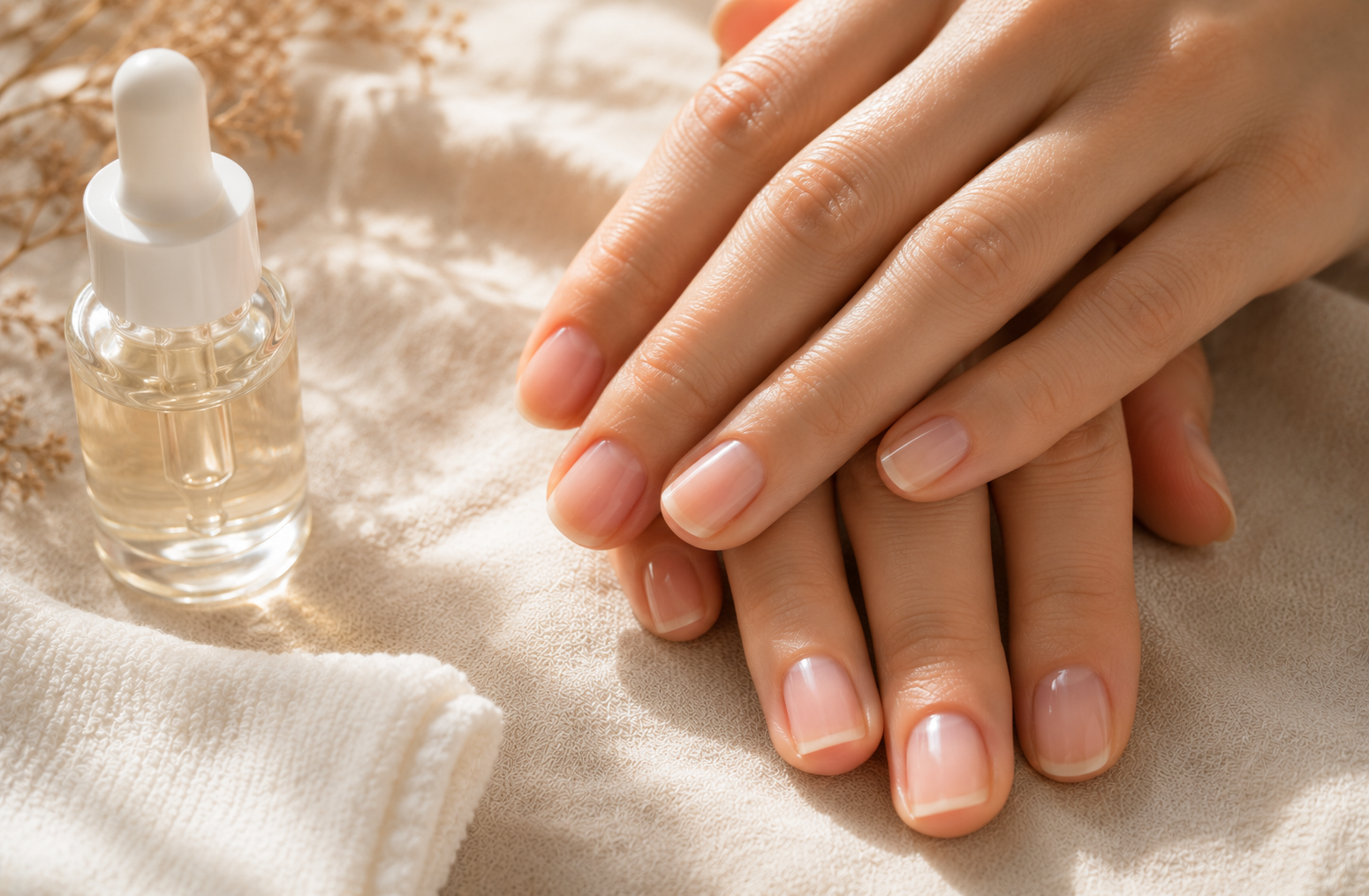
Why nails actually become weak
Healthy nails are made of layers of keratin — the same protein in your hair and the outer layer of your skin. These layers are held together by lipids (natural fats) and water. When that balance is disrupted, the layers separate, and you get the classic peeling, splitting, and flaking that defines weak nails.
The honest list of what actually causes weak nails:
- Dehydration — by far the most common cause. Frequent water exposure, hot water, dish soap, and acetone-based polish removers all strip the natural lipids that hold layers together.
- Over-processing — gel manicures applied or removed badly, acrylic application, aggressive filing, and dip powders that aren't soaked off properly all damage the nail plate.
- Mechanical trauma — using nails as tools (opening cans, scratching off stickers, peeling labels) creates micro-fractures that work outward over time.
- Climate — dry winter air or air conditioning pulls moisture from nails the same way it pulls moisture from skin.
- Underlying health conditions — thyroid issues, severe nutrient deficiencies, and certain autoimmune conditions can affect nails (more on this in the warning signs section).
- Aging — nails naturally become drier and more brittle over time, especially after menopause.
What's not on this list, despite popular belief: biotin deficiency, calcium deficiency, "needing more protein." For most people with weak nails, the cause is environmental, not nutritional. The fix lives in your bathroom, not your supplement cabinet.
If your nails were strong six months ago and are weak now — something changed. Did you start a new gel polish routine? Spend more time in water? Pick up a new cleaning job? Move to a drier climate? The cause is usually identifiable when you look honestly at recent changes.
What to stop doing immediately
Before adding new products, remove the things actively damaging your nails. The strengthening routine works much faster when you're not fighting against constant new damage.
Stop these habits today
- Peeling off gel polish. This is the single most damaging thing you can do. Each peel removes layers of the nail plate itself.
- Using your nails as tools. Opening packaging, scraping labels, prying things — all create micro-fractures.
- Filing back-and-forth. File in one direction only. Sawing creates micro-tears at the edge.
- Cutting cuticles. Cuticles are protective. Push them back gently after a shower instead.
- Using acetone polish remover frequently. Once a week maximum. Switch to non-acetone formulas for routine removal.
- Hot water exposure without protection. Long hot showers, dish washing with bare hands, hot tubs — all dehydrate nails fast.
Replace these immediately
- Bare hands while cleaning → rubber gloves with cotton liners (or just rubber gloves with cuticle oil applied first)
- Cutting cuticles → pushing cuticles back gently with a wooden orange stick after a shower
- Peeling polish → soaking off with foil-wrapped acetone pads, or having it removed professionally
- Metal files → glass or crystal files (gentler on the nail edge)
- Daily polish removal → maintenance polishing only when chipped
Why cuticle oil is the single best treatment
If you do nothing else from this guide, do this. Cuticle oil applied 2–3 times daily for 6 weeks fixes more weak nail issues than every supplement and hardener combined. It's also under $15 and lasts for months.
Cuticle oil works because nails need lipids the same way skin does. The natural fatty acids that hold nail layers together are constantly being depleted by water, soap, and chemicals. Cuticle oil replaces those lipids and — unlike most nail products — actually penetrates the nail plate.
What to look for
The best cuticle oils are simple. Skip the brightly colored ones with synthetic fragrance. Look for:
- Jojoba oil — most similar molecularly to your natural skin oils
- Argan oil — high in fatty acids and vitamin E
- Sweet almond oil — gentle and absorbs easily
- Vitamin E — supports nail bed health
How to apply
- Apply 1 drop directly onto the cuticle of each nail
- Massage in gently with your fingertip — work it across the entire nail surface and into the nail bed underneath the cuticle
- Don't rinse off. Let it absorb fully (1–2 minutes)
- Repeat 2–3 times daily — morning, after washing hands, before bed
Keep a cuticle oil bottle on your nightstand. Application before bed is the most powerful — your nails absorb the oil overnight without water exposure or washing interrupting it. Even one nighttime application is more effective than three rushed daytime ones.
The 6-week strengthening routine
Here's exactly what to do, day by day, to take weak nails back to strong over 6 weeks. None of this is dramatic — just consistent.
Daily (every single day)
- Apply cuticle oil 2–3 times: morning, midday, and before bed
- Wear rubber gloves for any wet work (dishes, cleaning, gardening)
- Apply hand cream after every wash
- Push cuticles back gently after showers — never cut
Weekly
- Soak nails in warm (not hot) water with a few drops of olive or jojoba oil for 10 minutes
- File any rough edges in one direction with a glass file
- Apply a strengthening base coat or treatment (more on which ones below)
Every 2 weeks
- Inspect for any peeling layers — gently buff smooth, don't tear off
- Trim straight across with sharp clippers, not curved
Avoid for 6 weeks
- Gel manicures, acrylics, dip powders
- Acetone-based removers
- Long polish wear (give nails breathing room)
- Long nails — keep them short while strengthening
Nutrition: what actually matters
Nails reflect overall health more than any single nutrient. While "biotin for nails" is the most marketed angle, the evidence for biotin specifically is weak unless you're deficient. The actually relevant nutrients:
| Nutrient | Why it matters | Best food sources |
|---|---|---|
| Protein | Nails are 95% keratin (protein) | Eggs, fish, lean meats, lentils, Greek yogurt |
| Iron | Deficiency causes spoon-shaped or ridged nails | Lean red meat, lentils, spinach, fortified cereals |
| Zinc | Required for keratin formation | Pumpkin seeds, oysters, beef, chickpeas |
| Vitamin B12 | Deficiency causes brittle, ridged nails | Animal products; supplement if vegan |
| Omega-3 | Supports natural oil production in nail beds | Fatty fish, walnuts, chia seeds, flaxseed |
| Biotin | Helps only if actually deficient (rare) | Eggs, almonds, sweet potato — usually adequate in normal diets |
The supplement question
If your diet covers these nutrients, supplements add little. If you suspect a deficiency — particularly if your nails changed quickly without lifestyle changes — get blood work for ferritin, B12, and zinc before guessing. A $40 blood panel beats $400 of supplement experimentation.
Mega-doses of biotin (5,000–10,000 mcg) — common in "hair, skin, nails" gummies — can interfere with thyroid lab tests and produce false readings. If you're taking biotin and need any blood work, tell your doctor first.
Nail hardeners: what works, what backfires
The nail hardener category is where people make their weak nails worse trying to fix them. Some products genuinely help; others temporarily hide problems while creating new ones underneath.
What actually helps
- Lipid-based strengtheners with jojoba, argan, or vitamin E — replenish the actual fats nails need
- Peptide-based strengtheners — newer formulations that support keratin structure
- Calcium-based base coats — provide trace minerals while giving a smoother surface
- "Nail rebuilders" with hydrolyzed keratin — fill in micro-cracks at the surface
What backfires
- Formaldehyde-based hardeners — brand themselves as the strongest. They make nails initially feel rock-hard, but cause severe brittleness and breakage within weeks. Many countries have restricted these for good reason.
- Toluene-based products — same story. Initial hardening, longer-term damage.
- Aggressive base coats with high resin content — create brittleness when worn continuously.
How to read a label: if a hardener lists formaldehyde or toluene in the first 5 ingredients, skip it entirely. Look instead for jojoba, argan, vitamin E, or peptide-related ingredients near the top of the label.
Manicure rules for fragile nails
If you can't give up manicures entirely, follow these rules to do them without compounding damage.
For regular polish
- Always use a base coat — protects the nail and prevents staining
- Skip the buffing step — heavy buffing thins the nail plate
- Limit polish wear to 7–10 days — let nails breathe between applications
- Use non-acetone remover for routine changes
- Apply cuticle oil immediately after removing polish
For gel manicures
- Don't peel. Ever. If polish chips and you can't get to a salon, file the chip smooth and apply a top coat over it until removal day.
- Take breaks. 2–3 weeks between gel applications minimum. Some people do gel for one set, then skip the next.
- Soak off properly. Foil-wrapped acetone pads for 10–15 minutes, then gentle removal — never scrape or pry.
- Find a technician who soaks rather than scrapes. Aggressive removal is the #1 cause of long-term gel damage.
- Apply cuticle oil daily during gel wear — yes, it absorbs through the polish.
What to avoid entirely
- Acrylics on already-weak nails — the prep filing alone causes major damage
- Drill files (electric files) for at-home use — they remove far more nail than necessary
- "Bond" or "primer" products at home — these chemically prep nails and need professional application
- Trying to "thin out" thick polish — it's better to let it dry fully than create uneven layers
When weak nails signal something else
Most weak nails are environmental and respond to the routine above. But sometimes, persistent or unusual nail changes signal an underlying health issue that warrants medical attention.
See a doctor if you notice:
- Spoon-shaped nails (curving up at the edges) — often signals iron deficiency
- Yellow, thickened nails — possible fungal infection
- Pitted nails (small dents) — can indicate psoriasis or thyroid issues
- Sudden change in nail color — especially dark stripes or spots
- Severe ridging that wasn't there before — may indicate B12 deficiency or thyroid problems
- Painful or swollen nail beds — possible infection
- Nails separating from the nail bed — can signal thyroid disease, psoriasis, or fungal infection
- Brittleness combined with hair loss and fatigue — possible thyroid issue worth investigating
None of these are immediate emergencies, but all warrant a primary care visit if persistent. Nails really are a window into general health — and persistent weakness despite consistent care often has a non-nail explanation.
The bottom line: Weak nails almost always come from dehydration and over-processing — not from missing nutrients. The fix is consistent cuticle oil, gloves for wet work, gentler manicure habits, and 4–6 months of patience while damaged length grows out. Skip the expensive hardeners with formaldehyde. Skip the biotin gummies unless your doctor confirms a deficiency. Buy a $15 bottle of jojoba oil and use it religiously — your nails will tell the difference within 6 weeks.