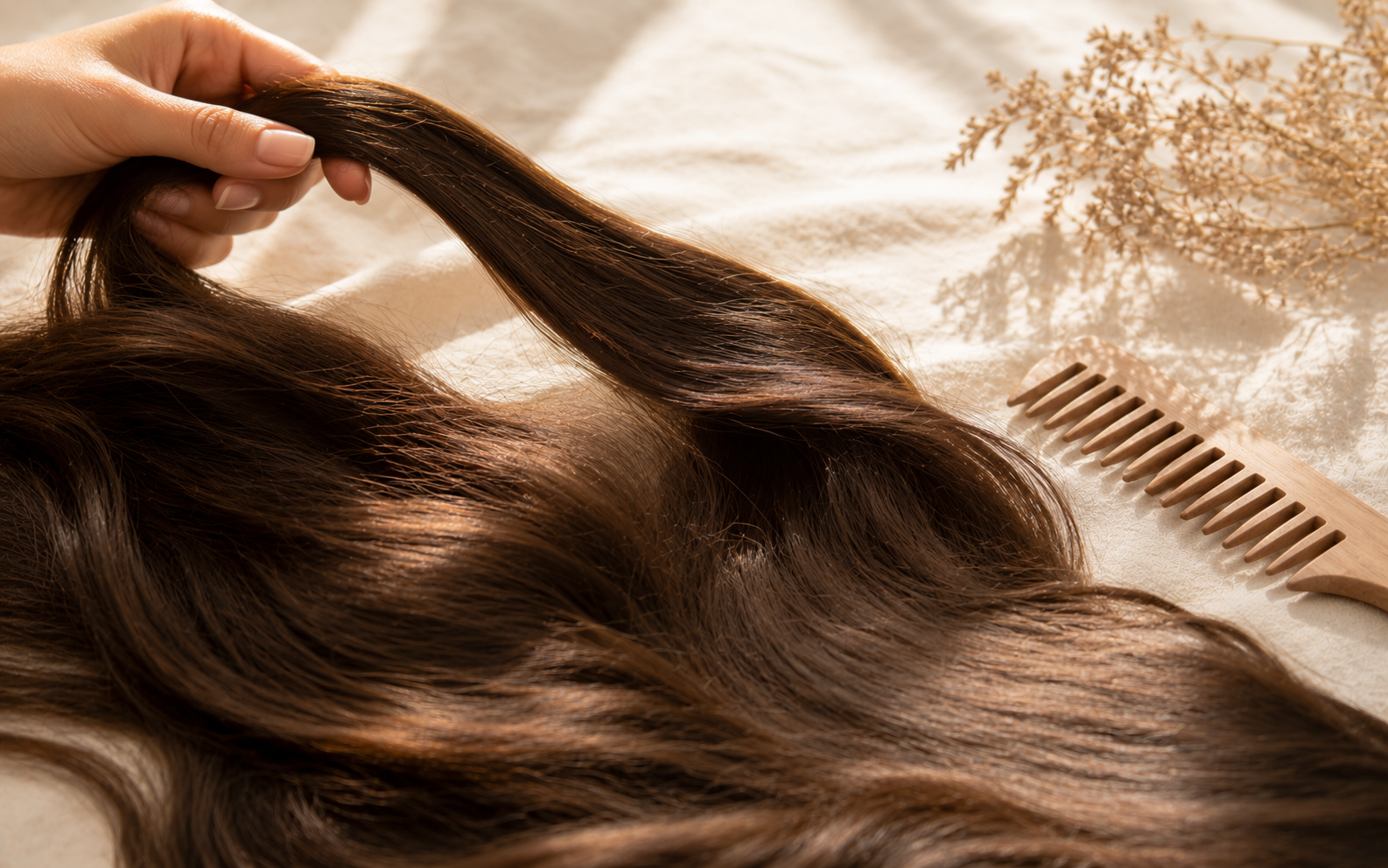
How fast hair actually grows
Before talking about how to grow hair faster, it helps to know how fast hair grows in the first place — and why there's a hard ceiling on how fast you can possibly accelerate it.
The average growth rate is approximately half an inch (1.25 cm) per month, or 6 inches (15 cm) per year. This rate varies slightly by genetics, age, ethnicity, and overall health, but it falls within a fairly narrow band for most people. Someone whose hair grows 0.4 inches per month is on the slow end. Someone whose hair grows 0.7 inches per month is on the fast end. No one's hair grows 2 inches per month.
Each hair follicle on your scalp goes through three phases:
- Anagen (growth phase): 2–7 years long. The hair actively grows during this time. The longer your anagen phase, the longer your hair can get.
- Catagen (transition phase): About 2 weeks. The follicle prepares to shed.
- Telogen (resting phase): About 3 months. The hair detaches and eventually falls out, then a new one grows.
At any given time, roughly 85–90% of your hairs are in anagen, 1–2% in catagen, and 10–15% in telogen. This is why you naturally shed 50–100 hairs per day — that's normal, not concerning.
The key insight: you can't make a single hair grow faster than your follicle's biological rate. What you can do is make sure every follicle reaches its maximum potential — which for most people, isn't currently happening because of stress, deficiencies, damage, or scalp issues.
What actually accelerates growth (evidence-backed)
The honest list of things with real research behind them:
- Topical minoxidil (2% or 5%) — the only OTC treatment with strong clinical evidence for accelerating hair growth and increasing density
- Adequate protein intake — 0.8–1g per kg of body weight, daily
- Iron sufficiency — particularly important for women; deficiency directly slows hair growth
- Vitamin D adequacy — chronic low levels correlate with reduced hair growth
- Scalp massage — limited but real evidence for stimulating local blood flow
- Stress reduction — chronic stress shortens the anagen phase
- Adequate sleep — growth hormone and tissue repair both peak during deep sleep
- Reducing mechanical damage — preventing breakage retains length over time
That's the complete list. Everything else you've heard — biotin gummies, rosemary water, rice water, scalp scrubs, $80 "growth serums" — has either weak evidence, no evidence, or works only by reducing breakage rather than accelerating growth.
Scalp health: the foundation everyone skips
Your scalp is the soil. Your hair is the plant. You can't grow great plants in poor soil — and you can't grow optimal hair on a neglected scalp.
The healthy scalp checklist:
- No flaking or excessive itch. Both indicate inflammation, which can disrupt hair cycles.
- Comfortable to the touch. Soreness or sensitivity often signals product buildup or irritation.
- Not visibly greasy at the roots within 24 hours of washing. Excess oil can clog follicles.
- Not visibly dry or tight. Dehydrated scalp produces more oil compensatory and creates an unfriendly environment.
To support scalp health:
- Wash often enough to keep it clean — 2–3 times per week for most hair types. Less for very dry or curly hair, more for oily.
- Use a gentle, sulfate-free shampoo on most washes, with a clarifying shampoo every 2–4 weeks to remove buildup.
- Massage the scalp for 4–5 minutes during shampooing. This stimulates blood flow and may improve nutrient delivery to follicles.
- Treat dandruff if you have it. Active dandruff inflames follicles and can disrupt growth cycles. Look for ketoconazole, zinc pyrithione, or salicylic acid.
- Don't apply heavy oils to the scalp if you're acne-prone or have oily skin. They can clog follicles in some people.
Daily 4-minute scalp massage shows measurable hair density improvements over 24 weeks in studies. Use fingertips (not nails) and gentle, circular pressure across the entire scalp. The cheapest hair-growth intervention available — and one of the better-supported ones.
Nutrition that actually moves the needle
Hair is made of keratin, a protein. Without adequate building blocks, your body deprioritizes hair growth in favor of essential systems. The relevant nutrients:
| Nutrient | Daily target | Why it matters for hair |
|---|---|---|
| Protein | 0.8–1g per kg body weight | Hair is 95% keratin. Inadequate protein = slower growth. |
| Iron | 18mg (women), 8mg (men) | Deficiency causes telogen effluvium (sudden shedding). |
| Zinc | 8–11mg | Required for hair follicle function and tissue repair. |
| Vitamin D | 15–20 mcg (600–800 IU) | Chronic deficiency correlates with hair thinning. |
| Omega-3 fatty acids | 1–2g | Anti-inflammatory; supports scalp health. |
| Vitamin B12 | 2.4 mcg | Common deficiency in vegetarians; affects hair quality. |
Whole foods deliver these better than supplements. Eggs, fatty fish, lean meats, lentils, leafy greens, and Greek yogurt cover most of the list naturally.
The supplement question
If your diet covers these nutrients, supplements add nothing. If you're deficient, supplements help — but only for what you're actually deficient in. The most useful step before buying anything: get a blood test for ferritin (iron stores), vitamin D, B12, and zinc. This costs $30–80 at most labs and tells you exactly what (if anything) you actually need.
Mega-doses of biotin (5,000–10,000 mcg) — common in "hair, skin, nails" gummies — can interfere with thyroid lab tests and produce false readings. Tell your doctor if you're taking biotin before any blood work.
Topical treatments that work
Minoxidil (2% or 5%)
The only over-the-counter topical treatment with strong clinical evidence for hair growth. Originally developed as a blood pressure medication, it was found to stimulate hair follicles as a side effect. Available without prescription as a 2% or 5% solution or foam.
What it does: Extends the anagen (growth) phase, increases follicle size, and stimulates dormant follicles. Visible results in 4–6 months.
What to know: Must be used continuously. If you stop, you lose any new hair grown within 3–4 months. Some people experience initial shedding in the first 2–4 weeks (a normal part of the cycle resetting), then visible improvement.
Apply: 1 mL twice daily to dry scalp at the area of concern. Let it absorb fully before styling.
Rosemary oil — modest evidence
A 2015 clinical trial showed rosemary oil performed comparably to 2% minoxidil for androgenic alopecia (genetic hair loss) over 6 months. The evidence is real but limited — one study isn't comprehensive.
How to use: Mix 4–5 drops of rosemary essential oil into a tablespoon of carrier oil (jojoba, coconut, argan). Massage into scalp 2–3 times per week. Leave overnight, wash out in morning.
What it doesn't do: Make hair grow longer faster. The evidence is for density and reducing thinning, not for accelerated length.
Caffeine-based serums — limited but genuine
Topical caffeine has been shown in some studies to stimulate hair follicle activity and counteract the effects of DHT (the hormone responsible for genetic hair thinning). Effects are modest but measurable.
What doesn't work (despite the marketing)
The honest list of popular "hair growth" interventions with no good evidence:
- Biotin supplements — only help if deficient, which most people aren't
- "Hair, skin, and nails" gummies — same issue as biotin, plus often loaded with sugar
- Rice water rinses — no controlled studies showing growth benefit
- Onion juice — one small study, results not replicated
- "Hair growth shampoos" — most contain ingredients that work topically (caffeine, biotin) at concentrations too low and contact time too brief to do anything
- Castor oil for length — provides scalp hydration and reduces breakage but no evidence for accelerated growth
- Aloe vera applications — soothing for scalp but no growth benefit
- Apple cider vinegar rinses — clarify the scalp but no growth claim is supported
This isn't to say these things are useless. Some genuinely improve hair quality, reduce breakage, or address scalp concerns. But none of them make your hair grow measurably faster.
The pattern in hair growth marketing: products claim to "accelerate growth" but actually work (when they work at all) by reducing breakage. Reduced breakage means longer hair retained over time — which looks like faster growth even though the rate is unchanged. Honest beauty content distinguishes the two.
Reducing breakage: the unsexy real solution
If you can't speed up the rate of growth at the follicle, the next best thing is keeping every inch you grow. Most people lose 1–3 inches of length per year to breakage. Fix that, and you'll see dramatically more length over 12 months — even at the same actual growth rate.
The interventions that actually preserve length:
- Sleep on silk or satin pillowcases. Reduces friction-induced breakage overnight.
- Use a wide-tooth comb on wet hair, working from ends to roots. Wet hair is the most fragile state.
- Don't wrap wet hair tightly in a towel. Use a soft microfiber wrap instead, or let air-dry partially before drying.
- Trim every 8–12 weeks. Yes, even when you're trying to grow it out. Tiny trims prevent split ends from traveling up the shaft.
- Reduce heat styling or use heat protectant religiously. Heat damage is responsible for a huge fraction of breakage in long hair.
- Avoid tight ponytails and hair ties with metal pieces. They cause breakage at the bind point.
- Deep condition weekly. Hydrated hair is more elastic and breaks less.
- Sleep with hair in a loose braid or bun if it's long. Reduces tangling and the breakage that comes with morning detangling.
A realistic timeline for visible change
Hair growth is a long game. Here's what to actually expect:
- 1–2 weeks: Minoxidil may cause initial shedding (normal). Otherwise, no visible change yet.
- 4–8 weeks: Improvements in scalp condition if addressing scalp issues. Hair quality may feel slightly better with consistent care.
- 3 months: About 1.5 inches of new growth. Visible if measuring carefully.
- 6 months: 3 inches of growth. New baby hairs may appear if using minoxidil or treating deficiencies.
- 12 months: 6 inches. The cumulative effect of reducing breakage becomes obvious — longer overall length than someone with the same growth rate but no protection routine.
- 2 years+: If your hair seemed "stuck" before, the difference at 2 years of optimized growth is dramatic.
The bottom line: You can't dramatically accelerate hair growth — biology has set the rate. What you can do: optimize scalp health, eat for hair quality, address deficiencies if you have them, consider minoxidil for density, and aggressively reduce breakage. Do those five things consistently for a year and your hair will look measurably longer and healthier — not because it grew faster, but because you finally let it reach its potential.