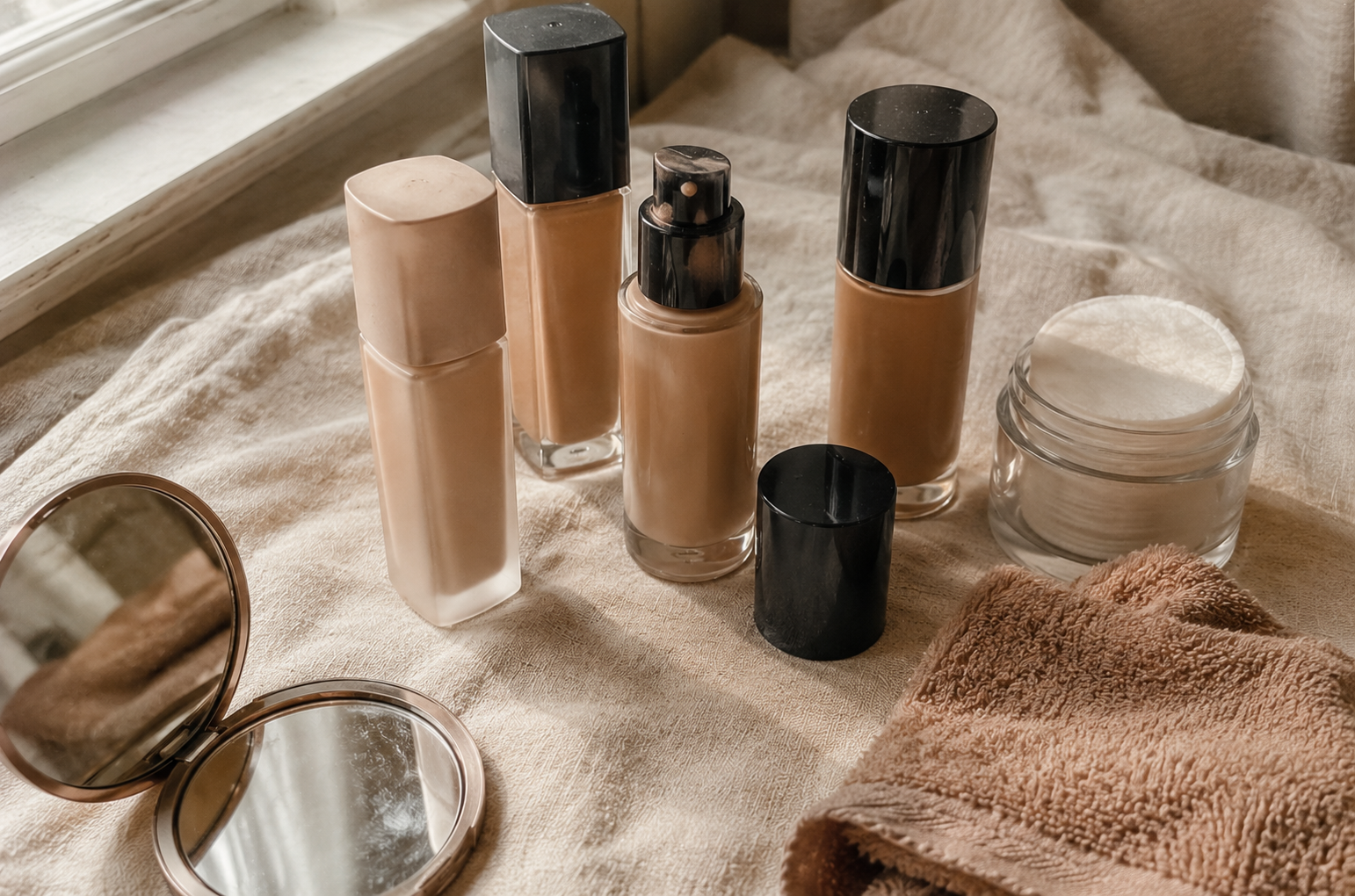
The three variables that determine your match
Most matching advice focuses only on shade depth — light, medium, or dark. That's roughly a third of the answer. The actual variables that determine a good match are:
1. Undertone
The underlying color cast of your skin — warm (yellow, golden, peachy), cool (pink, rosy, red), or neutral (balanced between the two). Undertone exists independently of skin depth — you can have fair skin with warm undertones or deep skin with cool undertones. Brands label this differently: "W" for warm, "C" for cool, "N" for neutral; or descriptive terms like "honey," "ivory," "porcelain," "sand."
2. Depth
How light or deep your skin is on a continuous spectrum. Brands typically divide this into 5–10 zones from fair to deep, though some newer inclusive ranges extend further in both directions.
3. Formula and finish
Even with the right color, the wrong formula will make foundation look wrong. A matte foundation on dry skin looks cakey; a luminous foundation on oily skin slides off by lunch. Formula matches skin condition; finish matches preference and occasion.
| Variable | What it controls | How to identify |
|---|---|---|
| Undertone | Whether foundation harmonizes with your skin's natural cast | Vein test, paper test, jewelry test |
| Depth | Whether the foundation looks lighter or darker than your skin | Jawline comparison in daylight |
| Formula | How the foundation behaves on your skin throughout the day | Skin type assessment and finish preference |
Getting two right and one wrong still produces a noticeably bad match. A perfect undertone in the wrong depth looks like you're wearing the wrong color. The right depth in the wrong undertone makes the skin look ashy or jaundiced. The right shade in the wrong formula looks like makeup sitting on top of skin rather than melting into it.
How to identify your undertone
Three tests, ordered from quickest to most reliable. Use multiple tests when you're uncertain — different tests can confirm each other.
The vein test (60 seconds)
Look at the veins on the inside of your wrist in natural daylight.
- Veins look blue or purple → cool undertones
- Veins look green → warm undertones
- Veins look both blue-green → neutral undertones
This works for most people but is less reliable for darker skin tones where veins are harder to see clearly through the skin.
The white paper test (most reliable across all skin tones)
Hold a piece of plain white printer paper directly under your jaw in natural daylight. Compare your skin's appearance against the white:
- Skin looks pink, rosy, or red → cool undertones
- Skin looks yellow, golden, or peachy → warm undertones
- Skin looks neither distinctly pink nor yellow → neutral undertones
- Skin looks gray-green → olive undertones (a specific category — see below)
This is the most reliable test because the white paper provides a true neutral reference point.
The jewelry test
Which metal flatters your skin more when worn close to your face?
- Silver, platinum, white gold flatter more → cool undertones
- Yellow gold, brass, copper flatter more → warm undertones
- Both look equally good → neutral undertones
The olive undertone category
Olive is a distinct undertone often confused with warm. Olive skin has a subtle green or gray-green cast that comes from melanin combined with green undertones. Olive-toned people often look "off" in warm-labeled foundations because the foundations lean too yellow without the green correction.
Brands that specifically address olive undertones: Hourglass Vanish, Pat McGrath Skin Fetish, MAC Studio Fix, NARS Sheer Glow. If your previous foundations always look slightly too orange or yellow, olive may be your category.
Sun exposure can temporarily shift your apparent undertone. A summer tan often warms your skin's apparent undertone even if your base undertone is cool or neutral. Match your foundation to your skin's current state, but recognize that you may need a different shade in winter when the tan fades.
How to identify your skin depth
Depth is harder to assess in isolation because there's no absolute reference. The most practical approach is comparison.
The comparison method
If you've worn any foundation before that came close to matching, that's your reference point. Note whether you needed to go lighter or darker, and by approximately how much.
If you've never worn foundation, or all previous attempts were wrong, use these descriptive reference categories:
| Depth category | Description | How light/dark |
|---|---|---|
| Very fair / porcelain | Very little pigmentation; can see veins through skin easily; burns easily, never tans | Lightest of light |
| Fair | Pale but not translucent; burns first then tans slightly | Lighter than average |
| Light | Visibly pigmented but on the lighter side; tans gradually | Below medium |
| Light-medium | Subtle warmth; the most common natural depth for many populations | Just below medium |
| Medium | Clearly visible pigment; tans relatively easily without burning much | Mid-spectrum |
| Medium-tan | Naturally warm-toned with noticeable pigment | Above medium |
| Tan | Rich warm pigmentation; rarely burns | Above-average depth |
| Deep | Significant melanin; rich pigmentation | Below the deepest range |
| Rich deep | Deeply pigmented skin with strong undertone visibility | Deepest range commonly carried |
| Ebony / ultra-deep | The deepest natural skin tones | Often underrepresented in mainstream brands |
The fingertip test
The skin on the inner side of your fingertips, near where they meet your palm, is usually close to your true face skin depth. It's less exposed to sun than the backs of hands and less affected by chronic redness or paleness than cheeks. Comparing foundation swatches against this skin gives a more accurate read than comparing against the back of your hand.
The chest test
The skin on your chest, between your collarbones, often shows your "true" skin depth without the redness, sun exposure, or pigmentation that affects faces. Many people find their foundation match falls between their face skin depth and their chest skin depth.
Choosing the right formula
Even a perfectly matched color can fail spectacularly in the wrong formula. Match formula to skin type and lifestyle.
By skin type
| Skin type | Look for | Avoid |
|---|---|---|
| Oily / acne-prone | Oil-free, mattifying, longwear, semi-matte finish | Heavy luminous, dewy, oil-based formulas |
| Dry / mature | Hydrating, dewy, luminous finishes with skincare-like ingredients | Full-matte formulas, heavy powders, ultra-longwear that cling to dryness |
| Combination | Satin or natural finish; medium coverage; balanced formulas | Extreme matte or extreme dewy options |
| Sensitive | Fragrance-free, minimal ingredients, mineral-based formulas | Heavy silicones, alcohol-based primers/foundations, fragrance |
| Normal | Whatever finish you prefer; the most flexible | — |
By coverage preference
- Sheer / tinted moisturizer — even skin tone with skin still visible. Daily wear. Brands: Laura Mercier Tinted Moisturizer, Bobbi Brown Skin Tint, Glossier Skin Tint.
- Light coverage — evens tone, covers minor redness, lets skin texture show. Brands: NARS Sheer Glow, Charlotte Tilbury Light Wonder, Maybelline Fit Me Dewy + Smooth.
- Medium coverage — the most versatile category. Covers most concerns while looking natural. Brands: Fenty Pro Filt'r, Estée Lauder Double Wear, Maybelline Fit Me Matte + Poreless, Charlotte Tilbury Airbrush Flawless.
- Full coverage — covers significant concerns; reads as obvious makeup unless skillfully applied. Brands: MAC Studio Fix Fluid, Fenty Pro Filt'r (with thicker application), Estée Lauder Double Wear, Dior Forever Skin Glow.
Coverage is buildable in almost any foundation — you can apply a light coverage product more thickly for moderate coverage. Going the other way is harder: full-coverage formulas don't look "sheer" when applied lightly, they just look like a thin layer of full-coverage product. When in doubt, choose a medium-coverage formula and adjust application thickness.
How to test foundation at home
Once you have candidate shades (whether one or several), here's the actual matching test that produces reliable results.
The jawline swatch test
- Cleanse the face and let skin fully air-dry. No makeup, no recent moisturizer (let it absorb at least 10 minutes).
- Apply a small dot of each candidate foundation along the jawline, 2–3 cm apart. Don't blend — just dot.
- Look in a mirror in natural daylight (near a window, not bathroom light).
- The shade that disappears against jawline skin — neither lighter nor darker, neither pink nor yellow against your tone — is your match.
- If you can see the swatch, even slightly, the shade is wrong.
The walk-outside verification
After identifying your candidate shade through the jawline test, walk to a window or step outside in actual daylight. Bathroom lighting, indoor lighting, and even northern-window light can all distort foundation matches in different directions. The truest test is outside, in indirect daylight (not direct sun).
Foundations that look great inside but ashy or orange outside are mismatched for outdoor use. Foundations that look great outside but heavy inside are usually too dark or wrong undertone.
The 30–60 minute wear test
This is the step most people skip. Apply the candidate foundation to a small area (a few cm of cheek or jaw, not full face), then go about your day for 30–60 minutes. Check again.
You're checking for:
- Oxidation — has it shifted darker, more orange, or more yellow?
- Wear behavior — has it stayed put, separated, or moved into fine lines?
- Skin reaction — any redness, dryness, or breakouts forming?
- Color persistence — does it still match after sitting?
A foundation that matches initially but oxidizes by 30 minutes is not your foundation — it's just one that matches you briefly.
Where to swatch (and where NOT to)
- Jawline: ✓ Most accurate. The transition area between face and neck.
- Lower cheek near jaw: ✓ Second best.
- Chest: ✓ Useful as a reference for true skin depth.
- Inside of forearm: ✗ Often different from face.
- Back of hand: ✗ Almost always darker and warmer than face.
- Wrist: ✗ Often paler and cooler than face.
- Forehead: ✗ Often oilier or more pigmented than the rest of face.
Cross-referencing shades across brands
Once you've successfully matched in one brand, finding equivalent shades in other brands becomes much easier.
Findation and similar shade-matching databases
Findation.com is a long-running free tool that lets you input shades you've successfully worn from major brands. It then suggests equivalent shades across hundreds of other brands. The accuracy is reasonable but not perfect — treat results as starting points, not guarantees.
Sephora and Ulta both offer their own shade finders. Brand-specific shade finders on company websites (Fenty's Shade Finder, MAC's Shade Finder) are more accurate within that brand but don't translate across.
Independent swatch resources
- Temptalia — beauty review site with detailed swatches across skin tones
- Beautypedia (formerly Paula's Choice) — skincare and makeup reviews with honest assessments
- YouTube swatch videos — search "[foundation name] swatch [your descriptor]" to find people with similar tones reviewing the product
- Reddit communities — r/MakeupAddiction and shade-specific communities have user-posted swatches
How to read other people's swatches
When looking at swatches by other people, compare their:
- Visible undertone in their face/neck
- Hair color and natural eye color (general undertone indicators)
- Lighting they're shooting in (natural vs. artificial)
- Where they swatched (face, hand, etc.)
The closer their general appearance is to yours, the more predictive their swatches are. Beware of heavily edited photos with skin-smoothing filters that can distort foundation appearance significantly.
Shopping foundation online with confidence
Without in-person testing, the goal is making informed guesses that minimize wasted purchases.
The "two-brand reference" approach
If you have one foundation that genuinely matches you, that's your reference point. When buying a new brand, find equivalent shades to your known match using cross-reference tools, then read multiple reviews to verify.
If you have no successful matches yet, start with one of the brands known for wide shade ranges and reliable shade names:
- Fenty Beauty Pro Filt'r — 50 shades, clear undertone naming, broadly accurate to skin
- Maybelline Fit Me — 60 shades, widely available, affordable for testing
- MAC Studio Fix Fluid — extensive range, predictable shade naming, available in most regions
Once one of these matches you, you'll know your reference point for cross-referencing other brands.
Return policies matter more than discount codes
For foundation specifically, prefer brands with generous return policies. Sephora, Ulta, and many independent brands accept returns of opened products that don't match. The slightly higher price is offset by the ability to return mismatches.
Discount sites and final-sale outlets are tempting for foundations but rarely worth it unless you've tested the exact shade in person before. A 50% discount on a foundation that doesn't match you is still 100% wasted.
Sample programs and travel sizes
Several brands now offer sample programs specifically for foundations:
- Some Sephora locations offer custom foundation samples
- Many brands include free samples with online orders
- Specific sample subscription services (Ipsy, BoxyCharm) sometimes feature foundations
Travel sizes of foundation are worth their slightly inflated per-mL price for testing — a 5–10 mL bottle is enough to test for several weeks before committing to full size.
Dealing with oxidation
Oxidation is when foundation shifts color (usually darker and warmer/orangier) within minutes to hours after application. It's caused by reactions between foundation ingredients and air, skin oils, or skincare underneath.
Why it happens
Most foundations contain iron oxides as pigments. When exposed to air, oils, or certain ingredients, these can shift color slightly. Some formulas resist this; others are notorious for it.
Foundations known to oxidize significantly
- Estée Lauder Double Wear (most famously)
- MAC Studio Fix Fluid (moderate oxidation in some shades)
- Many drugstore liquid foundations with high water content
How to compensate
If you've identified that you're prone to foundation oxidation:
- Choose foundations 0.5–1 shade lighter than perfect initial match
- Let skincare fully absorb (5–10 minutes) before applying foundation
- Use a primer specifically designed to control oxidation (silicone-based work well)
- Avoid stacking products with reactive ingredients (some vitamin C serums can react with iron oxides)
- Consider switching to formulas designed to resist oxidation — silicone-heavy or "true-to-shade" formulations
When and how to mix foundations
Mixing two foundations to create a custom shade is a perfectly legitimate solution. Many people fall between available shades, especially in lines with limited shade ranges.
When mixing makes sense
- You fall exactly between two shades in the same line
- One shade has perfect depth but wrong undertone
- Your skin shifts seasonally (mix more dark in summer, more light in winter)
- You want to customize for specific weather (more matte in summer, more dewy in winter)
How to mix effectively
- Pump or scoop the two foundations onto the back of your hand
- Mix with a clean fingertip or makeup brush
- Test the mixed shade on your jawline before applying to the full face
- Adjust the ratio if needed
- Apply the custom mixture as you would any single foundation
Mixing drops and color adjusters
Several brands sell dedicated color-adjusting drops for foundation customization:
- Cover FX Custom Cover Drops — concentrated pigment in lightening, deepening, warming, and cooling shades
- Black Up Custom Cover — focused on adjusting for deeper skin tones
- Fenty Beauty Match Stix — solid stick form for adjustment
These drops give more precise control than mixing two regular foundations, since they're designed for tiny incremental adjustments. A few drops can lighten, deepen, warm, or cool a foundation without changing its formula characteristics.
Seasonal adjustments
Skin color isn't static. For most people, summer brings warmer, slightly deeper tones, and winter returns to a paler, cooler baseline. Adjusting foundation through the year prevents the mismatched-makeup look that often happens in transition seasons.
The two-shade strategy
Many people maintain two foundations in their rotation:
- Lighter shade — fall through spring, when sun exposure is minimal
- Deeper shade — late spring through early fall, when natural tan develops
Mix them in transition months to gradually shift from one to the other rather than abruptly switching.
The single-shade plus drops strategy
For people who don't want to maintain two full-size foundations, a single year-round foundation plus deepening drops (used in summer months) is a more economical approach.
When to actually adjust
Many people overadjust seasonally — buying summer shades that look too dark by August's actual peak. Test against your skin every 2–3 weeks rather than committing to one shade for the whole season. The shift happens more gradually than people expect.
Common foundation matching mistakes
Patterns that derail otherwise good matching attempts:
Swatching on the back of the hand
The most common foundation-matching mistake. Hands are usually a different shade and undertone than faces — often darker, often warmer. A foundation that matches your hand probably doesn't match your face.
Buying based on store lighting
Department store and Sephora lighting is calibrated to flatter both customers and products. Foundations that look perfect under store lights often look wrong in natural light. Always test in daylight before purchasing if possible.
Choosing too dark "for warmth"
A common mistake driven by the desire to look sun-kissed or warm-toned. Foundation that's too dark looks like a mask above the neck — most people are better served by their actual matching shade plus bronzer for added warmth, not a foundation 2 shades too dark.
Ignoring the neck
Foundation that matches the cheeks but creates a sharp line at the neck is a sign of either wrong depth (face is paler than neck — likely an outdoor neck and indoor face) or wrong technique (no blending into the neck). Either fix by adjusting shade or extend application down the neck.
Trusting initial application only
Foundation can change significantly within 30 minutes. The shade that matches at the moment of application isn't necessarily the shade that will match all day. The 30-minute wear test is essential.
Loyalty to mismatched brands
Some people stick with a brand that hasn't worked because they don't want to start over. Foundation matching is brand-agnostic. The right shade in any brand is better than the close-enough shade in your favorite brand.
Treating one-time success as permanent
The foundation that matched you perfectly three years ago may not still match you. Skin changes — sun exposure, age, hormones, climate. Reassess every 1–2 years rather than assuming your match is static.
The bottom line: Matching foundation at home is a learnable skill, not a mysterious art reserved for store consultants. The three-variable framework — undertone, depth, formula — gives you the structure. The vein test, white paper test, and jawline swatch test give you the techniques. Cross-reference tools like Findation extend your matches across brands. Most importantly: trust your eyes, test in natural daylight, give the foundation 30–60 minutes before deciding, and don't keep wearing a shade that isn't working out of habit. The right foundation should disappear into your skin rather than sit on top of it. When it does, you'll know — and you'll never have to wonder if you "look like you're wearing foundation" again.