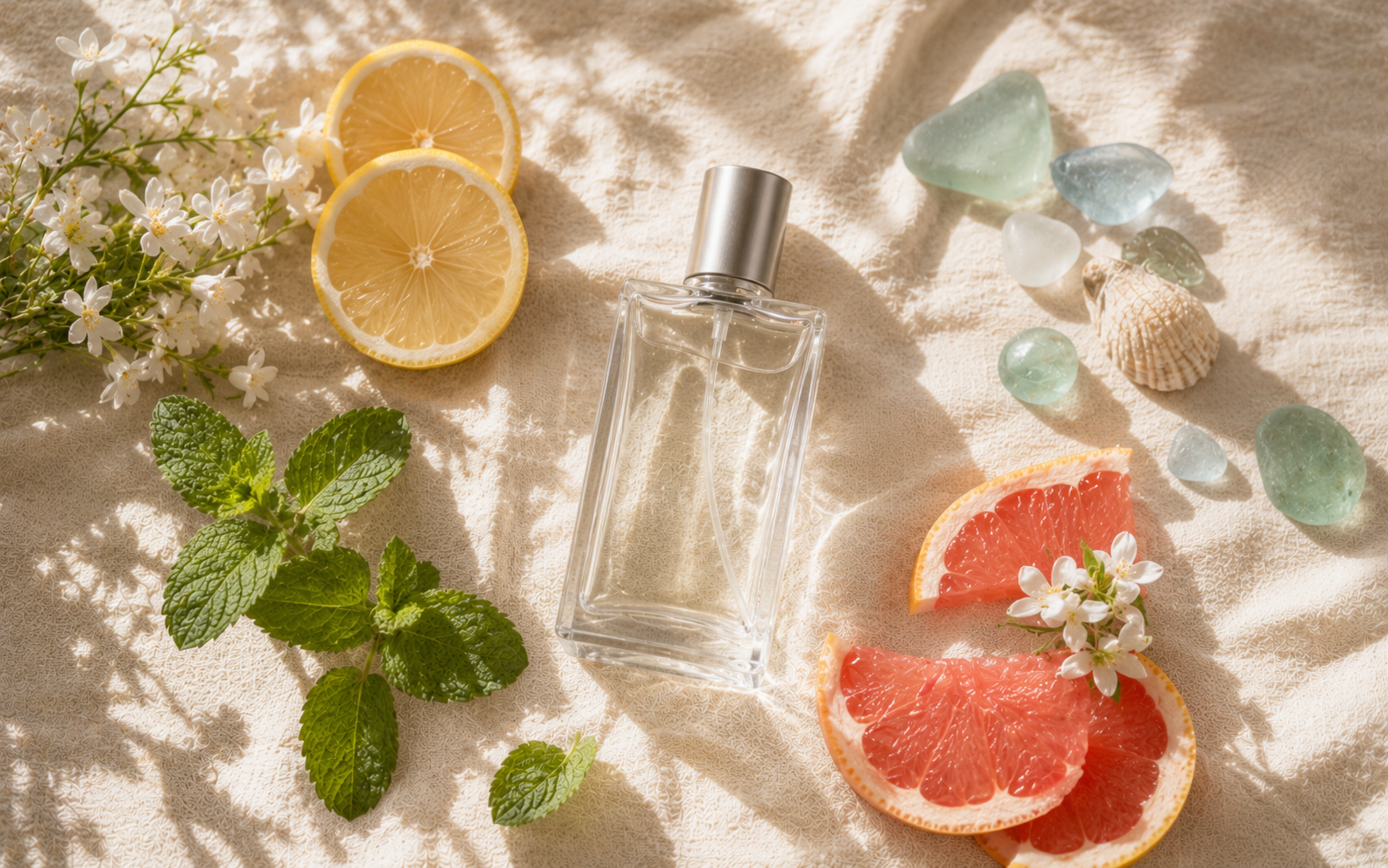
Why heat changes how fragrance smells
Fragrance behaves differently in summer for one specific reason: heat accelerates evaporation. The same perfume that takes 30 minutes to bloom on cool skin can hit full projection in 5 minutes on hot skin. And what was a balanced sillage in winter becomes a scent cloud in summer.
Three things happen when fragrance meets heat:
- Top notes burn off faster. The light, fresh opening you smelled at the store can be gone in 15 minutes instead of 30.
- Heart and base notes amplify. Heavy, warm notes like vanilla, amber, and patchouli project 2–3x more strongly in heat — what was sensual in winter can become overwhelming.
- Sweet notes turn cloying. Gourmand fragrances (vanilla, caramel, chocolate, tonka bean) often go from "delicious" to "headache-inducing" once temperatures climb above 80°F (27°C).
This is why summer fragrance isn't just about preference — it's about chemistry. A perfume designed for cool weather genuinely doesn't perform the same way in heat, regardless of how much you love it the rest of the year.
If you've ever wondered why perfume reviewers rave about a fragrance that smells overwhelming on you — they probably reviewed it in cool weather. Time of year matters as much as skin chemistry when assessing how a perfume will actually wear.
The best scent families for summer
Certain fragrance categories are built around lighter, more volatile molecules that handle heat without becoming oppressive. These are the families to focus on when shopping for summer scents.
Citrus / Hesperidic
The classic summer choice. Built around bergamot, lemon, neroli, mandarin, and grapefruit. Bright, sparkling, and naturally cooling-feeling on the skin.
Why it works: citrus oils are among the lightest molecules in perfumery — they evaporate fast in heat without leaving a heavy residue. They also pair beautifully with summer humidity, which can amplify their freshness rather than ruin it.
Look for: top notes featuring bergamot, lemon zest, neroli, petitgrain, mandarin. Heart notes featuring orange blossom, light florals. Base notes of clean musks or light woods.
Aquatic / Marine
Built around ocean-inspired notes — sea salt, calone (a synthetic that smells like ocean breeze), seaweed, sea spray. Often combined with cucumber, melon, or driftwood for a "by the shore" feel.
Why it works: aquatic notes feel literally cooling. The ozonic, watery quality reads as refreshing in a way that warmer scent profiles can't.
Look for: "ocean accord," sea salt, calone, ambergris, seaweed, white tea. These often pair with light citrus or fresh florals.
Light floral
Not all florals are summer-friendly. The ones that work in heat are airy, transparent flowers — orange blossom, neroli, white tea flower, lily of the valley, peony, freesia, mimosa.
Why it works: these flowers contain naturally light fragrance compounds that don't amplify oppressively in heat. They feel diffusive and graceful rather than heavy.
What to avoid in summer: heavy heady florals like tuberose, intense jasmine, narcotic gardenia, and rich rose. These can become headache-inducing in hot weather.
Green / Herbal
Built around grass, leaves, herbs, and stems — galbanum, fig leaf, tomato leaf, basil, mint, tea, violet leaf. Cool, slightly bitter, and refreshing.
Why it works: green notes are inherently "cooling" in a sensory way. They evoke shade, freshly cut grass, and morning gardens — all summer-friendly associations.
Look for: tea-based scents, fig and fig leaf scents, anything described as "green" or featuring violet leaf or galbanum.
Light fruity
Not the heavy fruit cocktails of '00s perfumery — modern fruity scents focus on lighter, more transparent fruits: pear, white peach, apricot, blackcurrant, raspberry leaf, lychee.
Why it works: light fruits paired with green or floral notes feel refreshing rather than syrupy. Done well, this category can be wonderfully wearable in heat.
What to avoid in summer: sweet fruit notes paired with heavy bases (vanilla, caramel, deep musks). These become cloying in heat regardless of how light the fruit is.
What to avoid in hot weather
Some scent profiles genuinely don't work in summer, no matter how much you love them in winter. Save these for cooler months:
- Heavy gourmands — vanilla, caramel, chocolate, coffee, dulce de leche. Lovely in winter, headache-inducing at 90°F.
- Deep ouds — full oud-heavy fragrances amplify dramatically in heat and can feel suffocating in close spaces.
- Strong amber-resin compositions — amber, labdanum, benzoin in high concentrations become overwhelming in heat.
- Heady white florals at full strength — tuberose, narcotic jasmine, indolic florals can shift from sensual to nauseating in hot weather.
- Heavy patchouli — earthy and warming, often becomes cloying in summer humidity.
- Strong leather and animalic notes — these scents amplify uncomfortably with body heat.
- Most "cozy winter" or "fireplace" fragrances — by definition, they're built for cold weather.
This isn't about absolute rules — some people genuinely wear gourmands all year. But if you're new to fragrance or finding that scents you love feel "off" in summer, the categories above are usually why.
The "blast of warmth" you feel from heavier fragrances in winter is exactly what becomes oppressive in summer. If a scent is described as "warming," "cozy," "intoxicating," or "sensual," it's probably better suited to colder months.
Concentration: EDT, EDP, EDC explained
Beyond scent family, the concentration of your fragrance affects how it performs in heat. Higher concentration means more fragrance oil per bottle — and in summer, that's not always desirable.
| Concentration | Oil percentage | Longevity | Best for |
|---|---|---|---|
| Parfum / Extrait | 20–40% | 8–12+ hours | Cool weather, evening, special occasions |
| Eau de Parfum (EDP) | 15–20% | 6–8 hours | Year-round; lighter EDPs work in summer |
| Eau de Toilette (EDT) | 5–15% | 3–5 hours | Daytime, summer, casual wear |
| Eau de Cologne (EDC) | 2–4% | 2 hours | Hot weather refreshment, post-workout |
| Eau Fraîche | 1–3% | 1–2 hours | Hottest weather, beach days |
Why summer favors lower concentrations
Higher concentrations project more strongly. In heat, that projection multiplies further — meaning a Parfum that's pleasant in winter can become overwhelming in summer. Lower concentrations like EDT and EDC are designed to feel light and reapplyable, which suits summer perfectly.
Many fragrances release summer-specific lighter versions (often labeled "Eau Fraîche" or "Summer Edition") of their flagship perfumes. These are usually identical scent profiles in lower concentration — a great way to keep wearing a fragrance you love in heat.
Summer fragrances by occasion
Different summer settings call for different scent profiles. A few guidelines:
Beach / pool day
Aquatic, salty, slightly tropical. Coconut, sea salt, ambergris, ylang-ylang in light concentrations. Look for "summer" or "beach" themed limited editions — these are usually formulated specifically for hot, humid conditions.
Avoid: anything heavy, sweet, or designed to project from a distance.
Office / work in summer
Light citrus, white tea, clean florals, transparent musks. Wearable in close quarters without being overpowering. Eau de Toilette concentration ideal.
Avoid: heavy projection, strong gourmands, heady florals. Workplace fragrance etiquette becomes more important in summer when air conditioning concentrates scents.
Daytime casual
Bright citrus, fig, fresh florals, light fruity scents. Anything that feels effortless and uplifting. EDT or EDP in moderate application.
Examples of structures that work: citrus + white florals + clean musk; fig leaf + iris + sandalwood; bergamot + green tea + cedar.
Summer evening / dinner
Slightly more depth than daytime — light orientals, soft amber, mature florals, white floral compositions. Heat is reduced after sunset, so you can wear richer fragrances than during the day.
Look for: light tuberose compositions, jasmine-and-citrus blends, soft sandalwood-musk bases.
Tropical vacation
Coconut, frangipani, white florals, light fruits. The tropical setting calls for fragrance that matches the environment.
Note: citrus fragrances can have phototoxic ingredients — bergaptene-containing bergamot can cause skin sensitization in direct sun. Look for "bergaptene-free" or apply to areas covered by clothing.
Application tricks for hot weather
How you apply matters as much as what you apply in summer. Five techniques that genuinely improve summer fragrance wear:
- Apply to moisturized skin. Dry skin loses fragrance fast — moisturizer or a body lotion provides a "base" that helps fragrance hold longer. Unscented or matching scented lotion both work.
- Focus on cooler body areas. Wrists and neck get hot fast in summer. Try inner elbows, behind the knees, or back of the neck instead — these areas stay cooler and project the fragrance more gradually.
- Layer matching products from the same line. Body wash + lotion + perfume in the same scent extends longevity dramatically without requiring more perfume application.
- Reapply lightly, don't over-apply once. One spray every 4–5 hours throughout the day works better in heat than 4 sprays at 8am.
- Avoid spraying on clothes in summer. Heat amplifies fragrance projection from fabric unnaturally — what reads as nice on skin can become aggressive on a hot t-shirt.
Keep a small travel atomizer (5–10ml) in your bag in summer. Decant 2–3ml of your daily fragrance into it for quick reapplication. This is more practical than carrying a full bottle and lets you refresh discreetly throughout the day.
Building your summer fragrance wardrobe
Most people don't need 10 summer fragrances. A small, deliberate wardrobe of 3–5 scents covers everything. The framework:
1. The everyday daytime fragrance
Light, easy, wearable in any setting. A citrus-floral or clean fresh scent that feels invisible in the wrong way — meaning it doesn't announce itself, but it makes you smell put-together. EDT concentration ideal.
2. The "cooling" hot weather fragrance
An aquatic, marine, or ozonic scent for the hottest days. Genuinely refreshing, often gender-neutral. Use this when temperatures cross 90°F (32°C) and other fragrances feel like too much.
3. The summer evening fragrance
Slightly more sophisticated — light tuberose, jasmine, fig, or soft amber. Worn after sunset when heat reduces and you want depth without weight.
4. (Optional) The signature scent in summer concentration
If you have a signature scent you love year-round, look for its EDT or Eau Fraîche version. This lets you keep your scent identity in summer without it feeling oppressive.
5. (Optional) The vacation / tropical fragrance
If you travel to hot destinations, a coconut, frangipani, or tropical white floral scent specific to that context. Doesn't need to be expensive — even body sprays can work here.
Common summer fragrance mistakes
Predictable patterns that cause "my perfume smells weird in summer" complaints:
- Wearing your winter fragrance unchanged. Even a "year-round" perfume often performs differently in heat — sample lighter alternatives.
- Over-applying. Two sprays of EDP in winter can equal three sprays of EDT in summer projection. Reduce dose in heat.
- Spraying directly into hair in summer. Heat plus alcohol plus hair = drying and unflattering. Spray fragrance on your hairbrush instead, then comb through.
- Ignoring expiration. Heat damages fragrance — perfume left in hot cars or sunny windowsills oxidizes faster, turning notes sour. Store fragrances in cool dark places.
- Layering perfume over scented sunscreen. Most sunscreens have their own fragrance that clashes with perfume. Use unscented SPF if you plan to wear fragrance.
- Choosing based on store sniff alone. Air-conditioned stores don't replicate summer skin chemistry. Always wait 4+ hours and ideally test on a warm day before committing.
The bottom line: The best summer fragrance is one built around light, fresh, naturally cooling notes — citrus, aquatic, light floral, green, or transparent fruity. Skip heavy gourmands and warming orientals until autumn. Choose lower concentrations (EDT, EDC, Eau Fraîche), apply to cooler body areas, and reapply lightly through the day. Once you understand why heat changes fragrance, choosing scents that work in summer becomes simple.