What fragrance notes actually are
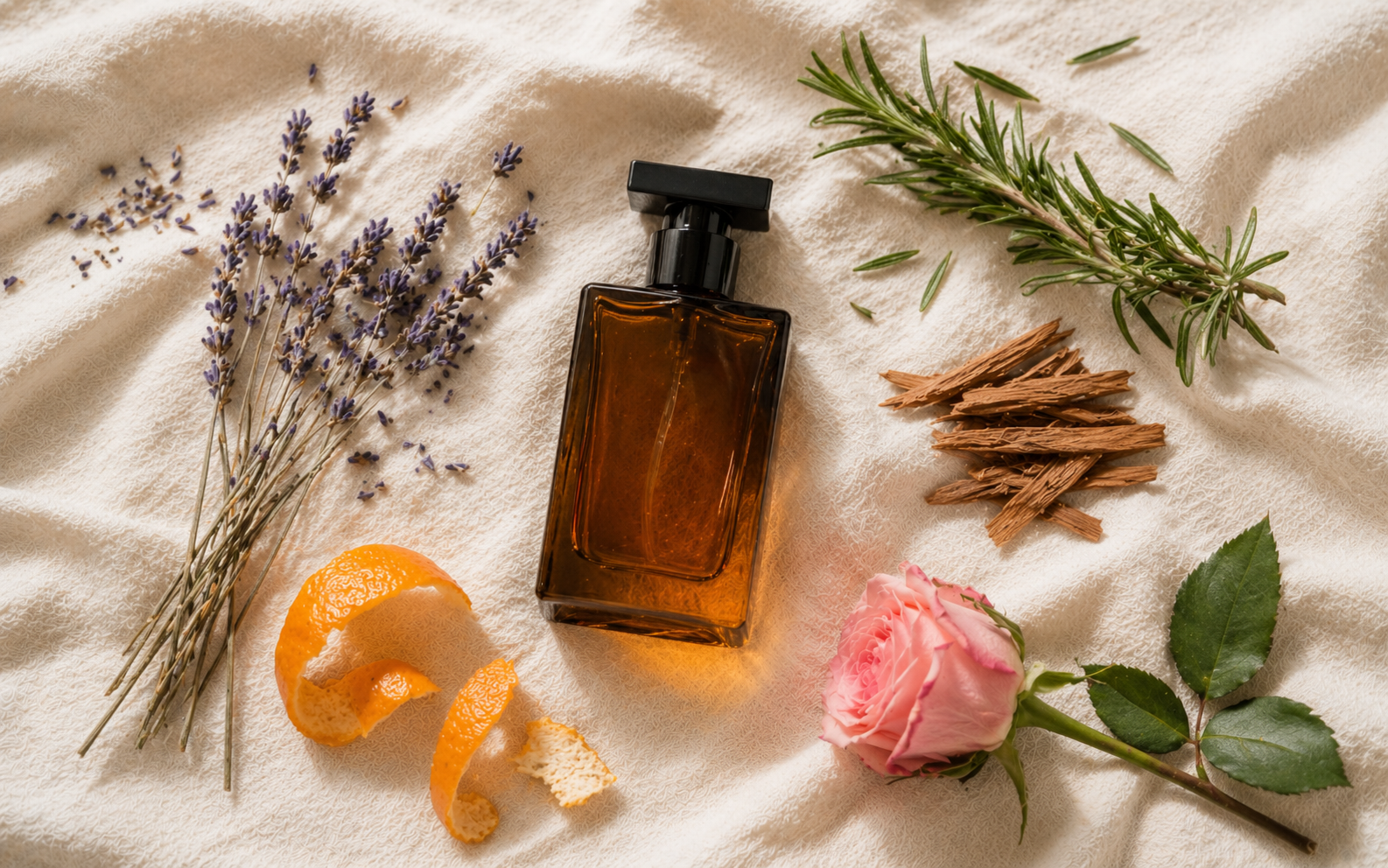
The "notes" in a fragrance are the individual scents you can perceive within it. Each note has its own character — bergamot is bright and citrusy, rose is floral and slightly sweet, sandalwood is warm and creamy. A perfume is built by blending many notes together, but they don't all hit your nose at once.
The reason: different scent molecules have different molecular weights, which means they evaporate at different rates. Light molecules float off your skin first; heavy molecules cling longer. This is the entire science behind why perfume smells different at hour 1 than at hour 6.
Perfumers organize this evaporation sequence into three categories: top notes, heart notes, and base notes. A well-composed fragrance has all three working together — opening with brightness, evolving into warmth, and settling into something that lasts.
The three-note system is sometimes called the "fragrance pyramid." Almost every perfume description you read — on bottles, brand websites, or fragrance review sites — uses this structure. Once you can read it, you can roughly predict how a fragrance will behave before ever spraying it.
The three layers and how they unfold
Top notes (the first impression)
What you smell in the first 5–30 minutes after spraying. These are the lightest, most volatile molecules — they make the strongest immediate impression but disappear fastest.
Common top notes:
- Citrus: bergamot, lemon, mandarin, grapefruit
- Light fruits: apple, pear, blackcurrant
- Herbs: lavender, basil, mint, rosemary
- Sparkling notes: aldehydes, ozonic accords
- Spices: pink pepper, ginger
Their job: grab attention. Top notes are designed to be appealing the moment a fragrance hits your nose at the perfume counter. They make you stop and pay attention.
What they're not: the actual character of the perfume. Many people choose fragrances based on top notes and end up disappointed when the dry-down doesn't match. Always wait past the top notes before judging.
Heart notes (the personality)
What you smell from roughly 30 minutes to 4 hours after application. Heart notes emerge as top notes fade and form the main personality of the fragrance.
Common heart notes:
- Florals: rose, jasmine, ylang-ylang, lily of the valley, peony, neroli, tuberose
- Fruits: peach, plum, apricot, raspberry
- Spices: cinnamon, cardamom, clove, nutmeg
- Greens: violet leaf, fig leaf, tea
- Tropical: coconut, frangipani
Their job: give the fragrance its identity. When someone says a perfume "smells like roses" or "smells warm and spicy," they're usually describing the heart notes.
What to know: if a fragrance description leads with the heart notes, the perfumer wants you to remember that scent specifically. Heart notes are often the marketing hook of the perfume.
Base notes (the foundation)
What you smell from 4 hours onward, often lasting 8–12 hours. The heaviest, slowest-evaporating molecules — they form the long-lasting "dry-down" that becomes the fragrance's true character on your skin.
Common base notes:
- Woods: sandalwood, cedar, oud, vetiver
- Musks: white musk, animal musks (synthetic versions)
- Resins: amber, frankincense, myrrh, benzoin
- Vanilla and gourmands: vanilla, caramel, tonka bean
- Leather: leather accord, suede
- Patchouli (deep, earthy)
Their job: linger. Base notes are what other people smell when they hug you 6 hours after you applied your perfume. They're also what makes a fragrance "memorable" — base notes anchor the entire scent in your memory.
What this means for you: if you don't love the base notes of a fragrance, you won't love wearing the perfume — full stop. Always smell a perfume after 4+ hours before deciding.
| Layer | When you smell it | Character | Examples |
|---|---|---|---|
| Top notes | 0–30 minutes | Bright, sparkling, fresh | Bergamot, lemon, lavender |
| Heart notes | 30 min – 4 hours | Round, defining, characteristic | Rose, jasmine, peach |
| Base notes | 4 hours – 12+ hours | Deep, warm, lasting | Sandalwood, vanilla, musk |
The major scent families
Beyond individual notes, fragrances are grouped into broader "families" based on their overall character. Knowing your preferred families is more useful than knowing individual notes — it dramatically narrows your search.
Floral
The largest family. Built around flower notes — rose, jasmine, peony, gardenia, lily, violet. Can be soft and powdery, bright and fresh, or rich and intoxicating depending on which flowers and what they're blended with.
If you like: classic feminine perfumes, flower gardens, fresh bouquets.
Citrus / Hesperidic
Built around citrus oils — bergamot, lemon, neroli, grapefruit. Light, fresh, energetic. Often dry down to clean musks or light woods.
If you like: fresh-out-of-shower scents, summer fragrances, anything described as "clean" or "uplifting."
Woody
Built around woods — sandalwood, cedar, vetiver, patchouli, oud. Warm, grounded, sophisticated. Can be smooth and creamy (sandalwood) or sharp and earthy (vetiver).
If you like: walks in forests, the smell of old libraries, cashmere sweaters.
Oriental / Amber
Built around resins, spices, and sweet warm notes — vanilla, amber, benzoin, cinnamon, cardamom. Rich, warm, often described as "exotic" or "sensual." Generally heavier and more dramatic than other families.
If you like: warm spices, candle stores, baking smells.
Fresh / Aquatic
Built around clean, watery, ozonic notes — sea salt, calone (a synthetic that smells like ocean breeze), cucumber, melon. Light, modern, often unisex.
If you like: ocean air, fresh laundry, anything described as "crisp" or "watery."
Gourmand
Built around food-like notes — vanilla, caramel, chocolate, coffee, almond, honey. Sweet, comforting, often associated with cozy or romantic moods.
If you like: bakeries, hot chocolate, dessert. Generally beloved or hated — there's not much middle ground.
Chypre
A classic structure built around bergamot, oakmoss, and labdanum. Sophisticated, slightly bitter, vintage feeling. The defining structure of many classic French perfumes.
If you like: vintage glamour, complex unisex scents, anything described as "mossy" or "old-school."
Fougère
Built around lavender, oakmoss, and coumarin (which smells like fresh hay). Most "masculine" colognes are fougères, though the family is increasingly worn unisex.
If you like: classic barbershop scents, herbaceous freshness, traditional men's fragrances.
Common notes you'll encounter
A reference for what you'll see in fragrance descriptions:
| Note | What it smells like | Usually appears as |
|---|---|---|
| Bergamot | Bright, slightly bitter citrus | Top note |
| Rose | Floral; can be fresh, jammy, or powdery | Heart note |
| Jasmine | Sweet, narcotic floral | Heart note |
| Sandalwood | Warm, creamy, milky wood | Base note |
| Vanilla | Sweet, warm, baking-like | Base note |
| Patchouli | Earthy, slightly sweet, distinctive | Base note |
| Vetiver | Smoky, grassy, slightly bitter | Base note |
| Iris | Powdery, soft, slightly carrot-like | Heart note |
| Oud | Deep, smoky, animalic wood | Base note |
| Lavender | Fresh, herbaceous, slightly sharp | Top or heart note |
| Tonka bean | Sweet, almond-like, hay-like | Base note |
| Musk | Soft, skin-like, clean or sensual | Base note |
| Amber | Warm, sweet, slightly resinous | Base note |
| Neroli | Bright orange blossom | Top or heart note |
| Tuberose | Heady, creamy, dramatic floral | Heart note |
How to properly test a fragrance
The biggest mistake in perfume shopping: choosing based on the first 30 seconds. Top notes can be misleading — a fragrance that smells incredible at the counter might smell completely different on your skin 4 hours later. Real fragrance testing takes time.
The right way to test
- Test on your skin, not on paper. Paper test strips only show top notes and don't react with your body chemistry. Always test on the inside of your wrist or the inner forearm.
- Test only 2–3 fragrances per visit. Your nose becomes overwhelmed quickly. After 3 perfumes, you can't reliably distinguish anything.
- Don't rub your wrists together. Rubbing breaks down the molecular structure of certain notes and changes what you smell. Press lightly if needed; don't rub.
- Walk away from the perfume counter. Surrounded by other scents, your nose can't focus.
- Wait at least 2 hours, ideally 4+. The dry-down (base notes) is what you'll actually wear. Judge based on this, not the first impression.
- If possible, sleep on it. Best fragrance you tested earlier in the day? Smell your wrist at bedtime. If you still love it, that's a real signal.
Stores like Sephora and Ulta typically offer small free samples on request. Ask for a 1ml decant of any fragrance you're considering. This lets you wear it home, sleep on it, and try it across different days and outfits before committing to a full bottle.
Why fragrances smell different on different people
"This one smells amazing on my friend but terrible on me" — almost everyone has experienced this. There's real chemistry behind it.
Skin pH
Skin pH varies between individuals (usually between 4.5 and 6.5). More acidic skin tends to make sweet, gourmand fragrances smell sharper. More alkaline skin can amplify musky and woody notes.
Sebum levels
Oily skin holds fragrance longer than dry skin. Sebum acts as a natural fixative, slowing the evaporation of every layer. This means oily-skinned people often experience the same perfume as more "intense" or longer-lasting than dry-skinned people do.
Body temperature
Warmer skin diffuses fragrance more strongly. People who run hot will project a fragrance further than people who run cool — meaning the same perfume can be a "scent bubble" on one person and a "skin scent" on another.
Diet and medication
What you eat affects how perfume smells on you, sometimes significantly. Heavy garlic, alcohol, and certain medications can shift body chemistry temporarily. Hormonal changes (pregnancy, menstrual cycles, menopause) can shift it more permanently.
Age
Skin chemistry shifts over decades. A perfume that smelled great on you at 20 may smell different at 40 — not because the perfume changed, but because you did.
Don't buy a perfume because it smells incredible on someone else. Skin chemistry is enough to make the same perfume completely different. Always test on your own skin and judge from there.
How to choose notes you'll love
Once you understand the structure, choosing fragrances becomes a process of elimination — not guesswork.
Step 1: Identify your scent associations
What smells in your everyday life do you actively enjoy? Coffee? Pine forests? Fresh laundry? Books? Roses in bloom? These are clues to your underlying preferences.
| If you love... | You'll likely enjoy these note families |
|---|---|
| Coffee, dessert, baking smells | Gourmand, oriental, vanilla-based |
| Pine forests, rain, woody scents | Woody, green, chypre |
| Fresh laundry, ocean, clean smells | Aquatic, clean musk, fresh citrus |
| Flower gardens, perfumed spaces | Floral, soliflore (single-flower scents) |
| Tea, books, antique stores | Powdery, iris-based, vintage chypres |
| Spice markets, warm cafés | Oriental, spicy, amber-based |
| Citrus desserts, fresh fruit | Fruity, citrus, sparkling |
Step 2: Read the note pyramid before testing
Most fragrance brands publish the top/heart/base note breakdown on their websites. Read it before going to the counter. If a perfume's base notes don't include anything you love, you probably won't enjoy wearing it long-term — regardless of how the top notes smell.
Step 3: Look for one signature note you love
Pick one note you genuinely love (rose, vanilla, sandalwood, whatever). Search for fragrances that use that note prominently in the heart or base. This narrows hundreds of options to a manageable shortlist.
Step 4: Sample before buying
Buy a 1–2ml sample of each shortlisted fragrance before committing to a full bottle. Sites like LuckyScent and Surrender to Chance ship samples for $3–8 each. Wearing a fragrance for a full day across a week tells you everything a 30-second store sniff can't.
The bottom line: Fragrance notes aren't perfume jargon — they're a roadmap. Top notes hook you. Heart notes define the experience. Base notes determine whether you'll actually love wearing the perfume. Test on your skin, wait through the dry-down, and pay attention to which note families show up in scents you already love. Once the structure makes sense, choosing a fragrance you'll genuinely enjoy stops being a gamble.