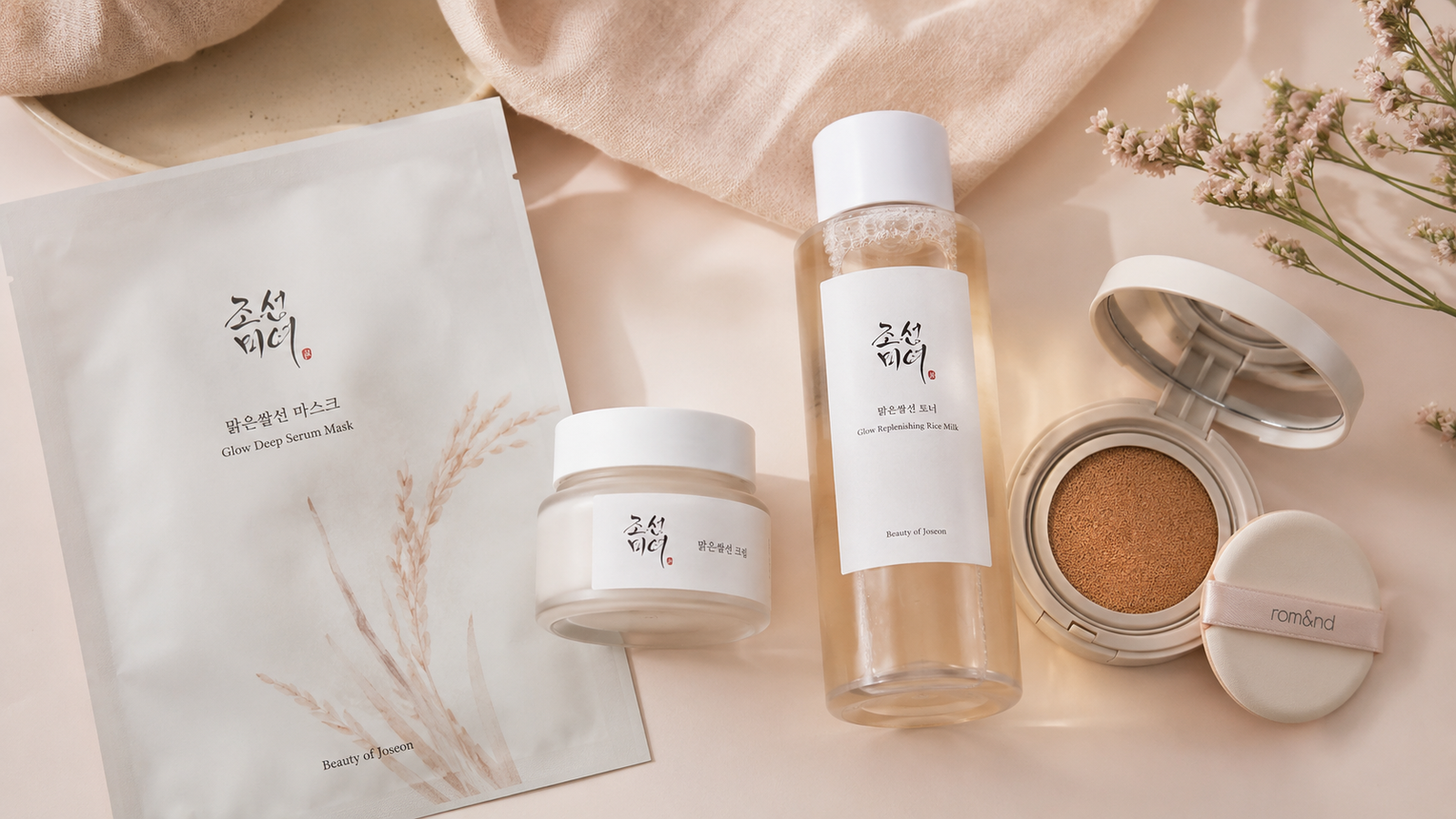
What is Korean beauty, actually?
"Korean beauty" or "K-beauty" refers to skincare and cosmetics that originated in or are associated with South Korea. The term went global around 2011–2014, when Korean brands like Missha, Innisfree, and TonyMoly began exporting widely and Western beauty journalists started covering Korean routines.
But "K-beauty" isn't a single thing. It's a marketing umbrella that covers at least five distinct things:
- Products made by Korean beauty brands
- Skincare philosophies associated with Korean culture
- Particular ingredients (snail mucin, propolis, centella, fermented extracts)
- A multi-step routine approach
- Aesthetic ideals like "glass skin" or "honey skin"
The most important thing to understand upfront: a product made by a Korean brand isn't automatically better, and a Western product borrowing K-beauty principles isn't automatically worse. The "Korean" label means manufactured in Korea. The actual quality depends on the formulation, like any skincare product anywhere.
The cultural origins of K-beauty
Korea has a long tradition of skincare practices rooted in hanbang — traditional Korean medicine that uses botanical ingredients like ginseng, green tea, and red ginseng for skin health. These practices predate the modern K-beauty industry by centuries.
The modern K-beauty boom started in the 1980s and 1990s when Korean companies like AmorePacific (which owns Sulwhasoo, Laneige, and Innisfree) began heavy R&D investment. Korean culture's emphasis on clear skin, combined with intense domestic competition in the beauty market, accelerated innovation. By the early 2010s, Korean skincare was producing genuinely novel formulations and ingredient combinations that Western brands had been slow to adopt.
The global breakthrough came from a combination of factors:
- Korean pop culture (K-pop, K-dramas) showcasing flawless complexions
- Affordable price points compared to Western luxury skincare
- Innovative packaging and product formats (sheet masks, BB creams, cushion compacts)
- Strong online beauty communities championing the routines
By 2016, K-beauty was a multi-billion-dollar global export. By 2020, Western brands were openly copying Korean formulation approaches. By 2026, the lines between K-beauty and Western skincare have blurred significantly — but the principles K-beauty popularized still drive a lot of the industry.
The famous 10-step routine — what it really is
The "10-step Korean skincare routine" is the most famous (and most misunderstood) aspect of K-beauty. The full routine consists of:
- Oil cleanser — removes makeup and sunscreen
- Water-based cleanser — removes sweat, dirt, residue
- Exfoliator — physical or chemical, used a few times a week
- Toner — preps skin and adds first hydration layer
- Essence — lightweight hydrating treatment, K-beauty's signature
- Treatment (serum or ampoule) — concentrated active ingredient
- Sheet mask — occasional treatment, 2–3 times a week
- Eye cream — targeted hydration for the eye area
- Moisturizer — locks everything in
- Sunscreen (AM) or sleeping pack (PM) — protection or overnight treatment
Here's the honest reality: even most Koreans don't do all 10 steps every day. The original idea wasn't that you do all 10 daily — it was a framework showing different categories of products you might use. A typical day might include 5–7 of these. Sheet masks happen 2–3 times a week. Exfoliation is once or twice a week.
The "10-step" name caught on in Western media because it was novel and headline-friendly. The actual Korean approach is more flexible than the name suggests.
What the 10-step framework genuinely emphasizes:
- Hydration in multiple layers — toner, essence, serum, and moisturizer each add water at different levels
- Gentle cleansing — double cleansing isn't aggressive; it's two milder cleansers instead of one harsh one
- Sunscreen as essential — daily SPF was a K-beauty principle long before it became Western mainstream advice
The number of steps matters far less than what's actually in each product. A 3-step routine with the right cleanser, treatment, and SPF outperforms a 10-step routine of mediocre products. K-beauty's real lesson isn't "more is better" — it's "the right things, applied gently, consistently."
K-beauty's most-talked-about ingredients
Several ingredients became famous through K-beauty marketing. Here's what each actually does:
Snail mucin (snail secretion filtrate)
The most iconic K-beauty ingredient. It's literally snail slime, harvested without harming the snails. Contains glycoproteins, hyaluronic acid, peptides, and antioxidants. The research is moderate — some studies show wound-healing and modest hydration benefits. It's safe for most skin types and works as a lightweight hydrator. Useful and gentle, but not the miracle ingredient marketing suggests.
Centella asiatica (cica)
Also called gotu kola. An herb with strong anti-inflammatory and wound-healing properties. The active compounds (madecassoside, asiaticoside) are well-studied in clinical research. Excellent for sensitive, irritated, or compromised skin barriers. One of the strongest K-beauty contributions to Western skincare — now widely used outside Korea too.
Propolis
A resin produced by bees with antimicrobial and antioxidant compounds. Used in K-beauty for acne-prone and irritated skin. Genuinely useful, though specific bee-product allergies are possible (always patch test).
Fermented ingredients (galactomyces, bifida ferment)
Yeast-fermented extracts containing amino acids and vitamins. Marketed for "glow" and "skin balance." The evidence is moderate — some studies show modest hydration and texture improvements. Pleasant to use, generally gentle, but not transformative.
Ginseng
Traditional hanbang ingredient with antioxidant properties. Marketed heavily for anti-aging. Pleasant in formulation, but the topical anti-aging benefits are smaller than marketing suggests.
Niacinamide and hyaluronic acid
Not K-beauty-specific, but Korean products often use them at higher concentrations and lower prices than Western equivalents. The actives themselves are universal.
If you want to try one K-beauty ingredient, start with centella (cica). It has the strongest research backing, the lowest irritation risk, and works for nearly every skin type. Products containing 5%+ centella extract are widely available from brands like Purito, Beauty of Joseon, and Skin1004.
The K-beauty principles worth borrowing
These K-beauty habits genuinely improve skin, even if you never buy a Korean product:
Hydration in layers
Applying multiple light, hydrating products (toner → essence → serum → moisturizer) lets your skin absorb water gradually. The result is skin that feels more comfortable than slathering on one heavy cream. You can do this with Western products — the principle, not the brand, is what matters.
Gentle double cleansing
Two mild cleansers (oil first, then water-based) remove makeup and sunscreen more thoroughly than one harsh cleanser, without stripping your skin barrier. This is universally useful for anyone who wears SPF or makeup.
Daily sunscreen, every day, consistently
K-beauty popularized lightweight, cosmetically elegant sunscreens that people actually want to wear daily. Korean sunscreens remain among the most pleasant to use globally. This single habit does more for long-term skin health than any treatment product.
Sheet masks as occasional treatments
Once or twice a week, a hydrating sheet mask is a pleasant 15-minute ritual that briefly boosts skin moisture. Not transformative on its own, but a useful add-in.
Patience and consistency
K-beauty culture emphasizes that visible results take weeks to months, not days. This is biologically accurate and worth internalizing. Skincare works on the timeline of skin cell turnover (about 28 days), not Instagram before-and-after timelines.
What's overhyped about K-beauty
"Glass skin" as a universal goal
Glass skin describes skin so clear, smooth, and luminous that it reflects light like glass. Some people can approach this look with skincare and lifestyle. Most cannot, because pore size, skin texture, and natural luminosity are largely genetic. Working toward healthy skin is achievable. Working toward glass skin specifically can be frustrating if your skin's underlying biology won't cooperate.
The 10-step routine as something everyone should do
Most people don't need 10 steps. A simple 3–5 step routine with proven products outperforms 10 steps of mediocre ones. The aesthetic of an elaborate routine is real, but the skin benefit doesn't scale with step count.
Specific ingredients as "Korean secrets"
Most K-beauty ingredients are available globally. Some Korean brands use them at better concentrations or in better formulations, but there's no proprietary "Korean ingredient" you can't get elsewhere. Snail mucin essence from a Korean brand and one from a Western brand often perform similarly.
Snail mucin as transformative
Snail mucin is genuinely useful as a gentle hydrator with mild wound-healing properties. It's been marketed as transformative. It's not. Use it because you enjoy the texture and want a gentle hydration layer — not because you expect miracles.
Be skeptical of K-beauty marketing claims that sound too good. "Reverses aging in 7 days," "instant glass skin," "20 years younger" — these are marketing language, not skincare science. Real skincare benefits arrive over months, not days. If a product promises overnight transformation, it's likely either an irritant masquerading as a result, or a temporary cosmetic effect that wears off after washing.
How to try K-beauty without buying 20 products
If you want to test K-beauty principles without overhauling your routine:
Add one K-beauty product to your existing routine
A snail mucin essence (under $20 from COSRX, Beauty of Joseon, or Some By Mi) is a low-risk introduction. Use it after cleansing, before moisturizer. Give it 6–8 weeks before judging.
Try the layering approach
Apply your existing toner, then a hydrating serum, then your moisturizer. You don't need K-beauty-branded products to do this. The layering principle works with any well-formulated lineup.
Swap your sunscreen for a Korean one
Korean sunscreens are still arguably the best in the world for texture and cosmetic elegance. Brands like Beauty of Joseon (Relief Sun), Round Lab (Birch Juice), and Anessa offer SPF 50+ that feels weightless. If sunscreen has been an obstacle for you, this single swap can fix the daily-wear problem.
Try one sheet mask a week
Pick up a single sheet mask for $2–4 and use it on a Sunday evening. See if you like the ritual before buying a multi-pack.
Don't buy a full Korean routine on day one
If something works for you, great — expand from there. If it doesn't, you haven't spent $200 on products sitting unused in your bathroom.
K-beauty vs Western skincare in 2026
The gap has narrowed dramatically over the past decade. Western brands have adopted K-beauty principles — lightweight sunscreens, hydration-focused routines, gentler formulations. Korean brands have adopted Western actives like retinol and stronger acids.
The remaining differences:
| Category | K-beauty advantage | Western advantage |
|---|---|---|
| Sunscreens | Significantly better texture and elegance | — |
| Hydrating essences | Still distinctive; gentler formulations | — |
| Mid-tier pricing | Better quality-to-price ratio | — |
| Novel ingredients | Faster adoption (snail, propolis, fermented) | — |
| Strong actives | — | Better retinol, vitamin C, exfoliants |
| Clinical research | — | More peer-reviewed studies per ingredient |
| Sensitive-skin formulations | Tie — both excellent now | Tie |
The best modern routine often combines both — Korean hydration and sunscreens, Western actives. The geography of where a brand is based matters less now than which specific products fit your skin.
The bottom line: Korean beauty's lasting contribution isn't a 10-step routine or any single ingredient. It's a shift in how the global skincare industry thinks about gentleness, hydration, consistent SPF, and cosmetic elegance. Borrow the principles, try one or two products, ignore the "glass skin overnight" marketing, and build a routine that fits your skin and your life. The number of steps doesn't matter. The right products, applied consistently, do.