What "AI beauty tests" actually means in 2026
"AI beauty test" has become an umbrella term covering very different kinds of tools, with very different purposes and very different consequences for users.
By the start of 2026, the category includes:
- Face-rating apps — "score" your attractiveness against an algorithmic ideal (Pretty Scale, beauty calculators, some viral TikTok tools)
- Facial analysis services — detailed reports rating your features against specific aesthetic frameworks (Qoves Studio is the most notable)
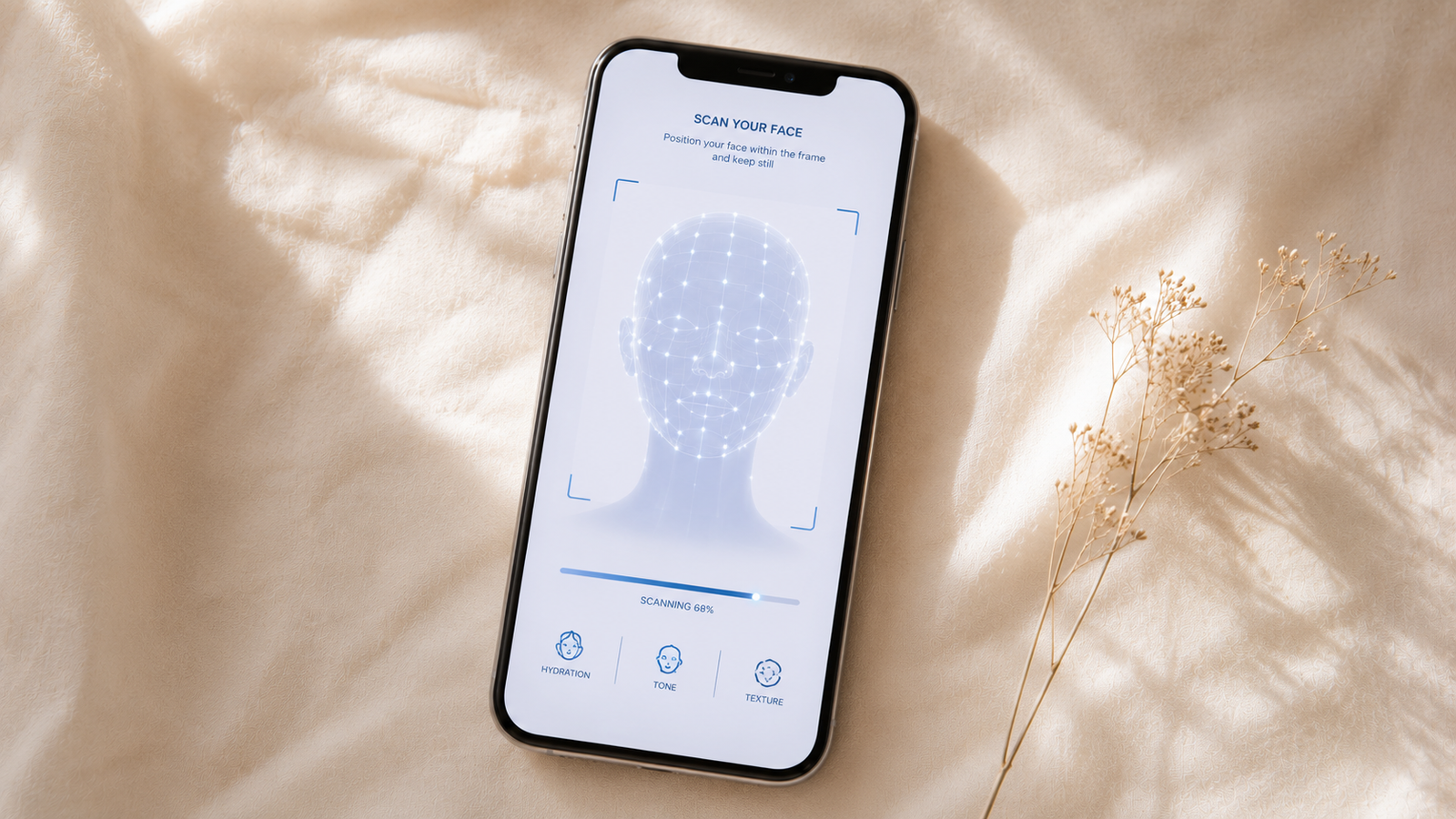
- Skin analysis apps — photograph your skin to identify concerns and recommend products (HelloAva, various brand-specific tools)
- Virtual makeup try-on — overlay makeup digitally on your face for purchase decisions (Sephora Virtual Artist, YOUCAM Makeup, ModiFace)
- Virtual hair color and style try-on — preview hair changes before committing (Madison Reed, various salon apps)
- Beauty filter apps — automatically "enhance" your face in photos and videos (FaceTune, beauty filters on TikTok, Snapchat, Instagram)
- Aging and transformation apps — show how you might look older, younger, or with different features (FaceApp is the famous one)
- Skin condition recognition — medical-adjacent tools attempting to flag concerning skin issues
These are radically different tools with different use cases, different evidence, and different harms. Treating them as one category causes confusion. The first step in evaluating any "AI beauty tool" is identifying which category it actually belongs to.
How the algorithms actually work
Most AI beauty tools use machine learning models trained on large datasets of face images. The basic process:
- Developers collect millions of face photos, often from public social media or licensed image databases
- The photos are labeled (sometimes by human raters, sometimes by other algorithms) according to whatever attribute the model needs to learn — "attractive," "young," "smooth skin," etc.
- A machine learning model studies the patterns that distinguish high-rated from low-rated photos
- When you upload your photo, the model compares your features against the patterns it learned and outputs a result
Two things to understand about this process:
The model has no concept of "beauty"
It doesn't know what beauty is. It only knows what features its training data correlated with whatever label it was given. If the training data labeled certain features as "high beauty" — those features become "high beauty" in the model. The model's output is a reflection of the training data, not a measurement of an objective property.
The model can be very confident and very wrong
AI models produce outputs with high apparent confidence even when they're statistically extrapolating beyond their training data. A model trained mostly on East Asian or Western faces, fed an image of a Sub-Saharan African or South Asian face, will still produce a "score" — but the score's meaning is essentially noise. The user has no way to see this limitation from the output.
The training data problem
This is the central technical issue with AI beauty tools and worth understanding clearly.
Beauty rating algorithms are trained on datasets that overrepresent specific demographics:
- Younger faces — much of the available training data comes from social media accounts of users under 35
- Already-edited faces — many training images have already been filtered, smoothed, or retouched, encoding "edited" appearance as baseline
- Specific ethnicities overrepresented — training data tends to overrepresent Western European, East Asian, and certain Latin American features
- Conventional poses and lighting — frontal, well-lit, neutral expression photos
- Cisgender presentation — algorithms trained primarily on cisgender faces produce confused outputs for trans, non-binary, or gender-nonconforming users
- Conventional grooming — makeup-friendly faces, common Western hair textures
The result: AI beauty scores reproduce the biases of social media beauty culture rather than measuring anything objective. A face that scores low against the algorithm is a face that doesn't match the demographics that dominated the training data. That's not an aesthetic judgment — it's a statistical observation about which photos the algorithm saw most often.
When an AI tool returns a "beauty score," it's telling you how well your face matches its training data, not whether you're beautiful. These are completely different things. The framing as "objective measurement" is the central deception in the entire category of beauty rating apps.
AI rating apps — the harmful category
Apps and services that explicitly "rate" attractiveness — Pretty Scale, various TikTok beauty calculators, Beauty Score apps, and similar tools — are the most clearly problematic AI beauty category.
The fundamental problem
The category sells "objective beauty assessment" as the product. Since objective beauty doesn't exist (see our piece on beauty standards across cultures), the underlying product is fictional. What's being delivered is conformity-to-training-data scoring, marketed as scientific measurement.
Specific tools worth knowing
Pretty Scale and similar web calculators: These analyze uploaded photos against simple proportional rules from classical aesthetic theory (the "golden ratio," symmetry measures). They give numerical "beauty percentages." Technically very simple; aesthetically baseless. Entertainment at best, harmful at worst.
Qoves Studio: The most rigorous tool in this space, offering paid detailed reports analyzing features against cosmetic surgery aesthetic frameworks. The analysis is technically thorough but rests on the same problematic premise — that there's an objective beauty standard to measure against. Qoves' criteria align with current Western cosmetic surgery norms, which themselves reflect specific cultural preferences. The reports often serve as cosmetic surgery roadmaps, which raises the harm question further.
TikTok and Instagram beauty score filters: Casual filter-based tools that pop up periodically as trends. These are typically the simplest and most arbitrary of the category. Their viral nature makes them especially harmful — they get to millions of young users without context for how poorly they actually measure anything.
"Symmetry analyzers": A subset of rating tools that focus specifically on facial symmetry. Symmetry research has found a small statistical preference for symmetric faces across cultures, but real human faces are never perfectly symmetric — and the small preference effect doesn't translate to "score your face for symmetry to see how attractive you are." The math is doing different work than the interpretation suggests.
If you or someone you know — especially a teenager — is using AI beauty rating apps regularly, the documented mental health impact is significant. The pattern is that scores get internalized as objective verdicts on self-worth, and users compare scores compulsively or "improve" their photos to get higher numbers. This is not a small effect: it's been linked to rising rates of cosmetic procedure requests, body dysmorphic disorder symptoms, and depression in younger users. Periodic experimentation is different from regular use; the latter has costs.
AI skin analysis — useful with caveats
AI skin analysis apps occupy a more legitimate middle ground. These tools photograph your skin and identify visible concerns — acne, hyperpigmentation, fine lines, redness, dryness, texture — then often recommend products or routines.
What they do well
- Identify common visible concerns at roughly the level of an attentive observer
- Track changes over time when used consistently with similar lighting
- Suggest reasonable routine starting points based on identified concerns
- Provide structure for people who feel overwhelmed by beauty product variety
- Demonstrate consistency in tracking for people building routines
What they don't do
- Diagnose medical conditions. AI skin analysis cannot reliably distinguish between conditions that look similar (acne vs perioral dermatitis vs rosacea vs fungal acne)
- Evaluate suspicious moles. Skin cancer screening requires dermatologist examination — AI tools are not approved for this purpose despite occasional marketing implications
- Replace clinical judgment. When skin conditions persist or worsen, professional evaluation is needed
- Account for lifestyle factors. Sleep, stress, diet, hormones, and medications affect skin in ways photos can't capture
Notable AI skin analysis tools
Brand-specific tools: Most major skincare brands now offer AI skin analysis built into their apps or websites — L'Oréal's Skin Genius, Olay's Skin Advisor, La Roche-Posay's Effaclar Spotscan for acne. These are reasonable for general routine recommendations from the brand's product line. They're also designed to recommend that brand's products.
Third-party skincare AI: Apps like HelloAva, Skintype, and various startup tools attempt brand-neutral analysis. Quality varies. Some are useful; some are largely marketing wrappers around simple algorithms.
Dermatology-adjacent tools: A growing category of apps positions itself between consumer beauty and medical use. Some are FDA-cleared for specific purposes; many are not. Read the regulatory status carefully — "FDA-registered" is not the same as "FDA-cleared" or "FDA-approved."
Virtual try-on tools — the legitimate category
Virtual try-on technology — using augmented reality to overlay makeup, hair colors, eyewear, or other beauty products on your face image — is the most consistently legitimate category of AI beauty tools.
This makes sense: virtual try-on doesn't claim to measure anything. It just shows you what something might look like before you buy it. The premise is honest.
What works well
The major retailer and brand try-on tools — Sephora's Virtual Artist, YOUCAM Makeup, ModiFace (powered by L'Oréal), the Ulta GLAMlab — have become genuinely useful for makeup buying decisions. You can see how a lipstick shade actually looks on your skin tone before committing. You can try ten foundation matches without leaving your house. For people who hate makeup counters or live far from them, this is real consumer benefit.
Limitations to know
- Color accuracy varies. Your phone's display, camera, and lighting all affect color rendering. The lipstick will look slightly different in real life than in the AR preview.
- Texture and finish are approximate. Matte, satin, and glossy finishes are simulated reasonably but not exactly
- Performance varies. How a product wears throughout the day — fading, transferring, settling into lines — can't be predicted from a still preview
- Skin texture and tone interaction isn't fully captured. A foundation may match your skin tone in the AR preview but not match the texture of your skin in person
Worth using
For shade selection, color experimentation, and general "what would this look like" curiosity, virtual try-on tools are useful and largely harm-free. They don't rate or score anything; they just visualize.
Mental health, minors, and filter dysmorphia
This section is the most important. The mental health implications of AI beauty tools, particularly rating apps and filters, have become well-documented.
The pattern of harm
Several studies in the past five years have established consistent findings:
- Heavy filter use correlates with body image dissatisfaction, particularly among adolescent girls and young women
- "Snapchat dysmorphia" — the term coined by cosmetic surgeons in the late 2010s — describes patients seeking surgery to look like their filtered selves rather than like specific other people. This category of consultation has grown substantially
- Comparison between filtered and unfiltered versions of yourself creates a baseline expectation that your real face is the deficient version
- Algorithmic beauty scores get internalized as identity statements ("I'm a 6") rather than understood as noise from a flawed measurement
- Compulsive use patterns — repeatedly testing rating apps, comparing across photos, modifying photos until they "rate higher" — show parallels with disordered behaviors
The age factor
The harm is concentrated in adolescents and young adults whose self-image is still forming. A 15-year-old whose first regular interaction with their own face is through filters and AI scores is forming their baseline self-perception against an algorithmically optimized version. This isn't an edge case — it's increasingly the median experience among teens with smartphones.
Parental and educator awareness of this has lagged the technological deployment. Many parents don't realize how saturated their teens' digital lives are with AI face manipulation. Many teens don't realize how unusual their relationship to their own image has become.
What helps
- Limit baseline filter use. Posting regularly with filters is fine; never seeing yourself unfiltered is the problem
- Don't return to rating apps. One-time curiosity is different from regular use. Regular use does cumulative harm
- Notice the comparison pattern. If you find yourself constantly checking your face against filtered versions, that's the pattern to interrupt
- Recognize algorithmic verdicts as algorithmic, not personal. "The algorithm gave me 6/10" is not "I am a 6/10." These are completely different statements.
- Professional support. Body dysmorphic disorder is treatable. If beauty filters and AI tools have become tied to persistent distress about your appearance, professional mental health support is genuinely useful — this is documented territory now, not a fringe concern.
Privacy and your face data
Less emotionally weighted but practically important: every AI beauty tool requires you to upload your face data, which has implications worth knowing.
What face data is
Biometric data — including face images and the face-feature vectors AI tools extract from them — is among the most sensitive personal data because it identifies you uniquely and can't be changed. Compromised passwords can be reset; your face structure cannot.
What apps typically do with your data
- Store it on company servers — usually noted in terms of service, often without specific deletion guarantees
- Use it to improve their models — your photo may train future versions of the algorithm
- Share with third parties — varies by app; some are transparent, some aren't
- Retain after account deletion — some retain data indefinitely regardless of account status
- Subject it to the laws of the country the company operates in — which may differ from your country's privacy protections
Apps with specific privacy concerns
FaceApp: Russian-owned Wireless Lab developed FaceApp. The company's data handling practices have been criticized by privacy researchers. The terms of service grant broad rights to user-uploaded images. The harm risk to specific users is unclear, but data sovereignty concerns are real.
TikTok beauty filters: TikTok's data practices have been controversial in many jurisdictions, with several countries restricting government employee use. Beauty filters add face-feature extraction on top of base data collection.
Anonymous "free" beauty calculators: Web-based "upload a photo to see your beauty score" tools often have no privacy policy, unclear data retention, and unknown sharing practices. Treat any photo you upload to these as potentially distributed widely.
Better-practice apps
Established beauty retailers (Sephora, Ulta, major brand apps) and dermatology-aligned apps generally have clearer data practices. They're not perfect, but they at least have privacy policies, retention statements, and accountability structures. Brand-specific virtual try-on tools usually process face data locally on your device for the preview, which is privacy-friendlier than server-side processing.
Before uploading a face photo to any AI beauty tool, do a 30-second check: Is there a privacy policy linked from the app or website? Does it say how long data is retained? Is there a way to delete your account and have your data removed? If any of these answers are unclear or missing, assume your face data is being collected without specific protections. This is fine for established consumer apps from reputable companies; questionable for anonymous "viral" beauty scoring tools.
How to use AI beauty tools without the harm
If AI beauty tools have a place in your life, six principles for using them well:
1. Identify which category each tool belongs to
Before using any AI beauty tool, classify it: rating, analysis, or try-on. Different categories have different evidence behind them and different harm profiles. "AI beauty test" is not a coherent category.
2. Treat rating outputs as algorithmic, not personal
If you use a rating app once out of curiosity, treat the score as data about the algorithm, not about you. "The algorithm output X" is true; "I am X" is not.
3. Use skin analysis as a starting point, not a verdict
AI skin analysis gives reasonable routine suggestions. It doesn't replace dermatology when something seems wrong. When in doubt about persistent skin issues, see a professional.
4. Try-on tools are for buying decisions, not insecurity testing
Virtual try-on is genuinely useful for "will this lipstick suit me." It can also become "I look bad without this product" — that's a different and harmful use.
5. Limit baseline filter exposure
Use filters when posting fun content. Don't let them become the only version of your face you regularly see. The ratio of filtered to unfiltered viewing matters.
6. Treat face data as something you're giving away
Once uploaded, you don't fully control what happens to your photo. Pre-decide what you're comfortable uploading, to whom, for what purpose. Established brand apps are safer than anonymous viral tools.
The bottom line: AI beauty tools in 2026 are a varied category with very different consequences for users. Rating apps and beauty calculators sell algorithmic conformity as objective beauty — they have no scientific basis and cause documented mental health harm, particularly in younger users. Skin analysis tools are useful for routine recommendations but can't replace dermatology. Virtual try-on tools are the most consistently legitimate category — they don't claim to measure anything, they just visualize. Every category requires uploading face data, which has privacy implications worth understanding. Use these tools as specific aids for specific purposes — never as objective measurements of yourself. There is no AI tool that can measure your beauty because there's no such measurement to make.