Why storage matters more than people think
Perfume is essentially complex chemistry suspended in alcohol — and chemistry is sensitive to environmental conditions. Most people store fragrance casually (on a bathroom counter, in a sunny window, in a closet without temperature control) without realizing the cumulative impact on the product.
The honest scale of the problem
Industry estimates suggest that improper storage shortens perfume lifespan by 50–75% for most fragrances. A $150 bottle that should last 3 years of regular use might be noticeably degraded within 12 months when stored on a sunny bathroom counter.
This isn't a small consideration. Multiplied across a fragrance collection, poor storage represents real financial loss. A $500–1,000 fragrance collection deserves the same protection that's given to other valuable items — and the protection is simple, free, and immediate.
What proper storage actually preserves
- The original scent profile — the fragrance smells the way the perfumer intended
- The complete development — top, heart, and base notes all evolve as designed
- Longevity on skin — properly stored fragrance lasts longer when worn
- Projection — the strength of the fragrance you actually paid for
- The bottle's value — degraded perfume can't be returned or sold; preserved perfume can be
The hidden cost of poor storage
Beyond financial loss, poorly stored perfume creates a different problem: it stops smelling like the fragrance you fell in love with. Many people abandon perfumes they think "don't suit them anymore" when actually the bottle has degraded. Identifying that storage caused the problem — not your changing chemistry — opens the door to enjoying fragrances longer.
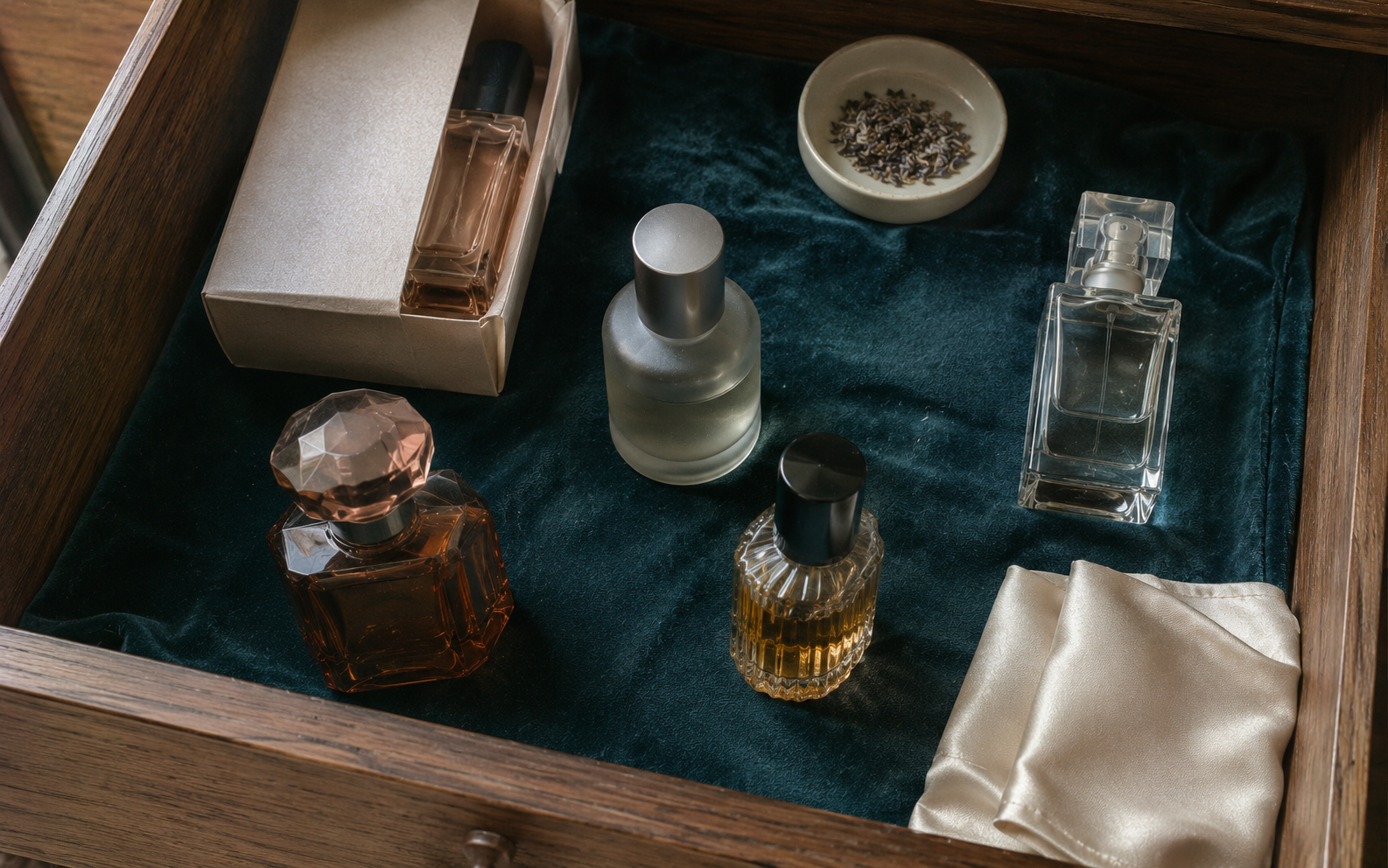
The single biggest fragrance preservation action you can take costs nothing: move your bottles from the bathroom or windowsill to a closed drawer or closet. This one change can double the effective lifespan of every fragrance you own.
What actually damages perfume
The four primary enemies of fragrance, in order of typical impact.
1. Heat (the biggest threat)
Heat accelerates the chemical breakdown of fragrance molecules. Higher temperatures cause:
- Faster degradation of natural ingredients (florals, resins, essential oils)
- Increased evaporation of volatile top notes
- Chemical reactions between fragrance components that weren't intended
- Color changes (clear fragrances may yellow, colored ones may darken)
Above 75°F (24°C), fragrance degradation accelerates noticeably. Above 85°F (29°C), damage accumulates rapidly. The ideal storage range is 60–70°F (15–21°C) — typical room temperature in air-conditioned homes.
2. Light (especially UV)
Ultraviolet light breaks down fragrance molecules through photochemical reactions. This is why most quality fragrances come in tinted or opaque bottles — they're designed for some light protection.
- Direct sunlight is the worst — can cause visible degradation within weeks
- Bright artificial light contributes over months
- UV from windows affects bottles displayed near windows even without direct sun
- Bathroom lighting (often fluorescent or LED) is less harmful but still cumulative
The simplest fix: store fragrances in their original boxes, or in any closed container where light doesn't reach the bottles.
3. Humidity
Humidity affects the alcohol base of fragrance and can introduce contaminants:
- High humidity (above 60%) can promote chemical reactions
- Humidity variation (the bathroom problem) damages more than steady humidity
- Closed boxes provide some protection but aren't humidity-proof
4. Temperature fluctuation
Repeated cycles of warming and cooling cause more damage than steady warm or cool storage. This is why:
- The bathroom is so harmful (rapid heating during showers, then cooling)
- Refrigeration isn't ideal (removing perfume from cold to room temperature creates cycles)
- Cars are terrible storage (extreme daily temperature swings)
- Windowsills with direct sun are damaging (heating during day, cooling at night)
5. Air exposure (after opening)
Once opened, oxygen gradually changes the fragrance. The atomizer or stopper minimizes air contact, but cumulative exposure happens with every use.
- Spray atomizers (most modern bottles) provide better air protection than open-stopper bottles
- Tightly closed splash bottles need to be sealed completely after use
- A nearly-empty bottle has more air-to-perfume ratio, so degrades faster than a full bottle
- Decanting (transferring perfume to smaller bottles) increases air exposure during the transfer
6. Vibration and movement (minor factor)
Repeated shaking can affect fragrance composition slightly over time. Not a major concern for normal home storage, but worth noting:
- Don't store perfume in regularly-disturbed locations (a drawer you open dozens of times daily)
- Avoid storing fragrance bottles next to washing machines or other vibration sources
- Travel jostling causes some damage but isn't significant for occasional trips
The bathroom storage problem
Most people store fragrance in their bathroom — and the bathroom is genuinely the worst home location for perfume.
Why bathrooms damage fragrance
- Shower steam — hot humid air contacts bottles and increases temperatures temporarily
- Humidity variation — bathrooms cycle between very humid (during/after showers) and normal humidity
- Temperature fluctuations — bathrooms heat up during showers, then cool quickly
- Light exposure — bathroom lighting and any window contribute to UV damage
- Heat from styling tools — hair dryers, curling irons create temperature spikes
The aesthetic conflict
Beautiful perfume bottles on a vanity look elegant — that's part of why people display them there. The honest tradeoff: aesthetic display vs. fragrance preservation. You can have either, but not really both with most fragrances.
If you must display perfume
If the aesthetic of displayed bottles matters to you, consider:
- Display empty or near-empty bottles you've finished, keeping unopened/full ones in storage
- Use decanters or atomizers in your bathroom for current use, keeping the main bottles in proper storage
- Place display bottles away from the shower area in larger bathrooms
- Use opaque display bottles or amber glass that better protects from light
- Accept faster degradation as the cost of the display aesthetic
The vanity-drawer solution
Many bathroom vanities have drawers. Storing fragrance inside a drawer (not on top) provides reasonable protection while keeping the bottles convenient for daily use. The drawer protects from light and shower steam, even though some humidity exposure remains.
This isn't ideal but is significantly better than counter display.
Ideal storage conditions
The honest "best" storage isn't fancy or expensive — it's specific environmental conditions.
Temperature
- Ideal: 60–70°F (15–21°C), stable
- Acceptable: 50–75°F (10–24°C), without frequent fluctuation
- Damaging: Above 80°F (27°C) or below 40°F (4°C); especially with daily temperature swings
Most homes' interior rooms (bedrooms, closets, living areas) maintain ideal temperatures with normal HVAC. The bathroom, kitchen, garage, attic, and car are the typical problem areas.
Light
- Ideal: No light exposure (closed drawer, closet, or original box)
- Acceptable: Indirect ambient light in a non-sunny room
- Damaging: Direct sunlight, windowsill display, bright bathroom lighting
Humidity
- Ideal: 30–50% relative humidity, stable
- Acceptable: 20–60% with limited fluctuation
- Damaging: Bathroom-level humidity (often 60–80% during/after showers); extreme dry conditions
Stability
- Ideal: Closed container in undisturbed location
- Acceptable: Lightly-used drawer or shelf
- Damaging: Constant movement, vibration sources, frequent temperature changes
The simple ideal setup
For most homes, the optimal setup is:
- A closed drawer or cabinet in your bedroom or closet
- Bottles in their original boxes
- Away from heating/cooling vents, windows, or external walls (which experience temperature variation)
- In an interior room away from the bathroom
This requires no special equipment and provides excellent protection for years of fragrance use.
Practical storage setups by living situation
The ideal isn't always practical. Here are realistic setups for different homes.
Small apartment / studio
Limited space but you can still protect fragrance:
- Dresser drawer (top drawer typically warmer; middle or lower drawers cooler)
- Closet shelf, away from any windows
- Under-bed storage box for less-used fragrances
- Avoid: kitchen drawers (heat from cooking), bathroom storage, windowsills
Larger home
More options for dedicated storage:
- Dressing room or closet shelf
- Bedroom dresser drawer
- Linen closet (often the most temperature-stable location)
- Spare room drawer or cabinet
- Avoid: garage, attic, basement (temperature swings), sunny rooms
Hot climates (Mediterranean, tropical, southern US)
Temperature management is the primary concern:
- Interior rooms (not near exterior walls)
- Air-conditioned spaces consistently
- Avoid any room without climate control
- Consider whether to refrigerate rare or expensive bottles (heat exposure beats refrigeration's downsides)
- Reduce purchases to what you'll use within 1–2 years if your home can't maintain cool temperatures
Cold climates with central heating
Often easier — heating systems maintain stable temperatures:
- Away from radiators, heating vents, or fireplaces
- Interior rooms preferred
- Avoid windowsills (cold air drafts plus light)
- Use humidifier if winter heating creates very dry air (below 25% humidity)
Shared spaces / dorm rooms
Limited control over environment:
- Closed container or box in your space
- Drawer inside your dresser
- Avoid windowsills, desk surfaces in sunny areas
- Travel cases work well for portable protection
Travel and vacations
Short-term storage requires different solutions:
- Travel-sized atomizers (5–10ml) for trips
- Solid perfumes (no liquid restrictions)
- Decanted samples in metal-tipped atomizers
- Don't leave fragrance in cars (extreme temperatures)
- Don't store in suitcase for extended periods (pressure changes, temperature fluctuations)
If your main storage space is shared with a partner or family member, consider a small lockable cosmetics box specifically for your fragrances. This adds physical protection from accidental disturbance plus light protection, and signals that the contents need careful handling.
How long perfume actually lasts
Honest expectations for fragrance lifespan, with realistic storage assumptions.
Unopened, properly stored
| Fragrance type | Expected lifespan |
|---|---|
| High-quality eau de parfum / parfum | 5–7 years (often longer) |
| Standard eau de parfum | 3–5 years |
| Eau de toilette | 3–4 years |
| Eau de cologne | 2–3 years |
| Mostly synthetic compositions | 4–6 years |
| Heavily natural / vintage style | 3–5 years; may age in interesting ways |
Opened, properly stored
| Time since opening | Expected condition |
|---|---|
| 0–6 months | Peak condition; original scent profile |
| 6 months – 2 years | Excellent; minimal change |
| 2–3 years | Good; possibly slight changes |
| 3–5 years | Still usable; noticeable changes for some fragrances |
| 5+ years | Variable; some fragrances still excellent, others degraded |
Opened, poorly stored (bathroom display, sunny location)
| Time since opening | Expected condition |
|---|---|
| 0–3 months | Peak condition |
| 3–6 months | Slight degradation may begin |
| 6–12 months | Noticeable changes in many fragrances |
| 12–18 months | Significant degradation typical |
| 2+ years | Often unrecognizable from original |
The "use it" vs "save it" decision
Two extreme approaches both fail. Using a bottle frenetically depletes it quickly. Saving a bottle for years often means it degrades before you use it. The balanced approach:
- Use fragrances regularly, not just on special occasions
- Don't accumulate more bottles than you can realistically wear in 2 years
- Open expensive bottles when you'll use them, not as long-term aging projects
- Rotate through your collection rather than wearing the same fragrance until empty
Vintage perfume considerations
Some classic perfumes (early Chanel, Guerlain, Caron) genuinely age well — gaining complexity over decades. Modern fragrances generally don't age the same way; the compositions weren't designed for aging.
If you're collecting vintage perfume specifically:
- Storage is even more critical
- Sealed conditions preserve longer
- Cooler temperatures (consistent 50–60°F / 10–15°C) can extend life
- Specialist collectors sometimes use wine refrigerators (consistent temperature, dark) for valuable bottles
Signs your perfume has gone bad
How to tell when a fragrance has degraded enough to affect your wearing experience.
Visual signs
- Color darkening — clear or light fragrances yellow; lightly tinted ones darken
- Separation — visible layers in the liquid; unusual for modern fragrances
- Cloudiness — fragrance loses its clarity, becomes slightly milky
- Crystallization — visible small particles in the liquid (rare but indicates degradation)
Scent changes
- Sharper, more alcoholic opening — the alcohol smell dominates more than originally
- Top notes are missing or weak — the bright opening you remembered is gone
- "Off" or sour smell — something has shifted that wasn't part of the original
- Plastic or chemical smell — degradation can produce notes that weren't in the formula
- Unrecognizable dry-down — the final stage of the fragrance smells different than you remember
Performance changes
- Weakened projection — the fragrance doesn't reach as far as it used to
- Reduced longevity — wears off faster than originally
- Flatter character — less complex than the original, with notes blending into a single "fragrance" smell
The honest assessment
Trust your nose. If a fragrance smells "off" to you, it probably has degraded — even if you can't identify what specifically. The fragrance industry doesn't have a standardized "expiration test"; user perception is the practical measure.
What to do with degraded perfume
- If barely degraded: still usable for daily wear; just be aware the scent is different from original
- If moderately degraded: consider using as a body spray rather than concentrated perfume application
- If severely degraded: replace and dispose. Don't continue using fragrance you find unpleasant.
Can you "rescue" degraded fragrance?
Not really. Chemical changes in degraded fragrance are largely irreversible. Some people try blending degraded fragrances with other products (body lotions, hair mists) to mask the degradation, but the underlying composition has changed.
The honest answer: if a fragrance has degraded significantly, accept that it's done and replace it. Trying to extend its life usually creates a worse wearing experience.
Degraded perfume can sometimes cause skin irritation that the original fragrance didn't. If you notice unusual redness, itching, or sensitivity when wearing an older fragrance, stop using it. The chemistry has changed enough that it's interacting with your skin differently.
Travel and short-term storage
Travel presents unique storage challenges.
For short trips (1–7 days)
- Travel-sized atomizers (5–10ml) — refill from your main bottle
- Solid perfumes — no liquid restrictions, durable, lightweight
- Sample vials — small, replaceable, cheap if lost
- Avoid: bringing full-sized bottles unless you're spending weeks away
For longer trips (weeks to months)
- Bring 2–3 small fragrances rather than one large one
- Store in protective cases when traveling
- Keep in checked luggage interior (less temperature extreme than overhead bins or outer compartments)
- In destination, store away from windows and heat sources
Air travel restrictions
- Liquids over 3.4 oz (100ml) generally must be in checked luggage
- Each container in carry-on must be 3.4 oz or less, in a quart-sized clear bag
- Solid perfumes have no restrictions
- Some airlines have additional restrictions on fragrance — check before traveling
Storage at destination
- Hotels: dresser drawer, not bathroom counter or windowsill
- Cars: never store fragrance in a car for extended periods — temperature extremes destroy bottles within days in summer heat
- Hot vacation destinations: bring less fragrance, expect some degradation
- Cold destinations: avoid storing near windows or in unheated spaces
The travel-sample strategy
Buying or making decants specifically for travel solves several problems:
- 5–10ml atomizers fit easily in luggage
- Loss or damage is less costly than full bottles
- Multiple fragrances available without bulky packing
- Main bottles stay safely stored at home
Many fragrance enthusiasts maintain a small "travel kit" of 4–6 decants representing their most-used fragrances, replaceable from main bottles when needed.
Storing a collection
For people who own more than 3–4 fragrances, organized storage becomes practical.
Display vs. storage strategies
- Hybrid approach: rotate "currently wearing" bottles to a display case in a non-sunny room while keeping unused bottles in protected storage
- Full storage approach: all bottles in dark closed storage; only retrieve when wearing
- Working collection vs. archive: active bottles accessible, rare or vintage bottles in protected long-term storage
Organizational systems
For collections of 10+ fragrances, consider:
- By family (florals, orientals, woody, etc.) for easy mood-matching
- By season (summer fragrances together, winter fragrances together)
- By occasion (daily wear, evening, special events)
- By usage frequency (most-used most accessible)
Documentation
For larger collections, keep notes on:
- Date purchased (helps track age)
- Date opened
- Original cost (for insurance and replacement decisions)
- Personal notes on how it wears, occasions used
- Note: many fragrance enthusiasts use apps like Fragrantica's collection tracker or simple spreadsheets
Specialty storage options
For serious collectors:
- Display cabinets with UV-protective glass — protects from light while allowing display
- Climate-controlled storage — small wine coolers or dedicated cabinets maintain stable temperature
- Acid-free archival boxes — for long-term storage of vintage or limited-edition bottles
- Locked cabinets — for valuable collections in shared spaces
These specialty options are unnecessary for typical fragrance owners but worthwhile for serious collectors with significant investments.
Common storage mistakes
The patterns that consistently damage fragrance investments.
Bathroom counter display
Already covered, but worth repeating as the single most common mistake. Move bottles to a dresser drawer or closet immediately.
Windowsill or sunny location display
The most visually appealing display location is one of the most damaging. UV light degrades fragrance rapidly even with closed windows.
Car storage
Cars experience extreme temperature swings — over 140°F (60°C) inside during summer days, below freezing in winter. Even brief car storage (a few hours of summer driving) causes measurable degradation. Long-term car storage destroys fragrance.
Above the stove or heat sources
Some kitchen or bathroom designs place display shelves above heat sources. The constant warmth degrades fragrance silently. Same for shelving near radiators, fireplaces, or heating vents.
Decanting prematurely
Decanting (transferring perfume to smaller bottles) exposes the fragrance to air. Done occasionally for travel, the impact is minimal. Done frequently or stored in low-quality decant bottles, the cumulative damage adds up.
If you decant regularly, use quality metal-tipped atomizers with tight seals, not plastic spray bottles.
Storing on top of bottles (stacking)
Stacking bottles on top of each other can damage atomizer pumps, create pressure inside bottles, and increase risk of bottle damage. Bottles should rest upright, not on their sides or stacked.
Storing horizontally for long periods
Most fragrance bottles are designed to be stored upright. Horizontal storage can:
- Cause perfume to seep around the atomizer seal
- Increase air exposure
- Damage the spray mechanism over time
Short-term horizontal storage (transporting, traveling) is fine; long-term horizontal storage isn't ideal.
Frequent opening/closing of stopper bottles
Vintage-style perfumes with glass stoppers need to be sealed carefully after each use. Repeatedly opening and not fully sealing dramatically increases air exposure and accelerates degradation. If you have stopper bottles, develop a habit of firmly resealing immediately after use.
Storing partially-used bottles for years
A nearly-empty bottle has more air-to-perfume ratio than a full one, so degrades faster. Either use up nearly-empty bottles promptly or transfer remaining perfume to a smaller container that minimizes air space.
Buying more than you can use
The biggest "storage problem" isn't really a storage problem — it's a purchase problem. Buying more fragrances than you'll realistically use in 2–3 years means some will degrade before you finish them. The honest solution: buy fewer bottles, use them more.
The bottom line: Perfume storage is one of the highest-impact, lowest-cost actions you can take to protect your fragrance investment. The four enemies — heat, light, humidity, and temperature fluctuation — all damage fragrance, and the bathroom (where most people store perfume) is genuinely the worst location in most homes. The ideal storage is simple and free: a closed drawer or closet in a temperature-stable interior room, ideally with bottles in their original boxes. Properly stored fragrance lasts 2–3 years opened, 3–5 years unopened. Poorly stored fragrance can degrade in 6–12 months. Signs of degradation include color changes, sharper or "off" smell, and weakened performance — trust your nose when something seems wrong. Move bottles out of the bathroom, away from windows, and into closed storage. Use them regularly rather than saving them for special occasions that never come. The most valuable fragrance is the one you wear; the most wasted is the one degrading on display.