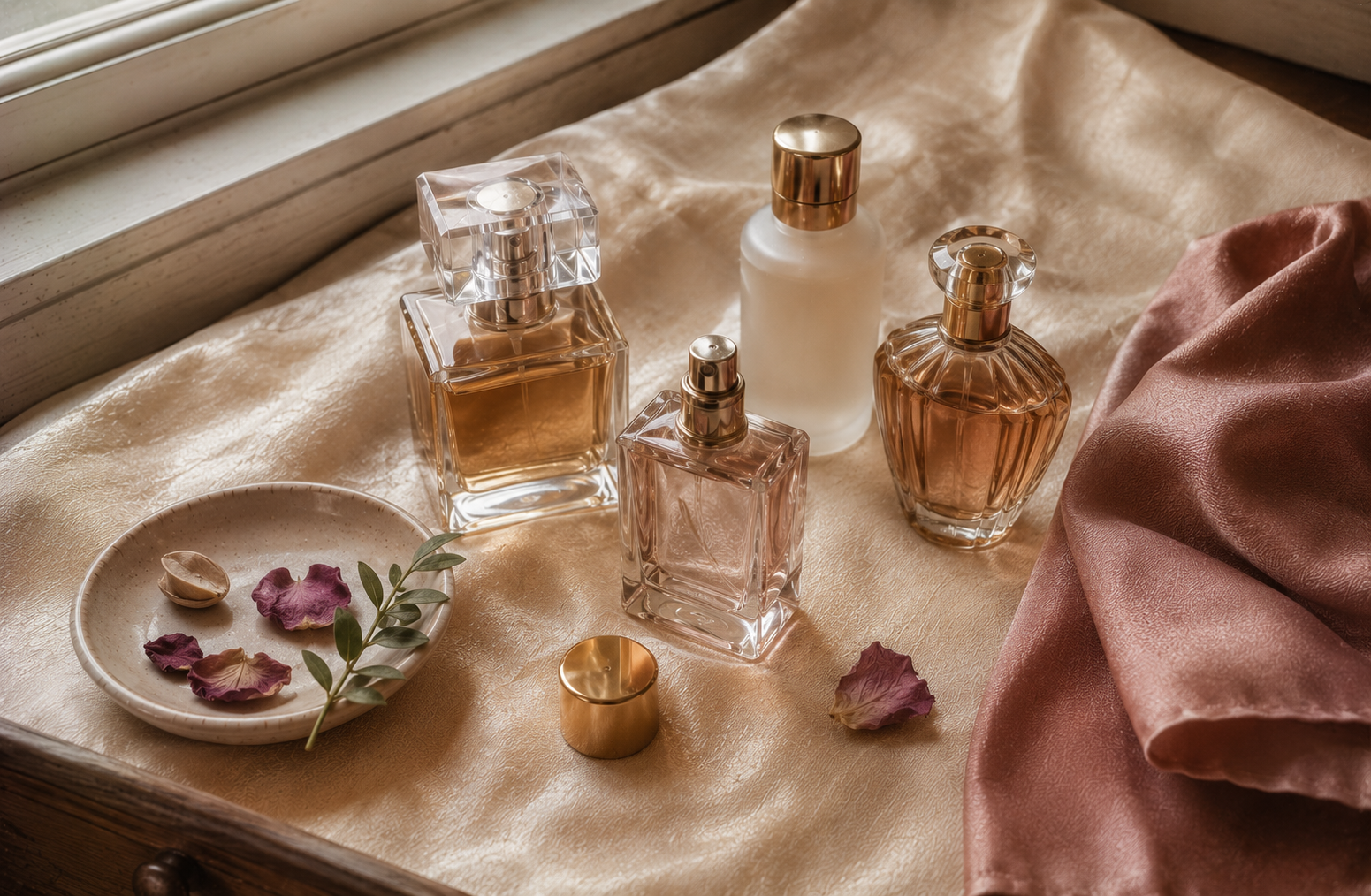
The big idea: skin-ification of fragrance
The defining shift of 2026 isn't a specific note — it's a philosophy. Fragrance is increasingly being designed to behave less like traditional perfume and more like skincare.
What "skin-ification" actually means
Industry perfumers have been explicitly discussing this trend in 2026. "In 2026, fragrance will continue moving closer to skincare, with the ongoing skin-ification of scent and the introduction of hydrating benefits" — this directly captures the shift. The trend appears in:
- Compositions that feel hydrating — softer textures, creamy musks, ingredient profiles borrowed from skincare
- Skin-like fragrance bases — musks and warm notes that smell like an enhanced version of your own skin rather than a separate scent layer
- Hybrid product formats — body oils with fragrance, hair mists with treatment benefits, perfumes that include moisturizing ingredients
- Quieter projection — fragrances designed for intimate proximity rather than room-filling power
Why this is happening
Several factors drive the trend:
- Beauty category convergence — skincare, makeup, and fragrance are increasingly developed together as a unified beauty experience
- The "clean beauty" influence — consumers want fragrance to feel natural and beneficial, not just decorative
- Wellness culture — fragrance is being framed as self-care rather than decoration
- The minimalism backlash — after years of clean/minimal perfume, the appetite is for fragrance that feels luxurious and skin-enhancing
Notable skin-ification fragrances
- Maison Margiela Replica Whispers in the Library — already a leader in this space; intimate, skin-like
- Glossier You — skin-like musk; the original skin-ification fragrance for many
- Le Labo Another 13 — molecular musk; "skin but better"
- D.S. & Durga's Mississippi Medicine — herbaceous skin-like complexity
- Maison Francis Kurkdjian À la Rose — rose softened to skin-like intimacy
The skin-ification trend is harder to capture in single-note descriptions because it's about overall character rather than specific ingredients. The simplest test: a skin-ification fragrance smells like a refined, idealized version of your own skin rather than a perfume distinct from you.
Pistachio: the breakout note of 2026
If 2026 has a breakout single note, it's pistachio. After years of vanilla, caramel, and chocolate dominating gourmand fragrance, pistachio has emerged as the sophisticated alternative.
Why pistachio works
- Less obvious than vanilla — vanilla has been the dominant gourmand note for years; pistachio feels fresh by comparison
- Inherent sophistication — pistachio reads as adult-gourmand rather than dessert-sweet
- Versatile pairing — works with vanilla, almond, warm spices, woods, and even some florals
- Cultural moment — pistachio has been having a broader culinary moment (gelato, dessert, beverages); fragrance reflects food culture
How pistachio fragrances actually smell
Done well, pistachio in fragrance creates a soft nutty-creamy character without being heavy. The note is:
- Slightly green, slightly sweet
- Creamy without being milky
- Sophisticated rather than dessert-like
- Often combined with vanilla or amber for warmth
- Sometimes paired with citrus for contrast
Notable pistachio fragrances for 2026
- Several niche launches feature pistachio prominently — the category is growing rapidly
- Major brand single-note pistachio offerings have emerged for those who want pure pistachio
- Pistachio + vanilla combinations — the most accessible entry into the trend
- Pistachio + rose — sophisticated and unexpected pairing
If you don't want to commit to pistachio
If you're drawn to the trend but uncertain about full commitment, try:
- Sample sizes from niche brands before buying full bottles
- Body products with pistachio scent (lower commitment)
- Wait 12–18 months — many trend notes either solidify into permanent categories or fade. Pistachio may be one of the lasting ones, but waiting confirms
Darker, more refined gourmands
The biggest evolution within an existing category. Gourmand fragrances — those built on edible notes like vanilla, caramel, and chocolate — aren't going away, but they're growing up significantly in 2026.
The shift from sugar-bomb to sophisticated
Industry perfumers have specifically called this out. "While gourmands and skin-centric scents remain popular, they're becoming darker, more refined, and longer-lasting" — the obvious sugar-bomb era is being replaced by more nuanced interpretations.
What this looks like in practice
- Coffee-based gourmands — bitter complexity balancing sweetness
- Tobacco and leather gourmands — darker masculine elements in traditionally sweet compositions
- Smoky gourmands — incense, burnt sugar, dark wood undertones
- Spice-forward gourmands — cardamom, clove, cinnamon adding depth
- Bitter-sweet pairings — gourmands with green or bitter accents
Notable darker gourmands
- Maison Margiela Replica Coffee Break — coffee-forward gourmand
- Tom Ford Tobacco Vanille — the classic dark gourmand
- Maison Margiela Replica By the Fireplace — smoky vanilla
- Initio Side Effect — complex modern gourmand
- Various dark vanilla launches in 2026 from major brands
The gender-neutral shift in gourmands
Traditional gourmands have been marketed primarily to younger women. 2026's darker gourmands are increasingly gender-neutral or men's-marketed — reflecting broader fragrance ungendering and changing tastes.
Powdery florals return
After years of fresh, clean floral interpretations, powdery florals — the soft, slightly sweet, slightly retro floral style — are returning with confidence.
What "powdery floral" actually means
- Florals softened by iris, orris, violet, or musks
- Slightly retro feel — evokes mid-century perfumery
- Often paired with skin musks or soft amber
- Less "fresh-cut flower" and more "softly dressed flower"
- Creates a feminine softness that recent fresh florals had moved away from
Why now
- Reaction against minimalism — fresh, clean florals had become ubiquitous; powdery offers complexity
- Vintage influence — broader fashion and beauty interest in mid-century aesthetics
- Adult femininity — powdery florals read as grown-up rather than youthful
Notable powdery florals
- Prada Infusion d'Iris — the powdery iris classic
- Chanel No. 19 Poudré — modern powdery interpretation
- Frederic Malle Iris Poudre — luxurious powdery iris
- Diptyque L'Eau Papier — soft powdery with paper-like dryness
- Multiple 2026 launches featuring iris, orris, and soft musks
Milk, coconut, and creamy notes
Notes that share a creamy, slightly milky character are emerging as a 2026 movement. Industry perfumers have specifically identified milk as an emerging note.
The creamy note landscape
- Milk — actual milk note, slightly sweet, slightly cool
- Coconut — but not tropical-suntan-lotion coconut. Refined creamy coconut that pairs with sophisticated bases
- Sandalwood — the original creamy wood, always relevant but particularly resonant in 2026
- Almond cream — slightly nutty, slightly creamy
- White chocolate / cocoa butter — emerging in some compositions
How these notes pair
- Milk + jasmine — sensual creamy floral
- Coconut + sandalwood — sophisticated tropical
- Milk + iris — extremely soft powdery cream
- Almond + vanilla — refined gourmand
- Coconut + tea — unexpected pairing gaining traction
Notable creamy fragrances
- Maison Margiela Replica Lazy Sunday Morning — clean creamy with milky notes
- Bond No. 9 Coconut compositions — refined rather than beachy
- Various niche milk-note launches in 2025–2026
Oud continues strong
Oud — the rich, complex agarwood note long popular in Middle Eastern perfumery — continues its mainstream popularity in 2026. Industry perfumers have confirmed it's not fading.
Why oud persists
- Distinctive character — no other note captures the same complex woody-resinous quality
- Lasting power — oud is one of the most long-lasting fragrance notes
- Status association — oud has been associated with luxury and exclusivity
- Versatile pairing — works with rose, jasmine, vanilla, woods, and many other notes
How oud is evolving
- Softer oud interpretations — less intense for Western tastes
- Oud + floral combinations (especially with rose) — refined and sensual
- Synthetic oud accords — better technology produces convincing oud at lower cost
- Hybrid oud + skin-like compositions — connecting to the skin-ification trend
Notable oud fragrances
- Tom Ford Oud Wood — accessible classic
- Maison Francis Kurkdjian Oud — refined niche
- Initio Oud for Greatness — modern oud with broad appeal
- Yves Saint Laurent M7 Oud Absolu — relaunched classic
Texture as creative direction
The most conceptually interesting trend. Rather than focusing on specific notes, 2026 perfumery is increasingly focused on texture and contrast within compositions.
What "texture in fragrance" means
Perfumers are designing fragrances around sensory contrast: cool meeting warm, sparkling meeting smooth, dry meeting creamy, sharp meeting soft. "Perfume trends in 2026 will be driven by textures as an exploration of multiple facets of familiar ingredients".
The texture-based vocabulary
- Sparkling — fizzy, effervescent, often with aldehydes or champagne accords
- Hot vs. cool — pepper meeting mint, spice meeting menthol
- Dry vs. creamy — sandstone notes meeting smooth musks
- Sharp vs. soft — green grass meeting velvet rose
- Crystalline vs. honeyed — clear watery notes meeting sweet warmth
What this means for wearing
Texture-focused fragrances often surprise on first wear because they don't fit familiar categories. A "hot and cold" fragrance might start with warm cinnamon, then reveal a cool mint center, then return to warmth in the dry-down. This complexity rewards multiple wearings as you discover the texture interplay.
Notable texture-driven fragrances
- Diptyque's recent launches — increasingly focused on textural contrast
- Le Labo's molecular fragrances — texture experiments
- Numerous 2026 niche releases emphasizing contrast over note lists
Leather, equestrian, and "thoroughbred" scents
A specific aesthetic trend gaining ground: fragrances inspired by leather goods, horse riding, and equestrian luxury.
The thoroughbred aesthetic
This trend connects to broader "old money" and quiet luxury aesthetics. Fragrances feature:
- Leather (saddle leather, polished leather goods)
- Tobacco
- Aged woods
- Sometimes hay or grass notes
- Sometimes hints of suede
Recent launches have explicitly invoked equestrian themes. Dior's most equestrian-centric fragrance, inspired by their iconic Saddle bag, features leather and musk with a delicate floral note, capturing this trend specifically.
Why now
- Old money aesthetic popularity in fashion
- Vintage luxury appeal
- Counter-trend to clean/minimal fragrances
- Genuine craftsmanship appreciation
Notable leather/equestrian fragrances
- Hermès Cuir d'Ange — refined leather
- Tom Ford Tuscan Leather — bold leather statement
- Maison Margiela Replica Jazz Club — leather with smoke
- Dior Vetiver d'Hiver / equestrian-inspired launches
- Penhaligon's Sartorial — tailored, refined with hints of leather
What's fading out
Equally important: trends that are losing momentum. These haven't disappeared, but they're not what's defining 2026.
Obvious sugar-bomb gourmands
The very sweet vanilla-and-caramel combinations popular in 2022–2024 are giving way to more refined gourmand interpretations. Not gone, but no longer leading.
Clean, green, soap-style fragrances
The "I just stepped out of the shower" fragrance category — Glossier You, Sol de Janeiro Cheirosa lines, similar — remains popular but is no longer growing at the rate it was. The minimalism backlash is real.
Single-note "molecule" fragrances
The Escentric Molecules style minimalism — single-molecule fragrances marketed as scientific — is being replaced by more complex compositions. Texture and contrast are the new sophistication.
Loud, statement-only florals
Traditional opulent florals (heavy tuberose, intense gardenia, peak Fracas) remain available but feel dated compared to the powdery florals and floral hybrids defining 2026.
Aquatic / ozone fragrances
The "ocean breeze" and aquatic floral category from the 2000s and 2010s remains a category but isn't trending. Replaced by skin-like musks for the "fresh but not soapy" niche.
Heavy traditional masculine fragrances
Old-school masculine perfumery (heavy fougère, dark vetiver, traditional Italian style) is being replaced by gender-neutral interpretations. The "men's fragrance" category as a separate marketing direction is losing ground to unisex offerings.
"Fading" never means "wrong" — many beloved fragrances live in these categories. The point of trend awareness is understanding the current cultural conversation, not abandoning what you love. If sugar-bomb gourmands are your favorite category, keep wearing them — fashion is cyclical and what's fading often returns.
AI and the shifting fragrance industry
One more 2026 development that's not a scent trend but affects the industry significantly: AI is starting to change how fragrance is created and marketed.
What perfumers are saying
Industry experts are openly discussing AI's impact on the fragrance business. Some perfumers have noted that AI-assisted formulation may shift power away from large fragrance conglomerates (which have dominated formulation for decades through expertise and secrecy) toward indie houses with access to AI tools.
What this means for consumers
- More fragrance launches — AI accelerates formulation, leading to faster releases
- More niche and indie options — smaller brands gain capability historically reserved for major houses
- Potentially lower prices in some segments as competition increases
- Personalization possibilities — custom fragrance becoming more accessible
- Some concerns about quality — AI-formulated fragrances haven't yet proven they age as well as master perfumer compositions
The honest assessment
It's too early to know whether AI will democratize fragrance or homogenize it. Both outcomes are possible. The next 2–3 years will reveal whether AI-assisted formulations match the quality of traditionally-composed fragrances. For now: be cautious about new brands launching dozens of fragrances rapidly; established brands with track records remain more reliable.
How to wear trends without overspending
Practical guidance for engaging with 2026's trends without buying everything new.
Sample before committing
Trend fragrances are exactly the kind of purchases people regret. The first-spray excitement often doesn't translate to long-term wearing satisfaction.
- Scentbird subscription ($15/month) — try one new fragrance monthly without commitment
- Decant services — 5–10ml of expensive fragrances at proportional prices
- Counter samples — most counters provide samples; ask
- Sephora/Ulta sample programs — generous sample policies
Wait 6–12 months for trend fragrances
Trend fragrances often go on sale within 12–18 months of launch as the industry moves on. If a trend fragrance interests you, the strategic approach:
- Note the fragrance you want
- Sample it if available
- Set a price alert on FragranceNet or similar
- Wait 6–12 months
- Buy at discount if you still want it, or skip if you've moved on
This approach respects both your interest and your budget.
Try one trend at a time
Don't buy a 2026 pistachio, a 2026 powdery floral, and a 2026 leather all in the same season. Choose one trend direction that genuinely interests you. Wear it for 6 months. Then decide if another trend is worth exploring.
Layer trends into existing wardrobe
If you have a fragrance wardrobe already, see whether trend notes can be added through:
- Body products (less commitment than a full fragrance)
- Layering with existing fragrances (see our layering guide)
- Smaller fragrance sizes (30ml instead of full bottles)
Mind the dupe options
For 2026 trends specifically, dupe brands (Oakcha, Dossier, Alt. Fragrances) often produce "inspired-by" versions of popular new releases within 6–12 months. If you want to wear the trend but don't want full-luxury commitment, dupes are a legitimate option (see our affordable luxury guide).
Trust your own nose
Social media excitement about a fragrance doesn't predict whether you'll like it. Body chemistry, personal preferences, and individual reactions vary dramatically. The fragrances that become your long-term staples are the ones you actually love on yourself — not the ones with the most hype.
Remember trends are cyclical
If you fall in love with a trend now, you don't have to rush to buy it before it "ends." The notes and styles that define 2026 will remain available for years. Some will become permanent additions to the perfumer's vocabulary. Others will resurface in subsequent trend cycles. Patience costs nothing.
The bottom line: 2026's fragrance trends reflect deeper cultural shifts — the convergence of beauty categories, the reaction against minimalism, the appeal of sophistication over obvious sweetness, and the increasing comfort with unusual notes like pistachio, milk, and equestrian leather. The skin-ification of fragrance is the year's defining theme. Pistachio is the breakout note. Gourmands are becoming sophisticated. Powdery florals return with confidence. Texture-driven design is replacing single-note simplicity. Oud continues strong. What's fading: sugar-bomb gourmands, soap-style fragrances, single-molecule minimalism. Most importantly: trends are information, not mandates. Sample before buying. Wait for prices to settle. Trust your own reactions over social media excitement. The fragrance that becomes your signature isn't the one trending hardest — it's the one that makes you feel most like yourself when you wear it. Use trends as inspiration; wear what you genuinely love.
Trend reporting reflects industry observations as of publication. Fragrance trends evolve continuously. This article will be updated as the year's trends solidify. For the most current information, check beauty publications and brand launches.