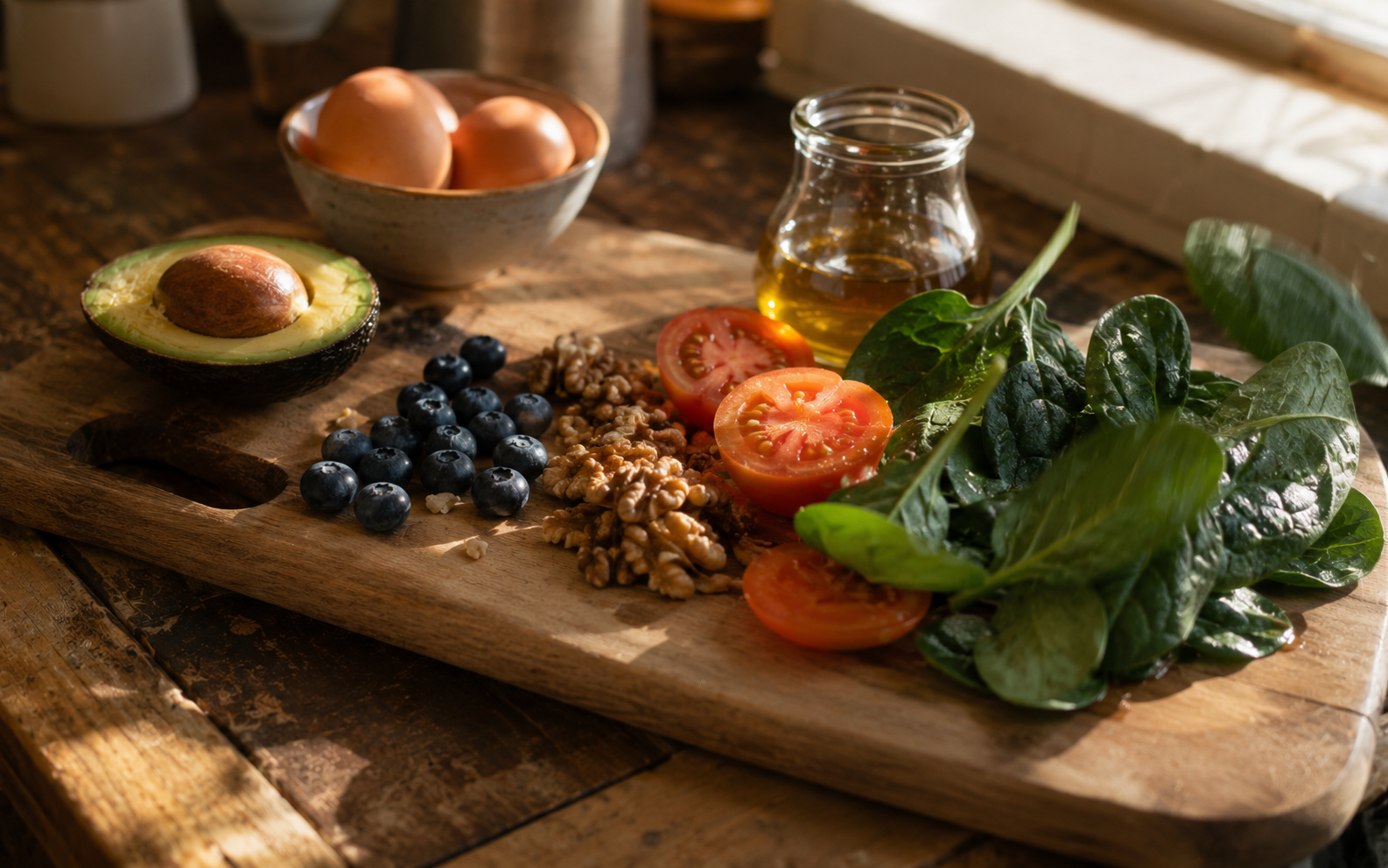
How diet actually affects skin
Before getting into specific foods, it helps to know how diet affects skin. The actual mechanisms are well-studied — and understanding them helps you separate evidence from wellness mythology.
Diet influences skin through four main pathways:
- Inflammation. Some foods promote chronic low-grade inflammation; others reduce it. Skin conditions like acne, rosacea, eczema, and psoriasis are inflammatory at their core.
- Hormones. Specific foods (notably dairy and high-glycemic carbs) raise insulin and androgens, which directly affect sebum production and acne.
- Building blocks. Skin needs amino acids, fatty acids, and certain vitamins to function. Inadequate intake limits skin's ability to repair, produce collagen, and maintain its barrier.
- Glycation. Sugar molecules in the bloodstream bind to collagen and elastin, stiffening these fibers and accelerating visible aging. This is one of the most well-documented diet-skin connections.
Notice what's not on this list: "drinking water plumps your skin." "Detoxing eliminates toxins through the skin." "Eating clean clears acne in days." These are popular claims that aren't supported by evidence — or at minimum, are oversimplified to the point of being misleading.
Diet is one of multiple factors affecting skin — alongside genetics, sun exposure, sleep, hormones, stress, and skincare. Improving diet helps, but it can't compensate for skipping sunscreen or sleeping 4 hours a night. Manage expectations accordingly.
Foods with real evidence
The honest list of foods that have genuinely supportive evidence for skin health, ranked roughly by strength of evidence:
Fatty fish (salmon, sardines, mackerel)
Why: rich in omega-3 fatty acids, which are anti-inflammatory and support skin barrier function. Multiple studies show diets high in omega-3s correlate with reduced skin inflammation, improved hydration, and slower visible aging.
How much: 2–3 servings per week of fatty fish, OR a quality fish oil supplement.
Honest caveat: the effects are modest and take 8–12 weeks to become measurable. Don't expect dramatic transformation.
Colorful vegetables and fruits
Why: contain a wide range of antioxidants — vitamin C, vitamin E, carotenoids, polyphenols — that protect skin cells from oxidative damage caused by UV and pollution.
The standout colors:
- Orange/red: carrots, sweet potatoes, tomatoes, bell peppers — high in beta-carotene, which converts to vitamin A in the body
- Dark green: spinach, kale, broccoli — folate, vitamin C, vitamin K
- Purple/blue: blueberries, blackberries, purple cabbage — anthocyanins (anti-inflammatory)
- Bright red: tomatoes — lycopene, which has the strongest evidence for natural sun protection
How much: aim for 5+ servings daily, varying the colors throughout the week.
Eggs and lean protein
Why: skin is largely made of protein. Inadequate protein intake limits collagen synthesis, slows wound healing, and accelerates visible aging. Eggs specifically contain choline, biotin, vitamin A, and selenium.
How much: 0.8–1g of protein per kg of body weight daily, from varied sources (eggs, fish, poultry, legumes, dairy if tolerated).
Nuts and seeds
Why: rich in vitamin E (a fat-soluble antioxidant that supports skin) and zinc (essential for skin healing). Walnuts and chia seeds add omega-3s.
The standouts:
- Walnuts — omega-3s, vitamin E
- Almonds — vitamin E, magnesium
- Brazil nuts — selenium (1–2 nuts/day covers your needs)
- Pumpkin seeds — zinc
- Chia and flax seeds — omega-3s, fiber
How much: a small handful (about 1 ounce) daily.
Green tea
Why: contains EGCG, a polyphenol with strong anti-inflammatory effects. Some studies show drinking green tea regularly correlates with reduced skin inflammation, mild sun protection, and improvements in acne.
How much: 2–3 cups daily for measurable effect.
Fermented foods
Why: emerging research on the gut-skin axis suggests gut microbiome health affects skin inflammation and conditions like acne, rosacea, and eczema. Fermented foods support a diverse gut microbiome.
The good options: yogurt or kefir (if dairy is tolerated), kimchi, sauerkraut, kombucha (low-sugar versions), miso, tempeh.
How much: 1 serving daily for ongoing benefit.
Avocados
Why: healthy fats support skin barrier function. Also contain vitamin E, vitamin C, and lutein. Studies show avocado consumption correlates with measurably improved skin elasticity in middle-aged women.
How much: half to one full avocado most days.
Tomatoes (specifically cooked)
Why: lycopene, which is one of the few foods shown to provide modest natural sun protection. Cooking tomatoes (in pasta sauce, soup, paste) actually increases lycopene bioavailability compared to raw.
Honest caveat: "natural sun protection" from food is real but minor. It doesn't replace sunscreen.
Dark chocolate (high cacao)
Why: high-cacao chocolate (70%+) contains flavonoids that support skin hydration and circulation. Multiple small studies show measurable improvements in skin condition with regular consumption.
Honest caveat: 70%+ cacao only. Milk chocolate and low-cacao "dark" chocolate don't have the same effect, and added sugar negates benefits.
How much: 1–2 squares daily, ideally 80%+ cacao.
Don't try to add all of these at once. Pick 2–3 you actually enjoy and integrate them into meals you already eat. Consistency over weeks beats variety for one week followed by abandonment.
Foods that may worsen skin
The opposite list — foods with evidence for negative skin effects, again ranked by strength of evidence:
High-glycemic refined carbs
What this means: white bread, sugary cereals, sweetened drinks, pastries, candy. Foods that spike blood sugar fast.
The evidence: consistent across multiple studies. High-glycemic diets correlate with worse acne and accelerated skin aging through glycation. The link with acne is one of the strongest food-skin connections in research.
What to do: swap refined carbs for whole-grain alternatives where reasonable. Don't obsess over occasional treats — chronic intake is the issue.
Ultra-processed foods
What this means: packaged snacks, fast food, pre-made frozen meals, processed meats, anything with a long ingredient list.
The evidence: ultra-processed diets correlate with chronic inflammation, which manifests in skin as worse acne, slower wound healing, and accelerated aging. The mechanism involves added sugar, refined seed oils, additives, and lack of nutrients.
Excessive alcohol
What this means: regular drinking beyond moderate (more than 1 drink/day for women, 2 for men).
The evidence: dehydrates skin, dilates blood vessels (worsens rosacea), interferes with sleep (which affects skin repair), and causes inflammation. Heavy drinkers visibly age faster than non-drinkers.
Excessive caffeine on an empty stomach
What this means: drinking 4+ cups of coffee daily without food, especially with lots of sugar/cream added.
The evidence: moderate caffeine appears neutral or slightly beneficial for skin. Excessive caffeine elevates cortisol, which can worsen acne and slow collagen production. The bigger issue is usually what's added to coffee, not coffee itself.
Foods you're personally sensitive to
This is the wildcard. Some people react to gluten, eggs, soy, nightshades, FODMAPs, or other specific foods with skin manifestations. Sensitivities are individual and don't apply universally.
How to figure out yours: elimination diet for 8–12 weeks, tracking skin changes. Reintroduce one food at a time and watch for flares. Don't pre-emptively eliminate foods without evidence of personal sensitivity.
The dairy question
Dairy and skin is the single most asked-about food-skin connection — and one of the most contested. Let me give you the honest version.
What the evidence shows
Multiple studies have shown a correlation between dairy intake and acne severity, particularly:
- Skim milk has the strongest correlation — counterintuitive, but consistent across studies
- Whey protein supplements correlate strongly with acne in users
- Cheese and yogurt have weaker correlations than milk
The proposed mechanism
Dairy raises insulin-like growth factor 1 (IGF-1) levels, which increases sebum production and may worsen acne. Hormones in milk also play a role. Skim milk's stronger effect may be because removing fat doesn't reduce the hormonal compounds.
Who's affected
Not everyone. Roughly 30–50% of acne sufferers see improvement when they reduce or eliminate dairy. The rest don't notice a difference. Genetics determines individual sensitivity.
How to test it personally
- Eliminate dairy completely (including whey, casein in protein bars, hidden ingredients) for 8–12 weeks
- Don't change other variables during this time
- Track acne severity in photos at week 0, 4, 8, 12
- Reintroduce dairy gradually after 12 weeks
- If skin worsens within 2–4 weeks of reintroduction, dairy is likely a trigger for you
Don't eliminate dairy preemptively if you don't have skin issues. Dairy is a useful source of calcium, vitamin D (in fortified products), B12, and protein. Cutting it without reason creates nutritional gaps you'd need to fill from other sources.
Sugar, glycation, and skin aging
Sugar's effect on skin has stronger evidence than most diet-skin claims. The mechanism involves a process called glycation, and understanding it helps you make informed decisions about sugar intake.
What glycation is
When blood sugar is consistently elevated, sugar molecules (glucose) attach to nearby proteins — including the collagen and elastin that give your skin its structure. The resulting compounds, called Advanced Glycation End-products (AGEs), make collagen stiffer and more brittle.
Visibly, this manifests as:
- Reduced skin elasticity
- Accelerated wrinkle formation
- Yellowing of skin tone
- Slower wound healing
What this means practically
Glycation increases with chronic high blood sugar. Occasional sugar intake doesn't measurably affect skin. Daily desserts, sugary drinks, and high-glycemic snacking does.
The cumulative effect over decades is significant. Studies on identical twins show one twin who consumed substantially more sugar over years had measurably more visible aging than their genetically-identical sibling.
Practical guidelines
- Limit added sugar to under 25g per day for women, 36g for men (American Heart Association guidelines)
- Choose low-glycemic carbs (vegetables, legumes, whole grains) over high-glycemic ones (white bread, sugary drinks)
- Pair carbs with protein and fat to slow glucose absorption
- Don't eliminate sugar entirely — chronic intake is the issue, not occasional consumption
Hydration: separating fact from myth
The "8 glasses of water for glowing skin" myth deserves direct addressing because it's so widespread.
What's true
Severe dehydration affects skin — visibly. Skin loses elasticity, becomes drier, and develops fine lines that disappear when rehydration occurs. If you're regularly dehydrated (which many people are), addressing it does help skin.
What's not true
Once you're adequately hydrated, drinking more water doesn't continue to improve skin. The body excretes excess water; it doesn't store it in skin tissue. The "glowing skin from gallons of water" before-and-after stories on social media are mostly placebo or attributable to other lifestyle changes happening simultaneously.
How much water do you actually need?
Roughly 2–3 liters per day for most adults, including water from food. Indicators of adequate hydration:
- Urine is pale yellow (not dark, not clear)
- Lips and mouth aren't consistently dry
- Skin pinch test: skin springs back quickly when pinched
If you're hitting these markers, drinking more won't improve your skin further.
The single biggest improvement in "skin from hydration" is usually moving from chronically under-hydrated (which many people are) to adequately hydrated. Going from adequate to over-hydrated produces no additional skin benefit.
Supplements: what's worth it, what isn't
The honest version of which skin supplements have evidence and which are wishful thinking:
Worth considering (with real evidence)
- Vitamin D — if blood work shows deficiency. Common in people with limited sun exposure. Affects skin cell function.
- Omega-3 (fish oil or algae oil) — useful if you don't eat fish 2–3x weekly. Anti-inflammatory effects on skin are well-documented.
- Zinc — for active acne specifically. Several studies show 30–50mg daily improves acne in some users.
- Collagen peptides — emerging evidence for modest skin elasticity improvements over 12+ weeks. Not as strong as marketing suggests, but evidence exists.
- Probiotics — limited but growing evidence for skin conditions linked to gut health.
Mostly hype, save your money
- Biotin "hair, skin, nails" — doesn't help unless deficient (rare). Marketing-driven category.
- "Skin-clearing" detox teas — laxatives don't clear skin.
- Most "beauty supplements" with proprietary blends — the dose is usually too low to matter.
- Hyaluronic acid pills — questionable bioavailability when taken orally.
- Marine collagen specifically — not significantly different from cheaper bovine collagen for results.
The supplement reality
Supplements only help if you're deficient or have a specific condition. They don't replace whole foods. Get blood work before guessing — testing for vitamin D, B12, ferritin (iron), and zinc costs $40–80 and tells you exactly what (if anything) you actually need.
Setting realistic expectations
What dietary changes can and can't deliver:
What diet CAN do
- Reduce inflammation across the body, including skin
- Improve acne in 30–50% of cases (especially when reducing dairy and high-glycemic foods)
- Slow visible aging when sustained over years (mainly through reducing glycation)
- Support skin barrier function and hydration
- Provide building blocks for collagen synthesis and skin repair
What diet CAN'T do
- Reverse existing sun damage (only retinoids and lasers do that)
- Compensate for poor sleep, chronic stress, or no sunscreen
- Replace the role of skincare actives (retinol, acids, peptides)
- Cure severe acne (often requires medical intervention)
- Eliminate fine lines or pigmentation through eating alone
Time horizons
| Timeframe | What to expect |
|---|---|
| 2–4 weeks | Hydration improvements; possible early acne changes |
| 8–12 weeks | Measurable acne improvements (if relevant); slight texture changes |
| 6 months | Visible inflammation reduction; barrier function improvements |
| 2+ years | Slowed glycation; meaningful difference in long-term aging |
Common diet-and-skin mistakes
Patterns that derail people trying to improve skin through diet:
- Expecting results in two weeks. Diet effects on skin take 8–12 weeks minimum. Most "I tried it and nothing happened" stories quit too early.
- Eliminating multiple foods at once. Makes it impossible to identify which (if any) was the trigger. Always isolate variables.
- Following influencer "skin diets" with no evidence. Most viral skin diet claims don't have research behind them. Stick to evidence-backed changes.
- Buying expensive "beauty foods" or supplements. Whole foods deliver the same nutrients at a fraction of the cost.
- Assuming dairy or gluten is the problem. Both can affect some people. Most acne and skin issues aren't caused by either. Test before eliminating.
- Drinking endless water expecting miracles. Adequate hydration matters. Beyond adequate, more is excreted, not stored in skin.
- Ignoring everything else. Diet is one factor. Sunscreen, sleep, skincare, and stress management matter at least as much.
- Replacing whole foods with "superfood powders." Powders have lower bioavailability and miss the synergy of nutrients in whole foods.
The bottom line: Diet genuinely affects skin — but as one factor among many, not as a silver bullet. The honest playbook: prioritize fatty fish, colorful produce, lean protein, nuts, green tea, and fermented foods. Reduce refined carbs, ultra-processed foods, and dairy if you have acne. Don't expect miracles, give changes 12 weeks, and remember that diet works alongside sunscreen, sleep, and skincare — never instead of them.