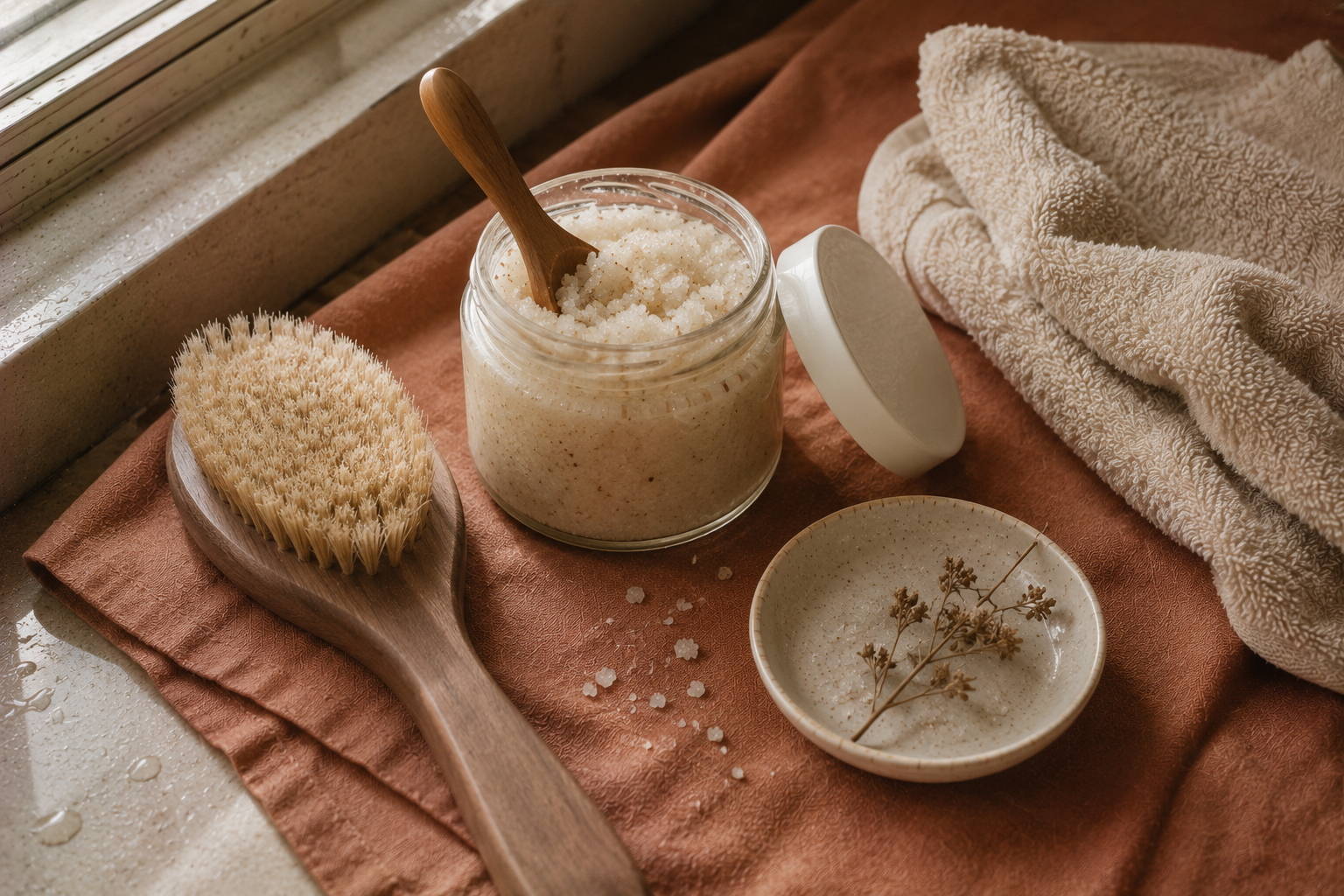
Why exfoliate at all
Before getting into methods, the honest question: is body exfoliation necessary?
The functional benefits
Body exfoliation provides specific, measurable benefits when done correctly:
- Removes dead skin buildup — body skin's slower cell turnover means dead cells can accumulate, particularly on elbows, knees, and heels
- Prevents ingrown hairs — by keeping hair follicle openings clear, particularly important for people who shave or wax
- Improves product absorption — moisturizers and treatments penetrate better through exfoliated skin
- Smooths visible texture — addresses roughness, bumps, and uneven surface
- Helps body acne — particularly chemical exfoliation with salicylic acid for clogged pores
- Addresses specific conditions — keratosis pilaris (KP), keratosis from chronic friction
- Reduces hyperpigmentation — gradually improves dark marks and uneven tone
- Brightens overall appearance — removes the dull layer of accumulated dead cells
What exfoliation doesn't do
Honest limits to set expectations:
- Doesn't fix cellulite — despite marketing claims, exfoliation can't change connective tissue structure
- Doesn't eliminate stretch marks — may slightly improve newer marks; older ones require more intensive treatment
- Doesn't significantly tighten skin — surface smoothing only, not actual tightening
- Doesn't permanently solve KP — manages but doesn't cure the underlying tendency
- Doesn't make skin "younger" — exfoliation maintains; it doesn't reverse aging
- Doesn't replace moisturizer — exfoliated skin needs more hydration, not less
When body exfoliation matters most
Some people benefit significantly from regular exfoliation; others get less impact. You'll see the biggest difference if you have:
- Visible rough texture on arms, thighs, or back
- Keratosis pilaris
- Frequent ingrown hairs
- Body acne on chest, back, or shoulders
- Hyperpigmentation from old marks
- Dry, flaky skin that doesn't respond fully to moisturizing alone
- Calloused or rough feet
- Dull-looking skin tone
If you have smooth, healthy body skin without these concerns, you may not need extensive exfoliation — gentle weekly maintenance is enough. The condition of your skin should determine your routine, not generic recommendations.
Exfoliation isn't universally beneficial — some skin types (very sensitive, eczema-prone, currently barrier-compromised) do better with minimal exfoliation. The right amount is the amount your specific skin needs, not the maximum your skin can tolerate.
How body skin actually works
Understanding the basics helps you choose the right approach.
Cell turnover by area
Different body areas have different natural cell turnover rates:
| Body area | Approximate turnover | Exfoliation need |
|---|---|---|
| Face | ~28 days (younger), longer with age | Lower (already turns over relatively fast) |
| Hands | ~30–45 days | Moderate |
| Arms and legs | ~45–60 days | Higher |
| Back and torso | ~45–60 days | Higher |
| Feet (sole) | ~60–90 days | Highest |
| Heels | Slowest of all | Highest |
This is why feet need much more attention than arms, and why arms accumulate texture issues faster than the face. Body skin's slower turnover means dead cells build up unless you actively help them shed.
How exfoliation actually helps
Two mechanisms:
- Removes accumulated dead cells — the surface layer that's already supposed to come off naturally but hasn't yet
- Stimulates cell renewal — by signaling that cells need to be replaced, exfoliation can encourage faster turnover beneath
Done correctly, this creates a virtuous cycle: regular gentle exfoliation maintains optimal skin function. Done incorrectly (aggressive or too frequent), it disrupts the barrier and creates damage that takes weeks to repair.
The barrier consideration
Your skin barrier — the outermost layer of cells held together by lipids — is what protects you from environmental damage, prevents water loss, and keeps pathogens out. Over-exfoliation damages this barrier, causing:
- Increased sensitivity
- Visible redness or irritation
- Faster moisture loss (paradoxically drier skin despite "active" treatment)
- Increased reactivity to other products
- Slower healing of small injuries
The goal of good exfoliation is removing the dead cells that should naturally shed while preserving the intact barrier underneath.
Chemical vs physical exfoliation
The two main approaches, with honest comparison.
Chemical exfoliation
Uses acids or enzymes to dissolve the bonds between dead skin cells, allowing them to slough off naturally.
How it works: Acids weaken the "glue" (corneodesmosomes) that holds dead cells to the skin's surface, allowing them to release without scrubbing.
Pros:
- Very gentle when used correctly
- Penetrates into pores (BHA especially) for deeper benefit
- Consistent dose with controlled formulations
- Works well for KP, body acne, and texture issues
- Can be applied daily in lotion form without irritation for most people
- Addresses hyperpigmentation along with texture
Cons:
- Takes weeks to show results
- Can cause sun sensitivity
- Some products irritate sensitive skin
- Requires more consistency than physical methods
Physical exfoliation
Uses mechanical action — scrubbing, brushing, friction — to physically remove dead cells.
How it works: Particles or surfaces rub against skin to dislodge dead cells through friction.
Pros:
- Immediate visible results
- Satisfying tactile experience
- Good for very rough areas (feet, elbows, heels)
- Inexpensive options widely available
- No concern about sun sensitivity
- Easy to incorporate into shower routine
Cons:
- Easy to overdo — most people scrub too hard
- Quality varies dramatically (large rough particles can cause micro-tears)
- Less effective for follicle-related issues like KP
- Doesn't address skin tone or pigmentation
- Can spread bacteria if scrub tools aren't clean
Which to choose
For most body care concerns, chemical exfoliation produces better results. Physical exfoliation has specific niches where it excels:
| Concern | Better approach |
|---|---|
| Keratosis pilaris (KP) | Chemical (AHA, BHA, urea) |
| Body acne | Chemical (BHA salicylic acid) |
| Hyperpigmentation | Chemical (AHA) |
| Dullness, uneven tone | Chemical (AHA, BHA) |
| Very rough heels | Physical (pumice) + chemical (urea) |
| Calloused elbows/knees | Either; combination works best |
| Ingrown hairs | Chemical primarily; gentle physical helps |
| Tactile preference | Physical (scrubs feel like "doing something") |
| Cost concern | Either; both have affordable options |
Combining approaches
The most effective body care routine often combines:
- Chemical exfoliation as the daily or every-other-day foundation
- Physical exfoliation 1× weekly for specific rough areas
- Targeted physical treatment (pumice on heels) as needed
This combination addresses both the surface texture and the deeper issues that chemical alone may miss.
Chemical exfoliants explained
The major chemical exfoliant categories, what they do, and where they work best.
Alpha hydroxy acids (AHAs)
Water-soluble acids that work on the skin's surface.
Lactic acid
- Most gentle AHA; well-tolerated
- Excellent humectant in addition to exfoliating
- Best entry-level chemical exfoliant for body
- Particularly good for KP and dryness
- Effective concentrations: 5–12% in body lotions
Glycolic acid
- Smallest molecule of the AHAs — penetrates well
- Slightly stronger and faster-acting than lactic
- Can be more irritating for sensitive skin
- Effective concentrations: 5–10% in body products
Mandelic acid
- Larger molecule, penetrates more slowly
- Gentle option for sensitive skin
- Works well for hyperpigmentation
- Less aggressive than glycolic for first-time users
Beta hydroxy acids (BHAs)
Oil-soluble acids that can penetrate into pores and follicles.
Salicylic acid
- The main BHA used in body products
- Penetrates into hair follicles — particularly effective for KP and body acne
- Anti-inflammatory in addition to exfoliating
- Effective concentrations: 1–2% for daily; 2%+ for treatment products
- Best body exfoliant for back acne and chest acne
Polyhydroxy acids (PHAs)
Newer category with larger molecules.
Gluconolactone, lactobionic acid
- Very gentle — among the mildest chemical exfoliants
- Larger molecules don't penetrate as deeply
- Less irritating than AHAs
- Good for very sensitive skin
- Slower visible results but more sustainable for sensitive skin
Urea
A keratolytic that works through different mechanisms.
- Low concentrations (2–10%): primarily moisturizing
- Higher concentrations (15–40%): actively dissolves keratin
- Particularly effective for KP, calluses, and very rough skin
- Often more tolerable than acids for some skin types
- Can be combined with AHAs for synergistic effect
Enzymes
Natural exfoliating proteins from sources like papaya (papain) and pineapple (bromelain).
- Very gentle; suitable for sensitive skin
- Best for surface dullness
- Don't penetrate as deeply as acids
- Less commonly used for body care than face
Choosing your chemical exfoliant
| Your concern | Best starting option |
|---|---|
| General body texture | Lactic acid 5–10% lotion |
| KP on arms/thighs | Lactic acid 12% or urea 10–20% |
| Back/chest acne | Salicylic acid 1–2% lotion or wash |
| Body hyperpigmentation | Glycolic acid 5–10% with niacinamide |
| Very dry, rough patches | Urea 20–40% spot treatment |
| Very sensitive skin | PHA-based body toner |
| Calluses on feet | Urea 40% foot cream |
Reliable chemical exfoliant products
- AmLactin Daily Moisturizing Lotion (~$15) — 12% lactic acid; reliable KP option
- CeraVe SA Lotion for Rough & Bumpy Skin (~$15) — salicylic acid with ceramides
- The Ordinary Glycolic Acid 7% Toning Solution (~$10) — affordable, can be used on body
- Paula's Choice 2% BHA Body Spray (~$28) — best for back acne
- Eucerin UreaRepair Plus 10% Urea Lotion (~$15) — for very dry KP
- Naturium The Smoother Glycolic Acid Body Wash (~$15) — wash-off application
- Necessaire The Body Exfoliator (~$30) — glycolic + sugar combination
Physical exfoliation methods
Mechanical approaches, with honest assessment of which actually work well.
Body scrubs
Granular products that physically buff away dead cells.
Types of scrub particles
- Sugar — dissolves slightly during use, becoming gentler over time; good for sensitive skin
- Salt — larger particles; more aggressive; not for sensitive areas
- Coffee grounds — irregular shape can cause micro-tears if too coarse
- Fruit seeds (apricot, walnut) — controversial; can be too aggressive; some have been criticized for skin damage
- Synthetic beads — smooth uniform particles; gentler than natural alternatives (note: microbeads are now banned in many regions)
How to use scrubs correctly
- Apply to wet skin (not dry — friction is too aggressive on dry skin)
- Use light pressure — let the particles do the work, not your hands
- Circular motion, 30–60 seconds per area
- Focus on rough areas; lighter on sensitive areas
- Rinse thoroughly
- Apply moisturizer immediately
Reliable scrub options
- Tree Hut Sugar Scrubs (~$10) — popular drugstore option; many scent varieties
- Frank Body Coffee Scrub (~$15) — gentler coffee scrub
- Necessaire The Body Exfoliator (~$30) — sugar + glycolic combo
- First Aid Beauty KP Bump Eraser (~$28) — for KP specifically
- Soap & Glory Flake Away Body Scrub (~$15) — affordable option
Exfoliating mitts and gloves
Textured fabric tools used like washcloths.
- Korean exfoliating mitts — specifically designed for body exfoliation; effective but can be aggressive
- Standard exfoliating gloves — gentler; good for everyday use
- Sisal mitts — natural fiber; firmer texture
- Konjac sponges — very gentle, suitable for sensitive skin
Mitt safety considerations
- Rinse thoroughly after each use
- Let dry completely between uses
- Replace every 4–6 weeks (bacteria buildup)
- Don't share between people
- Don't use on broken or irritated skin
Dry brushing
Using a natural-bristle brush on dry skin before showering.
Claims: Better lymphatic drainage, cellulite reduction, improved circulation, smoother skin.
Honest assessment:
- Provides gentle mechanical exfoliation — modest benefit
- Improves circulation temporarily
- Cellulite reduction claims are overstated; no studies support permanent improvement
- Feels good and energizing — psychological benefit
- Generally safe when done gently
How to dry brush properly:
- Use a natural-bristle brush (not too stiff)
- Brush dry skin before showering
- Start at feet, brush upward in long strokes toward the heart
- Light pressure — should feel pleasant, not painful
- 2–3 minutes total
- Shower afterward to remove dead cells
- 2–3 times per week maximum
Pumice stones and foot files
Specifically for very rough areas — primarily heels and sometimes elbows.
- Use on damp skin (in shower)
- Gentle pressure in one direction (not back-and-forth which is too aggressive)
- Maximum 1–2 minutes per area
- Replace pumice stone every 2–3 months
- Don't share between people
- Use immediately followed by thick foot cream
Body brushes (in-shower)
Long-handled brushes used in shower with body wash.
- Useful for reaching back area
- Choose firm but not aggressive bristles
- Replace heads every 3 months
- Less aggressive than dry brushing
What to avoid
- Aggressive loofahs — most are too rough; also harbor bacteria
- Microbead products in regions where they're banned — environmental harm; ineffective
- Walnut shell or apricot pit scrubs with sharp edges — cause micro-tears
- Mechanical exfoliating devices on the body — usually too aggressive
- Daily aggressive scrubbing of any area — barrier damage
If a scrub causes any sting, burning, or visible redness during use, it's too aggressive for your skin. Stop using it. The "more aggressive = better cleaning" instinct is wrong for body care — gentler approaches consistently outperform harsh ones over time.
Frequency by body area
Different body areas have very different exfoliation needs.
The frequency-by-area guide
| Area | Frequency | Best method |
|---|---|---|
| Face/neck | Per facial routine (not body) | Facial exfoliants only |
| Chest/décolletage | 1× weekly maximum | Gentle chemical (AHA lotion) |
| Shoulders | 1× weekly | Either; depends on issue |
| Upper arms | 2–3× weekly (KP); 1× weekly (normal) | Chemical (lactic acid lotion) |
| Lower arms/hands | 1–2× weekly | Gentle scrub or AHA lotion |
| Back | 1× weekly | BHA spray (for acne); chemical lotion (for texture) |
| Stomach/torso | 1× weekly | Either |
| Thighs | 1–2× weekly | Chemical (KP-prone); scrub (for smoothness) |
| Knees | 1–2× weekly | Combination (chemical + targeted scrub) |
| Lower legs | 1× weekly | Scrub or chemical |
| Feet (tops) | 1× weekly | Gentle exfoliation |
| Heels | 1–2× weekly | Pumice + urea cream |
| Soles | 1× weekly | Foot file + urea |
| Buttocks | 1× weekly | Chemical (KP-prone); gentle scrub |
Frequency principles
- Start low and increase if your skin tolerates and you see continued benefit
- Match frequency to skin response — if skin feels sensitive, reduce frequency
- Adjust by season — winter usually requires less frequent exfoliation due to dryness
- Skin condition matters — eczema flares, sunburn, irritation = pause exfoliation
- Consistency over intensity — daily gentle outperforms weekly aggressive
When to skip exfoliation entirely
- Sunburned skin
- Active eczema or psoriasis flares
- Recently waxed or shaved (within 24 hours)
- Cuts, wounds, or healing injuries
- Active acne flare with broken skin
- Visible irritation from previous exfoliation
- The day before/after laser hair removal
- Recent professional skin treatment (peel, microneedling)
Building your routine
Practical approaches to incorporating exfoliation into body care.
The minimalist routine
For people who want simple but effective:
- Daily: Apply AmLactin or similar AHA lotion to body after showering
- 1× weekly: Use a gentle physical scrub in shower for any rough areas
- As needed: Pumice stone on heels
That's it. This handles 90% of body exfoliation needs for most people.
The comprehensive routine
For people with specific concerns or who enjoy a fuller routine:
Morning:
- Gentle body wash in shower
- For acne-prone back: BHA body spray after shower
- Body lotion (chemical exfoliating if KP)
- SPF on exposed areas
Night (2–3× weekly):
- In shower: gentle exfoliating mitt or sugar scrub on body
- Pumice on heels if needed
- Body cream
- Foot cream
Weekly intensive:
- Higher-concentration AHA treatment on targeted areas (KP-affected zones)
- Foot mask or intensive foot treatment
- Hand intensive treatment (overnight with cotton gloves)
The routine for specific concerns
For KP (keratosis pilaris)
- Daily: AmLactin Daily Moisturizing Lotion (12% lactic acid) or CeraVe SA Lotion
- 2× weekly: Gentle physical exfoliation on affected areas (NOT aggressive scrubbing)
- Weekly: Higher concentration urea cream for stubborn patches
- Avoid: hot showers, aggressive scrubs, picking at bumps
For body acne (back/chest)
- Daily: Salicylic acid body wash (with 5 minute contact time)
- 3× weekly: Paula's Choice BHA Body Spray after shower
- Weekly: Gentle physical exfoliation in non-active areas
- Always: Clean sheets weekly, breathable clothing
For dull skin tone
- Daily: AHA body lotion (glycolic 5–10%)
- 2× weekly: Gentle physical exfoliation
- Always: SPF on exposed areas (chemical exfoliation increases sun sensitivity)
For ingrown hair prevention
- Daily: Chemical exfoliant (BHA preferred) on hair-removal areas
- 1–2× weekly: Gentle physical exfoliation
- After hair removal: Wait 24 hours before exfoliating
- Always: Sharp razors, hair growth direction shaving
For very dry skin
- Daily: Urea-based lotion (10–20%) instead of harsher AHAs
- 1× weekly maximum: Very gentle exfoliation
- Always: Heavy moisturizer immediately after
- Avoid: Harsh scrubs, hot water
What to apply after exfoliation
The most important step that many people skip:
- Apply moisturizer immediately to damp skin
- Use heavier products than you might without exfoliation
- For very rough areas, layer body oil + cream
- Sunscreen if exposed areas — exfoliated skin is more sun-sensitive
- Wait 10 minutes before applying makeup if relevant
Exfoliation followed by moisturizer significantly outperforms either alone. The exfoliation removes the barrier of dead cells that prevents products from penetrating; the moisturizer fills the now-receptive skin with hydration. Skipping the moisturizer step wastes most of the exfoliation benefit.
Common mistakes
The patterns that consistently cause problems.
Scrubbing too hard
The single most common mistake. People think harder scrubbing = better cleaning = better results. The opposite is true. Gentle pressure with consistent frequency outperforms aggressive scrubbing.
Exfoliating too often
Daily aggressive exfoliation damages the barrier, paradoxically creating the rough, dull skin you're trying to fix. Most people do best with 1–3 times weekly chemical and physical exfoliation combined.
Using the same approach everywhere
Your décolletage doesn't need the same treatment as your heels. Adjusting intensity and frequency by area is fundamental to effective body care.
Skipping moisturizer afterward
The exfoliation step removes dead cells; the moisturizer fills the now-receptive skin with hydration. Skipping moisturizer wastes 70% of the exfoliation benefit.
Exfoliating immediately after shaving
Freshly shaved skin is already mildly exfoliated by the razor. Adding immediate chemical or physical exfoliation causes irritation, bumps, and discomfort. Wait 24 hours.
Switching products too frequently
Body exfoliation takes 4–8 weeks to show full results. Changing products every week or two prevents you from seeing what actually works. Choose a product based on your needs, stick with it for at least 6 weeks, then evaluate.
Ignoring barrier signs
If your skin is suddenly sensitive, stinging from products that previously didn't sting, or visibly red after routine application, your barrier is damaged. Stop exfoliating until it recovers (usually 1–2 weeks).
Using face products on body without adjustment
Face products are generally formulated for thinner, more sensitive skin. They're not always too gentle for body — but they're often too expensive for body application. Use products designed for body areas.
Using body products on face
The reverse mistake. Body exfoliants are often too aggressive for facial skin, particularly around delicate areas. Stick to face products on face.
Trying to fix problems instantly
Body skin conditions developed over months or years; they don't fix in a week. Building consistent routines and waiting 4–8 weeks for results outperforms intensive short-term interventions.
Treating cellulite as a texture problem
Cellulite isn't a surface texture issue — it's connective tissue structure beneath the skin. No amount of exfoliation can fix it. Marketing that promises this isn't honest.
Troubleshooting problems
"My skin feels rougher than before I started"
Possible causes:
- Over-exfoliating (most common)
- Not moisturizing enough afterward
- Skin barrier damage
- Initial purging if treating specific condition
What to do: Reduce frequency by 50%. Apply heavier moisturizer. Wait 2 weeks. If improvement, continue at lower frequency.
"I'm developing red bumps after exfoliation"
Possible causes:
- Allergic reaction to a product ingredient
- Irritation from too-aggressive method
- Bacterial contamination from a scrub tool
- Folliculitis from harsh exfoliation
What to do: Stop the suspected product. Clean tools or replace. If bumps persist after 2 weeks, see a dermatologist.
"My KP isn't improving even with treatment"
Possible causes:
- Wrong product (heavy moisturizer without exfoliating actives)
- Too low concentration of active ingredient
- Inconsistent application
- Aggressive scrubbing alongside the lotion (worsens KP)
- Need for stronger prescription treatment
What to do: Switch to a 12% lactic acid lotion (AmLactin or similar). Apply daily without exception for 6 weeks. If no improvement, see a dermatologist.
"My body skin is suddenly very sensitive"
Possible causes:
- Barrier damage from over-exfoliation
- Cumulative effect of too many actives
- Seasonal change (winter)
- New product irritation
What to do: Stop all active exfoliation for 1–2 weeks. Use only gentle cleanser and rich moisturizer. Reintroduce one active at a time at lower frequency.
"I see no difference even after weeks"
Possible causes:
- Need more time (some conditions need 8–12 weeks)
- Product not strong enough for your concern
- Application too inconsistent
- Your skin condition needs medical treatment, not topicals
What to do: Document with photos. Continue consistent application for another 4 weeks. If still no difference, consult a dermatologist for evaluation.
"Should I use exfoliating products if I have eczema?"
Generally avoid during flares; cautious use during remission may be possible. PHAs are gentler options. Discuss with a dermatologist before adding actives to an eczema routine.
Special considerations
Body exfoliation during pregnancy
- Glycolic, lactic, and salicylic acids in cosmetic concentrations are generally considered safe during pregnancy
- Avoid high-concentration salicylic acid (above 2%) without doctor approval
- Avoid retinoids entirely (oral and most topical)
- Physical exfoliation is fully safe
- Discuss any new active ingredients with your doctor or midwife
Body exfoliation for darker skin tones
- More cautious approach can prevent post-inflammatory hyperpigmentation
- Gentle chemical exfoliation often works better than aggressive physical
- Always use SPF on exposed areas — increased risk of hyperpigmentation
- Start with lower concentrations and increase slowly
- Niacinamide-containing products help with overall tone
Body exfoliation for very sensitive skin
- Start with PHAs rather than AHAs or BHAs
- Once weekly maximum at first
- Physical exfoliation only with very gentle tools (washcloth, konjac sponge)
- Patch test all new products on inner arm first
- Heavy moisturizer immediately after
Body exfoliation in winter
- Reduce frequency by 25–50% compared to summer routine
- Use gentler concentrations
- Apply heavier moisturizers after
- Use humidifier indoors
- Be especially careful with hands (frequently washed and dried)
Body exfoliation in summer
- Can increase frequency slightly
- SPF becomes critical on exfoliated skin
- Lighter chemical exfoliants (PHA, lower-concentration AHA)
- Stay hydrated to support skin function
Before swimming or beach trips
- Don't exfoliate within 24 hours of significant sun exposure
- Pool chlorine and ocean salt can irritate freshly exfoliated skin
- If you must exfoliate, apply heavy moisturizer + SPF before exposure
Before professional treatments
- Skip home exfoliation for 1 week before waxing, laser hair removal, or chemical peels
- Professional skin treatments + recent exfoliation = risk of irritation
- Follow specific guidance from your treatment provider
The bottom line: Body exfoliation, done correctly, produces visibly smoother, healthier-looking skin and addresses specific concerns from KP to hyperpigmentation to ingrown hairs. Done incorrectly — too aggressive, too frequent, without moisturizer — it causes more problems than it solves. The principles that matter most: chemical exfoliation generally outperforms physical for body skin issues; frequency varies dramatically by body area; gentle and consistent beats aggressive and sporadic; and always follow exfoliation with generous moisturizer. Start with simple choices — AmLactin or CeraVe SA Lotion as a daily AHA, gentle physical exfoliation 1× weekly for rough areas, pumice on heels as needed. Adjust based on your skin's response over 4–6 weeks. Don't expect overnight transformation — body skin responds gradually but reliably to consistent gentle care. The goal isn't aggressive removal of dead cells; it's supporting your skin's natural renewal process while removing what's ready to come off. When exfoliation works, your skin feels and looks better. When it doesn't, scaling back is almost always the right answer.